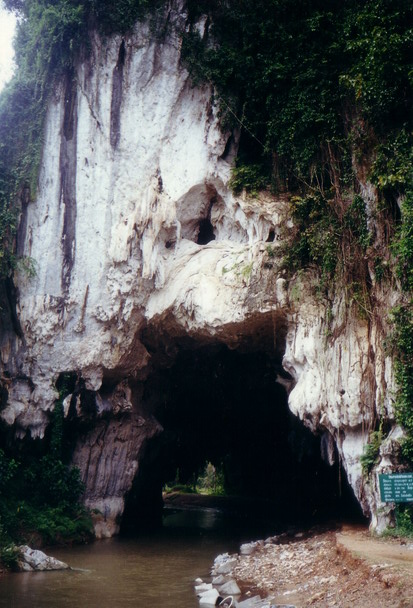
sign in a cave in Laos

18 March 2012

Six Mile Tunnel, Perak

Six Mile Tunnel is a river cave in Perak. It is located near the Tambun Lost World theme park and they now control access and run adventure caving trips there (RM 80 pp for 10+ pax, RM100 pp for 2-9 pax).

Years ago it used to be quite an adventure to get to the cave, as you had to cross lakes covered in tall reeds and negotiate mud and slime. In those days cavers often used inner tubes as flotation devices and to transport their bags across the lake.

When I visited in 2006 after a long absence, the lakes had been cleared, the first part of the lake had been filled in and there was a rough track so we could drive part way.

However there was still some very deep sticky mud to negotiate to enter the lake in front of the entrance.


The cave passes through the hill and was used by tin miners. It is not 6 miles long, more like 700 m.

The entrance is quite low and the passage can fill to the roof, so the cave should be avoided during heavy rain!

There are lots of bats in the passage and sometimes they brush against you
- Jan S took this photo of 2 bats heading straight for the camera

There is nice calcite decoration in the passage
these straws have probably grown since the miners regularly used the cave.
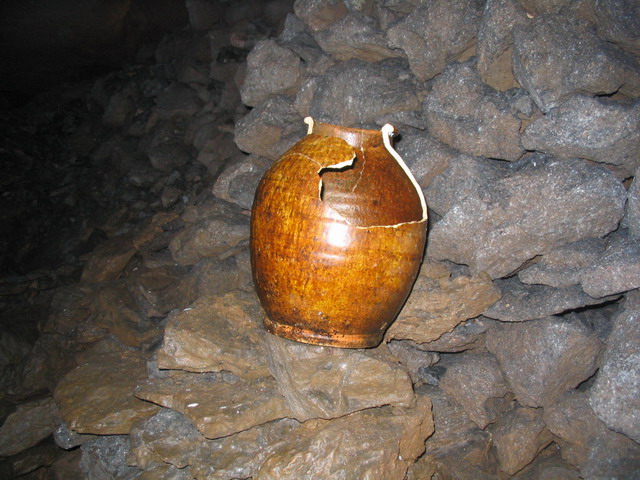
There are some relics left by the miners

We saw a frog and a turtle and there were fish in the water

The cave comes out into a wang, so the only way on is back through the cave!

The miners stacked their waste stones at the side of the passage
Fungus

Jan leaving the cave
and wading across the lake

Across the valley is Pencil Rock.

Six Mile Tunnel register number Prk 27/03.

See more photos on Jan's blog.

© Liz Price
No reproduction without permission

1 February 2012

Lower Ganesh or Ramayana Cave, Batu Caves

Lower Ganesh is part of the Ganesh System at Batu Caves. This system is the most extensive and with the greatest vertical range at Batu Caves.

Lower Ganesh is now called Ramayana Cave. It is at ground level, the entrance is behind the large green statue of Hanuman and the gate to Batu Caves station.

When I first visited in June 1991 it was a 'wild cave'. Although it was gated one could squeeze through and was used by people for things like smoking and courting couples, and to pray for lucky numbers, hence there were a couple of altars.
1992 view of the entrance
2010 view
2012

Inside there were no paths at that time. A climb up at the back leads to Upper Ganesh Cave. The main chamber is quite large and you can climb up to 2 separate chambers. There is a big pillar at the top.

On my next visit in May 1993 we found the cave was being fitted out as a temple. The outside gate was still the same. Inside was full of statues being made and painted. And parts of the cave wall had been painted blue for background scenes.

The place was all lit up and looked so different.

We went back in Sept and the workmen let us in. There were 15-20 scenes from the Ramayana, but most of the statues were unpainted. One was huge, a reclining figure. These are the 1993 and 2012 photos -


By 1993 the cave was fitted out with electric lighting, paths and stairs and filled with brightly coloured statues, and called Ramayana Cave. According to the plaque, the cave was opened in 1995.

I didn't make any more notes until 2001 when the cave was closed. It was still closed in 2004. In 2010 I noticed it was open and there was a man selling tickets at the entrance.

On my most recent visit on 29 Jan 2012 I noticed the gate was open and people were going in so I followed. The cave was brightly lit and the statues all very colourful.

There was a JCB parked in the cave.

Steps lead up to the back chamber

In this back chamber there is now a staircase under construction up to the pillar at the top.

I'm not sure what the steel structure is that runs around the cave above the tableau, almost looks like a monorail support

Looking towards the entrance
This passage leads on and is used as a dump, the passage is nicely carved


When I left the gate was closed, so I had been lucky as it was probably only opened temporarily by the workmen.

The Ramayana is an ancient Sanskrit epic from the Hindu faith. The Ramayana is one of the two great epics of India and Nepal, the other being the Mahabharata. It depicts the duties of relationships, and features ideal characters such as ideal father, servant etc.

The Ramayana Cave presents a concise but comprehensive narration of Lord Rama's history.

Lower Ganesh register number Sgr 01/07

© Liz Price
No reproduction without permission

29 January 2012

Tham Krachaeng-Lod, Yala, Thailand

In the 1990s I went caving in Yala province on several occasions. One cave I visited several times was Tham Krachaeng.

At the time (1993) Tham Krachaeng was the 6th longest cave in Thailand (now it is 7th) at 5,633m. It is located near Ban Than To in Yala province. Ban Than To is roughly halfway between Yala and Betong on route 410[6].

There are two main entrances, the side entrance sink, Tham Lod, and the
resurgence, Tham Krachaeng. By road these are 10 km apart.

To reach Tham Krachaeng resurgence, you walk through Krachaeng Arch which is a 100m long natural arch.

View from inside

Having gone through this cave, turning to the right, steps lead up to the Buddhist temple which was constructed in 1995. The cave consists of one large chamber, and a climb at the back leads up to a tunnel about 20m long.

However Tham Krachaeng is straight ahead following the river. The entrance is blocked by gours so you have to climb up and over them. The large river passage can be followed to a boulder choke and a route up leads to the continuation of the passage and then the confluence with Tham Lod.

Tham Lod is a sink and a 620m long passage leads to the main confluence. This passage is very flood prone and great care should be taken during the rainy season.

There are huge tree trunks and branches and other debris. I even saw banana plants struggling to survive

and coconuts that were shooting - note they have been deposited on a high ledge at least 2 m above the floor

The water is deep in some areas

The place where the water sinks is some distance away and is impenetrable


See more on the ACG expedition 2000.

© Liz Price
No reproduction without permission