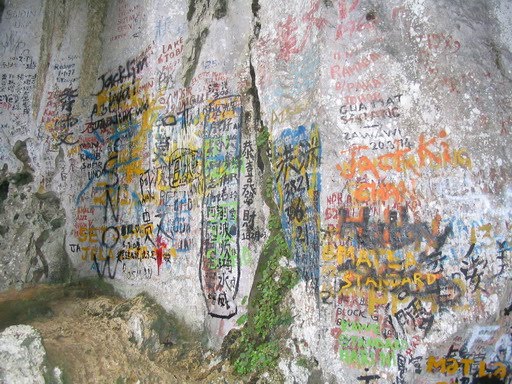
sign in a cave in Laos
Showing posts with label graffiti. Show all posts

28 April 2019

Chinese and Japanese writing in Perak caves

The Star on 27 April 2019 had an article "Japanese, Chinese writing dating back to 1913 found in Tambun's Gunung Datok cave".

The article, by Manjit Kaur, says writing believed dating back to 1913 has been found inside Gunung Datok in Tambun. This would pre-date WW1 and is from the Japanese Taisho period.

I first visited Gua Datuk in 1991 but don't have any photos of the graffiti.

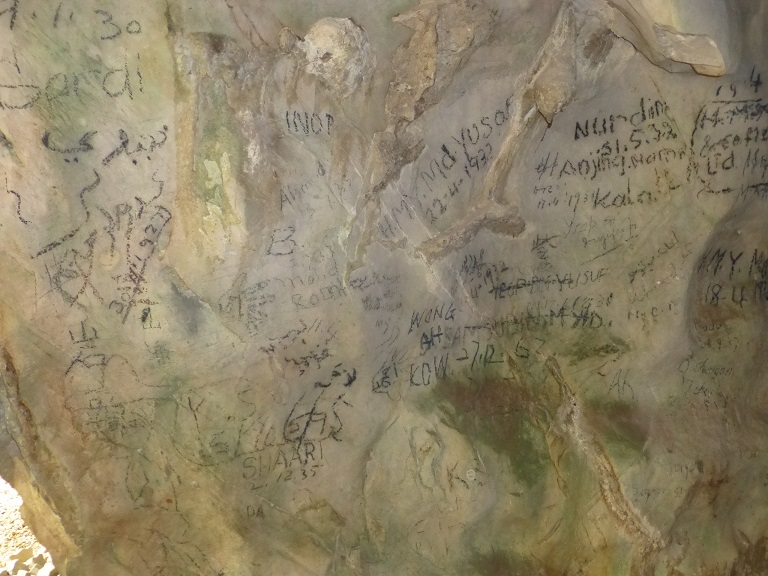
Other caves in the Kinta Valley have a mix of Chinese and Japanese writing, which I was told by a Japanese friend Menju, that the writing is Kanji. Kanji means Chinese characters in Japanese. In the Japanese writing system, the characters are adopted from Chinese ones. Caves on the west side of Gunung Lanno show these characters. Although much of the graffiti there dates between 1930-50.

Gua Pulau (Prk 18/16) and Gua Batu Nesan (Prk 18/17) and Gua Selari (Prk 18/15) all have graffiti. My friend Law Siak Hong translated some Chinese characters as "continue to fight the battle" and "may our comrades continue to strive [for the cause]". There are also lot of names - Chinese, Malay and Sikh, also police.

There is also what we guess to be war graffiti, of a soldier shooting a man

See my more detailed blog about these caves, "Lanno revisited" in 2013.

© Liz Price
No reproduction without permission

--
This is the majority of the Star article :
"Japanese and Chinese writing believed dating back to 1913 has been found inside Gunung Datok in
Tambun near here.
State Tourism, Arts and Culture Committee chairman Tan Kar Hing said the inscriptions that were written in charcoal mentioned the year 1913 and the Taisho period.
"1913 is even before World War 1. We believe soldiers were at the cave probably as intelligence troops.
However, we need more experts to come down and have a look, especially the Japanese embassy," he said.
He said the cave is located within the Banjaran Hotsprings Retreat.
"However, we will be writing to the embassy, and we will get experts to tell us what the writing is
about," he added.
The Taisho period in Japanese history dates from 1912 to 1926, coinciding with the reign of the Emperor Taisho."

4 October 2012

Don’t cover graffiti with black paint - Lenggong

5 Sept 2012 I had a letter published in The Star about covering over graffiti in black paint.

Don’t cover graffiti with black paint


I REFER to the report “Preserving Lenggong Valley” (The Star, Sept 4) which says “the authorities have failed to barricade the area, making it easy for people to walk in and out”.

When I visited the area last week, I found that some of the sites had been taped off and there were “work in progress” signs.

I also noticed that in some caves, especially Gua Kajang, the graffiti had been covered by black paint.

I don’t know who did this or when. But it is a very bad practice to try and cover any graffiti with paint or with any other substance.

This is frowned upon by the international caving community, as it can damage the microbes on the wall, apart from the fact that it is unsightly.

If the authorities wish to do something about the graffiti, please research how to do it properly.

Do not simply use paint or mud or whatever.

LIZ PRICE

Kuala Lumpur

18 December 2011

Gua Musang, Kelantan

Gua Musang is the name of a town and area in Kelantan, Malaysia.

It is also the name of a well known cave in the town. The name translates as Civet Cave.

The cave is located high in the hill right behind the railway station.

To reach the cave you walk along the railway platform, cross over the lines and follow the path past the houses, then climb steeply up the hill.

The cave entrance is a narrow rift which leads up and into a large chamber.
Climbing along the right side leads to the main chamber. This is a huge passage running through the hill. It's big.

In the entrance is a mass of multicoloured graffiti

The passage is high,

There are a few crickets and whip spiders in a side chamber. On the floor we saw lots of moth wings

The passage leads up to a back entrance

From the entrance there is a route to the top of the hill, but it was too wet and slippery to do when we visited.

Gua Musang register number Ktn 136/01.

© Liz Price
No reproduction without permission