sign in a cave in Laos
Showing posts with label tin mining. Show all posts

15 September 2025

Kampar tin mining museum

In 2013 I went to the Kampar tin mining museum and now in 2025 realise I didn't do a blog on it!

The Kinta Tin Mining (Gravel Pump) Museum is located in Kampar in Perak, Malaysia.


I'm too lazy to post photos now, so will just add an article I wrote at the time. It was published in The Star, 23 Nov 2013.


Back-breaking work: Life-sized models of yesteryear’s tin miners using manual methods to obtain the precious ore, at the Kinta Tin Mining Museum.


Located in Kampar, Perak, is a fascinating museum of tin mining artifacts where
one of the exhibits on display dates back 6,500 years!
THE two security guards welcomed me as I walked into the Kinta Mining Kongsi
and handed me a ticket. I knew that admission was free, so I was a bit surprised
to receive a ticket. I had entered the Kinta Tin Mining Museum. Located in Kampar,
Perak, this one-year-old museum is a wonderful display of artifacts and relics from
the days of tin mining.
I know for many Malaysians, learning about tin mining (gravel pump) at school
was probably one of those dull subjects that held little interest for a child. But for
me, a foreigner in Malaysia, I am fascinated by the subject and love any
opportunity to learn more about the bygone days of the tin mining industry. I
guess this is related to my love of caves, although, of course, mines are manmade
whereas caves are totally natural.

Assorted heavy machinery is utilised in tin mining.

As I walked into the outdoor compound, I noticed a couple of people in the corner.
I was quite glad I wasn’t the only visitor on a Monday morning. I was soon
absorbed looking at the first display of a palong (where the tin is separated from
the sludge). However, I was a bit puzzled when I glanced over and realised that the
figures hadn’t moved. I looked again, and the penny dropped. They weren’t people,
but life-sized models of tin miners.
Apart from the display of actual machines and equipment, the museum has
incorporated many such figures to show the various jobs done by tin miners.
These include two female dulang (manual separation of the tin ore using a pan)
washers and a group of men moving stones and operating a gravel pump. In fact,
there were several more of these figures in the outdoor exhibition area. It is a
commendable tribute to the men and women who sweated and toiled in this
industry.
The sun was beating down during my visit, adding to the atmosphere as I could
imagine the tin miners being out in similar conditions during their working day.
They would have had to endure all the elements – hot sun, rain and high humidity.
I was glad I was only walking around, not actually having to do any work.

Imagine the sun beating down while the miner is toiling away.

From the palong area, I had a look at the large machinery that included generators,
engines and pumps, as well as huge buckets from a dredge.
The next group of life-sized models puzzled me as there were no labels and I
wasn’t sure what they were doing. They seemed to be pounding poles into the
ground which I assume is a vital process in the tin extraction process, but I
couldn’t be sure! However, I found out later in the exhibition that they were
“prospecting”.
Generally, the exhibits were adequately labelled, although some could do with
more explanation.
I’ve been lucky enough in the past to visit operational open-cast tin mines in Perak,
so I have first-hand knowledge of how tin is extracted. Names such as gravel
pump, palong, sluice and pig basket are familiar to me. So, it was good to see
examples of these on display, as well as an old tractor and lorry.
I then moved into the coolness of the exhibition hall which is divided into two large
rooms. The first one I entered has two floors. Lots of old photos and small tools
can be found downstairs, as well as tableaux representing a kitchen and dining
area and also a shop for trading tin.

The entrance to the one-year-old museum that was set up in October last year by Tan Sri Hew See Tong, a former tin miner.
 

In the middle of the hall is a collection of large tree trunks. I thought they were for
decoration until I read they are actually part of a fossilised tree trunk named “The
Star”. This was discovered about 1978 in the nearby Batu Karang tin mine. It was
ignored, along with several other fossilised trunks for 30 years. Then “The Star”
found a new home in the museum and a piece was sent to the USA for radiocarbon 
dating – it proved to be around 6,500 years old and is so well preserved, having 
been buried in sediments for all that time. The Forest Research Institute of Malaysia 
(FRIM) identified it as a chengal tree.
The space upstairs is devoted mostly to documents and charts relating to mining
and geology. The earliest records of the Malaysian tin industry are dated 1851,
when tin production was far higher than that of both Indonesia and Thailand
combined.
I moved into the next gallery where I saw, on display in the centre, a model of Larut, 
a pet elephant belonging to Long Ja’afar in the 1800s. The story goes that
the elephant had stumbled on tin deposits near Taiping (later named Larut).
Other exhibits display the uses of tin and associated products, and there are
replicas of methods of hand-digging and mining as well as more models of dulang
washers and newly arrived Chinese labourers from the 1860s.
There are a couple of large models of open-cast mines, and buttons you can press
to light up various items of machinery. It was a pleasure to find that the lights
worked, as so often in museums you press a button and nothing happens.
Obviously, this museum is better maintained than some others!

Admission to the museum is free. However, those who wish to donate towards its upkeep may do so.


I was interested in seeing the old photos of various tin mines and their workings.
They brought back memories of the two mines I visited years ago. I realised that
there wasn’t much mention of tin dredges, although of course it would be
impossible to display much from these giants, apart from the buckets. Also the
Kinta Tin Mining Museum is mainly devoted to the gravel pump method.
The museum opened just a year ago, at the end of October 2012. It is the first of
its kind in the country and was set up by Tan Sri Hew See Tong, a former tin miner
from 1949-1989.
It is great that entry is free although I feel most people would be willing to pay an
admission fee, especially considering the exhibition halls have to be kept cool for
the visitors. There are donation boxes in the main halls so I hope visitors will be
generous and give some money.
I found the museum to be quite fascinating and spent an hour there, absorbed in
looking at the displays and thinking of how hard the miners worked to produce the
tin that we take for granted.
The museum is definitely worthy of a visit and should be of interest to children as
well as adults. It is a fun way to remind and teach people of the heyday of tin
mining in Perak and one of Malaysia’s most important industries.

**

21 October 2011

Wang Mengkuang cave tin mine, Perlis

Wang Mengkuang 2 is a natural cave that has been mined for tin. It is in Tasik Meranti area, north of Kaki Bukit in Perlis. I visited the cave with some cavers from UK in 2010. It is about 407 m long.

The horizontal passage has a clear stream running out

In some areas the narrow passage has been widened


There are a few bats

Some of the old pipes are heavily calcited.
There are still pegs in the walls and light bulbs left by the miners

The cave now ends in a sump, here is Tony looking into it

Wang Mengkuang 2 register number Prs 85/02.

See more on a nearby cave Tasik Meranti Road Shaft.

© Liz Price
No reproduction without permission

23 August 2008

Sg. Lembing tin mine museum - Star


(These photos were stolen and published with the article on VirtualTourist.com]

THE STAR Lifestyle
Saturday, June 28, 2003

Sg. Lembing’s golden years of ore

The Sg. Lembing tin mine, among the world’s largest and deepest, once earned Pahang the name ‘El-Dorado of the East’. LIZ PRICE pays a visit to the museum that records its history.

IMAGINE going to work each day, stepping into a cage big enough to hold half a dozen men and plummeting to the bowels of the earth.

This was how the miners of Sg. Lembing tin mine reached their workplace each day. They would then spend six hours underground, extracting the tin ore from the main lode. At the end of their shift, the lift would transport them back to the surface and daylight and fresh air. For those six hours of subterranean work, they were paid $40-$44 in 1950.

The Sg. Lembing tin mine in Pahang was reputed to be among the world’s largest and deepest. The total tunnel length is 322km, with a depth of between 610m and 700m. Tok Tangguk, who was possibly from Cambodia, was an outstanding figure in the history and opening of the mine.

Mining began in the 19th century in 1868 when Sultan Ahmad signed a concession with Baba Ah Sam. From 1891, the Pahang Consolidated Company Limited, (PCCL), which was under British control, had a 77-year lease to mine the area. It is a reminder of the lengths the British would go to to make some money from the remote areas. PCCL managed the mine from 1906 until its liquidation in 1986 when world tin prices collapsed.

Up to 1942 the mine employed 1,350 personnel, of whom half worked underground. Today the old buildings and surface workings lie rusting and silent, and there is little to show of this once bustling place.

However, a new museum has been set up to re-live the glorious days of Sg. Lembing as Pahang’s richest manufacturer of tin. Its objective is to publicise the history and exhibit relics from the mine.

The museum is housed in a refurbished bungalow, once home to the mine’s general manager. The almost century-old building is perched on a small hill with stunning views of the hills which surround Sg. Lembing.

The Pahang state government renovated the bungalow, about 40km northwest of Kuantan, and collected artifacts to place in the museum. The original facade of the building was preserved, despite the difficulty in getting custom-made wood panelling and other necessary materials.

Let's play cricket

Sg. Lembing is said to get its name because during the rainy season the water surface looks like spear-points flowing in the river. The river in those days was probably much deeper, as today much silt has accumulated. The town is now likened to a ghost town, but was rich and famous during its heyday as the main producer of tin in Pahang. It was known as the El-Dorado of the East.

The town straddles the river, and the main street on the right bank is split by an avenue of majestic trees. At the end, an old wooden building overlooks the padang where games of cricket and other social activities were held. PCCL was responsible for the care of the township, providing the roads, electricity, schools and healthcare. Old photos in the museum depict cricket matches and people cycling across the field.

Pit mining was not common in Malaysia as it was both dangerous and costly. But in Sg. Lembing there was sufficient tin to justify the costs. There were two main mines. Myah Mine is 700m deep, and Tabeto Mine 488m. The mines were dug on many levels, with about 30m of rock between the tunnels. Miners dug into the rock face and broke the stones using iron hammers. The lumps of ore would be put into railway carts, which were taken up to the surface by lift.

For lighting the men used carbide lights, until they were replaced in later years by personal electric lights. The battery pack was worn around the waist and connected by a cable to the headpiece mounted on the helmet. These lamps are still used by miners around the world today.

The museum is on two floors and has a fine display of artifacts. The artifacts are arranged according to historical chronology and events. Visitors can see how the ore was extracted and brought to the surface. It was then filtered and sent to the smelter. Interesting items include a drilling machine, railway track, safety helmet and lamps as well as communication equipment.

Upstairs, there is a display of gems, minerals and rocks, with explanations on the geology. There are mining memoirs, and a room laid out as was used by visiting VIPs in those days, as well as the general manager’s bedroom and bathroom.

A few panels highlight individuals closely connected to Sg. Lembing mining such as Sultan Abu Bakar, Tok Janggut and W.W. Abel. Outside the building are a few more items of mining equipment, as well as a Mini Mox car which was used by the managers.

The museum officially opens in June, when it is expected to have underground tours for visitors. The visits will be restricted to areas close to the surface as today all the deeper levels are now flooded.

Other tourist spots

Apart from Sg. Lembing’s museum, there are other nearby attractions as the area is endowed with mountains, waterfalls, and rivers. It is worth climbing Bukit Panorama, especially to see the glorious sunrise over the surrounding green hill slopes. Many visitors come here just to do this, especially at weekends, and liven up the otherwise dead town. However logging activities are having a detrimental effect on the eastern hills of Sg. Lembing.

Some 16km from Sg. Lembing is Gunung Tapis Nature Park, where one can camp, fish, and shoot the rapids. Gunung Tapis itself is 1,512m high. On the way to Sg. Lembing is Gua Charas, a temple cave that is a popular tourist destination. Sungai Pandan Waterfall, 29km from Kuantan, is easily accessible from the road and is a nice place for a picnic. W


The museum opens Tuesdays to Sundays 9am-5pm; Fridays, 9am-noon, 2pm-5pm. Closed Mondays. Admission is free.
Muzium Sungai Lembing
26200 Kuantan, Pahang.
Tel: (09) 541 2377/8
Fax: (09) 541 2377

22 March 2008

Dredging up the past - a tin dredge in Perak - Star

THE STAR
LIFESTYLE    Travel & Adventure


DREDGING UP THE PAST


For a trip down memory lane to Malaysia’s tin-mining past, nothing beats a visit to TT No.5, one of only three dredges left in the country. 

Walking onto the tin dredge was like stepping back in time. The cavernous interior was strangely silent, but I am sure that when this dredge was in full operation, the noise and vibration would have been almost unbearable. This huge metal monster is a relic of the past, a reminder of the once bustling tin mining industry that thrived in Malaysia. 

Tin mining is one of Malaysia’s oldest and most successful industries. In the 1600s, this industry started to thrive in Kedah, Perak and Selangor. Over the centuries, tin was extracted in huge quantities from both open cast and deeper mines. Dredges were commonly used.  

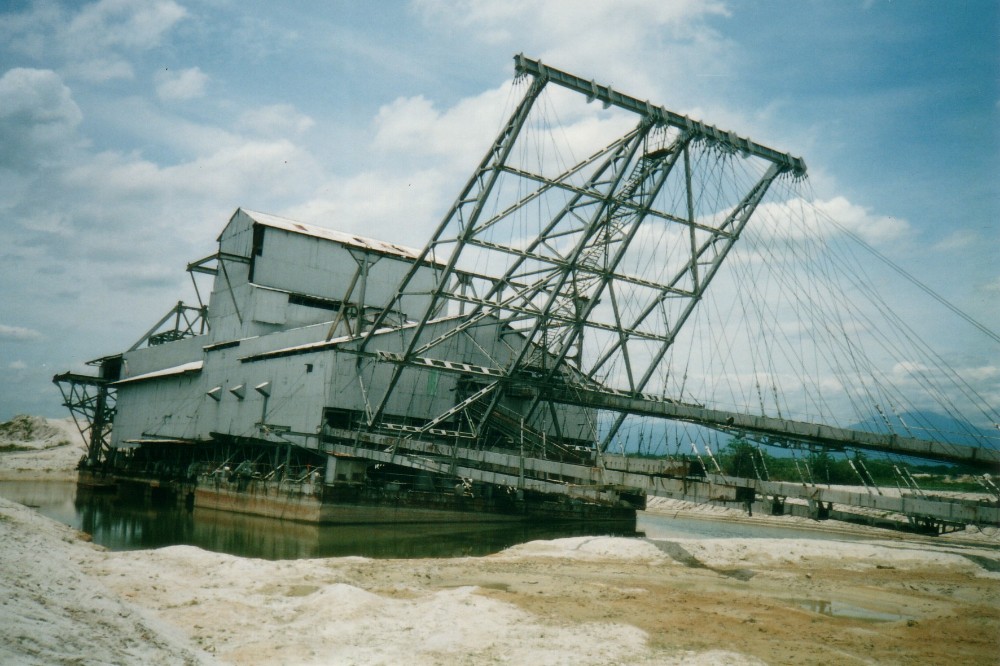
Today, there are only about three old dredges left in the country, and this one at Chenderoh, near Tanjong Tualang, Perak, has been preserved. In Feb 2008, it was opened to the public for tours. 

The dredge looks like a colossal metal monster sitting in a pond, maybe a relative of the dinosaur. It looks too big to possibly move, but these massive dredges once devoured swamp and jungle as they searched hungrily for tin deposits. 

Steven Ng, 56, the man responsible for renovating this giant, is a director of Osborne & Chappel, the company that gave the dredge, TT No. 5, a RM100,000 face lift. Osborne & Chappel was started by British engineers in Malaya in the 1890s and was at the forefront of the alluvial mining industry in Malaysia.  

TT5 was built in 1938 by W.F. Payne and Sons (UK), and modified in 1960. 

Monstrous: A motionless tin dredge is now part of history.
As we walked onto the dredge, we realised just how big it was. The pontoon is 75m long, 20m wide, and three storeys high. It is essentially a floating factory where buckets on a chain scoop earth deep from the pond. These buckets were then transported up to an area high in the body of the dredge. 

Nordin our guide opened a hatch in the wall and revealed the buckets on the ladder, which once took them to the top of the dredge. It looked like something from a bizarre fairground ride.  

Each bucket was huge, made of manganese steel and the edges were reinforced to endure the damage done when scooping up the earth containing tin. 

There are 115 buckets on the ladder, and each one can hold more than 600 litres. The maximum digging depth of this dredge was 31m.  

At the front end we could see the buckets where they came out of the water before beginning the long ascent to the top of the dredge. We also clambered up to the upper levels to get an overall picture of how the dredge worked. 

The dredge was built using steel girders, many of which came from Britain and have the manufacturers’ names stamped on them, such as Shelton, Skinningrove, and Appleby-Frobingham.  

The dredge weighs 4,500 tonnes. It was moved by means of a 1.5km long cable, worked from the control area. 

If the cable was released on the right side, the dredge moved left. 

At the top of the dredge, we got a bird’s eye view over the surrounding ponds. I was surprised to see a few birds nesting in the dredge. There are three ponds in the vicinity, and the one TT5 sits on is surrounded by paths and embankments. Fish have been stocked in the neighbouring ponds, which hopefully will encourage more birds in the area. 

From the front end of the dredge, we walked along the narrow walkway on the roof and entered the next area where we had a close up view of the buckets all the way to the very top. Further on, we got to look down on the jigs. Leaving the buckets, the excavated material was broken up by jets of high-pressure water as it fell on to the revolving or oscillating screens.  

Large stones and rubble were retained by these screens, while the tin bearing material passed to the jigs. These were vibrating trays, where water was forced up from below, pulsing up in a wave, so the heavy tin sank and the lighter hematite floated off. From this primary separating plant, the tin went down to the palong below and into a big container ready for transportation.  

The waste went out via a disposal chute at the tail end of the dredge and was subsequently dumped on the banks. These tailings were bulky as excavating just one cubic metre of new ground produced 20 cubic metres of waste material, as the new ground was compact, but the waste was separated and full of water.  

Nordin informed us that the dredge operated 24 hours a day, with three shifts of about 17 men.   An area near the jigs was designated as the eating area, where the men had their food. A selection of tools is now exhibited here.  

Back at deck level, we could see the many hoses above our heads, which carried the tin from the jigs to the collecting areas.   We continued our tour around the back end of the dredge and had a look at the control area. On the wall here is a list of the major components of the dredge and the date they were installed and last serviced.  

We could see that the bucket band was fitted in 1974. Nordin showed us how the buckets were fixed to the band, and we could see the giant hammer used for removing the pins, which held the buckets in place.  There are squat toilets on the dredge at the back end, which open directly to the pond. After our tour of the dredge, we walked around the outside and then went to the small exhibition room.  

During the heyday of the tin mining industry, 40 dredges were operated in Perak, with a record of 105 working in 1929 in the whole of the peninsula. This particular dredge stopped work around 1983 after more than 40 years of service. 

Ng’s goal is to preserve the dredge. More money is needed to repair the two pumps. He also wants to set up a palong and to turn the area into a living museum, with people dressed in traditional clothes, including women dressed as dualang washers. A video will also be shown on how this giant worked.  A visit to this dredge is an ideal way to get some understanding of what was once one of Malaysia’s most important industries. 

TT5 is open from 8:30am to 7pm daily, including weekends and public holidays.   A RM10 entrance fee is charged for a walkabout on deck level while the grand tour is priced at RM15 and includes a guided one-hour tour on the upper levels and a video presentation. 

 TT No. 5  5th Mile
Jalan Tanjong Tualang,
31000 Batu Gajah
Perak 
  • For more information, call: 05 3702 2216 or 012 517 1260 


  • © Liz Price

    4 February 2008

    Caves and limestone hills of Malaysia website

    http://www.cavesofmalaysia.com

    15 December 2007

    Tin mining relics

    Tin mining is one of Malaysia's oldest and most successful industries. In the 1600's, this industry was beginning to thrive in Kedah, Perak and Selangor. In the heyday of tin mining in the mid 19th century Perak was one of the most active areas. There was an increased demand for tin by Chinese and Europeans and at the same time, extensive and rich deposits of tin were found in Perak and Selangor. With the arrival of labour from China and influx of capital, the tin industry rapidly expanded to become the largest in the world. More than 3000 Chinese arrived annually to work the mines. Tin was also mined from some caves, especially in Perlis.
    Today very few mines are working and most of the artefacts are lost. There are only about 3 dredges left.


    1960s postcard
     

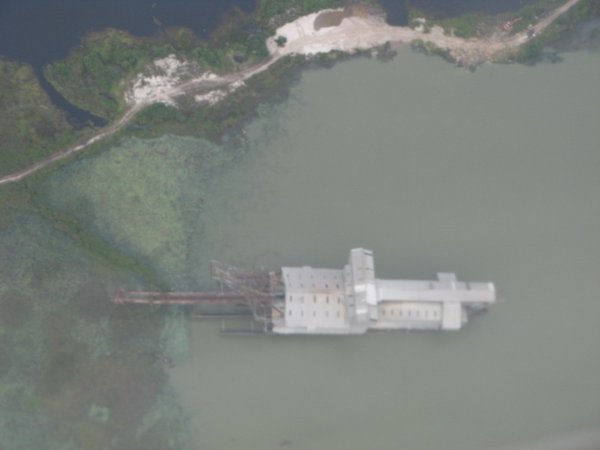
    dredge seen from air approaching KLIA in Selangor -


    Many of these pictures are old photos that I have scanned so the quality is not good (and I haven't bothered to play around with any photoshop type software), but they are here for the record.


    Ipoh museum display -

     gravel pump used in New Lahat mine
    trolley used in 1925

    The next few photos were taken at New Lahat mine in Perak in 1997 -

     buckets of ore


     the kitchen


    "pig basket" strainer, now abandoned

     palong, a series of sluices


    a "pig basket" in this revolving steel drum the gravel is broken into small pieces -


    Open cast pit of New Lahat mines


    tin mine workers -
    Tin mine Perak
     Tin mine Ulu Selangor
    Merapoh Mine near Kpg Kepayang in Perak, 1997 -

    jets of water under pressure break up the tin-bearing soil

    the extraction area where jets of water under pressure are shot at the sides of the mine to break up the tin-bearing soil

    the muddy mixture collects in a pool, called a sump


    controlling the water monitor


    from the sump the slurry is pumped up to the palong -
    the slurry
    channels leading to the sluices (above),
    overview of the channels and sluices -

    gravel containing the tin

    For more recent photos taken on the Perak dredge see tin dredge in Perak.

    © Liz Price
    No reproduction without permission