Pictorial blogs on some of the interesting caves I have visited around Southeast Asia. On some blogs I have included photos taken over the years.
Although this blog was only born in 2011, I have now included older posts from my Multiply blog which closed in March 2013. This includes articles I have written. I am now also adding news relating to caves I have a particular interest in.
See my website on Caves of Malaysia.
" Lost Wonders: 10 Tales of Extinction from the 21st Century" by Tom Lathan et al was published by Picador in Sept 2024. It features 10 species that have become extinct since the turn on the 21st century. And one of those species is the Bukit Panching snail, from Pahang, Malaysia.
Lafarge Malaysia, who are quarrying Gunung Kanthan (see labels), provided a grant to scientists from Rimba and Universiti Malaysia Sabah to study land snails on 12 limestone hills in Perak. See Rimba for more on this.
The results were published in ZooKeys 682 on 4 July 2017, Diversity and biogeography of land snails (Mollusca, Gastropoda) in the limestone hills of Perak, Peninsular Malaysia, by Junn Kitt Foon, Gopalasamy Reuben Clements, Thor-Seng Liew. The results are very interesting, on 12 hills -
"We found 122 species of land snails, of which 34 species were unique to one of the surveyed hills. We identified 30 species that are potentially new to science. The number of land snail species recorded at each hill ranged between 39 and 63 species.".
This is quite exciting, lots of potentially new species.
The study also reveals that "Charopa lafargei which previously presumed as endemic to Gunung Kanthan (Vermeulen and Marzuki 2014), is shown in our study to also occur on the limestone hills at the north of Kinta Valley".
--------
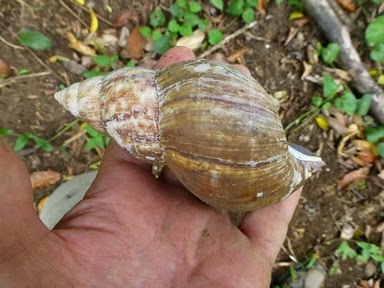
Over the years I have collected a few snails from limestone areas. This one is common all over Peninsula Malaysia -
Malaysian snail among hundreds of species to become extinct as a result of fishing, logging, mining, agriculture and other activities to satisfy our growing appetite for resources.
Humble snails are no match for the might and indifference of the global cement industry. So it has proved for the now extinct Plectostoma sciaphilum, a rather beautiful snail that lived only on a single limestone hill in Peninsular Malaysia. A cement company blew up the entire hill and all remaining molluscs with it. All that is left of its former habitat is a big hole in the ground filled with water.
Its extinction was highlighted by the global environment network IUCN when it launched a major new study showing that 22,413 out of its 76,199 assessed species are threatened with extinction.
The neighbouring isolated hills are being quarried by Malaysian multinational YTL, owner of Wessex Water, where snails such as the bizarrely-shaped Hypselostoma elephas are in critical danger.
While attention is often drawn to iconic species threatened with extinction – the IUCN report highlights the vulnerability of the Pacific bluefin tuna among others – it also chose the demise of the tiny snail as an example of the damage being done by the extractive industry.
According to the IUCN: “The future of several other species in the region is uncertain for similar reasons. Whilst some mining companies are starting to take the necessary steps to reduce impact, IUCN is urging stronger commitment to prevent further extinctions.”
IUCN’s intervention comes just weeks after Guardian Sustainable Business revealed that another snail was at risk in Malaysia. The mollusc, recently discovered living on an isolated limestone hill called Gunung Kanthan in the northwest of Peninsular Malaysia, was named Charopa lafargei after Lafarge in a bid to prevent the global and aggregates giant from decimating it. The IUCN says this snail is critically endangered and that the “continued existence of the species will depend in large part on the actions of the company.”
Tony Whitten, Fauna & Flora International’s Asia regional director, says the humble snail should not be seen as any less important than iconic species. “Snails have a marketing problem because they are small and in general are considered joke animals because they are slow and slimy,” he says.
“But they have beautiful shapes and colours and on a personal level I abhor the idea of extinctions when it results from deliberate ignorance. A species is a species and we are morally bound to protect them. When I ask people why they think snails are less worthy, they don’t really have an answer.
“Some people may see species such as the bluefin tuna as being more important but that is only because we can identify with them because of their size and the fact we like to eat them.”
Whitten says the reason the cement industry has been able to escape scrutiny until now is because limestone is not considered a strategic mineral so regulation tends to be governed at a local level, and because the companies rarely need international financing. Cement is a basic commodity and margins are razor thin. Whitten says because companies focus on volume to maintain profits, they are unhappy to set aside protected areas within quarrying sites.
It is not only in Malaysia where snails and other species are at risk from the cement industry. “This is a global issue,” he says. “Wherever in the world limestone occurs it has a special fauna and flora but the problems are especially acute in countries such as China, Indonesia, Vietnam, and the US where you get isolated limestone hills.”
A common problem among cement mining companies, according to Whitten, is that environmental impact assessments they carry out are often of a poor quality and focus on birds and mammals and don’t give enough attention to limestone-associated species. The reports are not made public and cannot be scrutinised independently.
Worse still, Whitten says the cement industry has become fixated with trumpeting the restoration of sites they destroy, rather than taking a rational, proactive landscape approach which would include sustainable management and protection.
“No cement business has ever admitted the scale of the problem,” he says. “They tout their biodiversity pages in their websites and sustainability reports with pictures of ducks and frogs and children enjoying the wetlands created from the hills they remove. They give and receive prizes for their restoration work – but do not acknowledge what is being lost.”
The snail at Lafarge’s quarry was named after the company to make it pay attention to inconspicuous animals. “They would never have taken note of the snail unless the scientists had named it after them,” Whitten says. “Lafarge did not like it ... But the reality is I had been talking with them for 15 years and you get to the point where that discussion gets nowhere. This led Fauna & Flora International to resign from their international biodiversity panel. We are, though, having positive discussions with the local senior management.”
The IUCN’s Red List, the world’s most comprehensive information source on the global conservation status of plant, animal and fungi species, shows that Plectostoma sciaphilum is one of 901 species of the 76,199 assessed to have become extinct through fishing, logging, mining and agriculture.
The Guardian (UK) 17 Nov 2014 featured some of the world's most threatened species on the IUCN Red List report. Two of these are snails, found on limestone hills in Malaysia, which may be quarried to extinction.
The first is Charopa lafargei , which has Critically Endangered status, and is found at Gunung Kanthan in Perak. This hill is being quarried by Lafarge, after whom the snail was named. I have already posted many blogs about the quarrying of the hill and our fight to save the hill, caves, flora and fauna from destruction/extinction.
The second snail featured is Plectostoma sciaphilum. This is already thought to be extinct. It was known on Bukit Panching, near Kuantan in Pahang. This hill was totally destroyed some years ago, all that remains now is a lake.
End of August saw a flurry of pieces in the international media about the newly described Gunung Kanthan snail that is named after the quarry company Lafaarge who are destroying the hill. The snail is called Charopa lafargei, and is endemic to Gunung Kanthan. The scientific paper was published in Basteria, (2014) 78(1-3).
Mongabay on 24 August 2014 had this piece, "Scientists name new endangered species after the company that will decide its fate".
The Guardian in the UK published this piece on 25 August 2014, "A tiny, rare snail in Malaysia has big consequences for global cement giant".
The Epoch Times, 26 Aug, "Tiny Endangered Snail Named for Company".
CemNet.com 27 Aug, "New species of snail discovered in Lafarge Malaysia limestone quarry".
Global Cement on 28 Aug, "Future of Charopa lafargei snail in hands of Lafarge Malaysia".
Espandar Cement News , "Future of Charopa lafargei snail in hands of Lafarge Malaysia".
Novataxa BlogSpot on 24 Aug, "[Mollusca • 2014] ‘Charopa’ lafargei • A New, presumed narrowly Endemic Species (Gastropoda, Pulmonata, Charopidae) from Peninsular Malaysia".
Then the Malaysian papers : The Star 30 Aug published "New snail species found".
Malay Mail, 2 Sept
In Ipoh, rare snail named after cement giant is safe, says French quarry company
Ipoh Echo, No 197, 16-30 Sept
New Snail Species Discovered In Kinta Valley
Bukit Sagu in Pahang is being quarried by Pahang Cement / YTL. The neighbouring Bukit Tenggek is also being quarried. These 2 hills are among a group of 4 limestone hills located west of Kuantan, the others being Bukit Charas and Bukit Panching - the latter has been totally removed by quarrying. This is a GE image of the 4 hills in 2003, from south to north = Panching, Charas, Sagu, Tenggek -
Pahang Cement was established in 1995 as a 50:50 joint venture between the State Government of Pahang Darul Makmur and YTL Cement. The purpose of the joint venture was to build and operate the proposed integrated cement plant to be located in Bukit Sagu, Kuantan. The plant, the first of its kind in the Eastern Corridor, became operational in May 1998. YTL Cement acquired the remaining 50% of Pahang Cement in 2003. Pahang Cement Sdn Bhd (Pahang Cement) operates a state-of-the-art integrated cement plant in Bukit Sagu with the capacity to produce over 1.2 million tonnes of ordinary portland cement per annum. See more on YTL.
General view of the west side Bukit Sagu, with a large vertical opening on the left side -
View of Sagu from YTL plant -
and the YTL cement trucks waiting to take away the hill
View from the north end
1997 views -
2003 GE -
The untouched southern end -
Bukit Tenggek in 2003 & 2011 -
2014 from west side -
and 1997 view -
FLORA and FAUNA
Both hills have caves and are home to endemic flora and fauna. Of special interest, Bukit Tenggek is home to a snail, Hypselostoma elephas, listed on IUCN Red List as critically endangered. Another critically endangered endemic snail is Plectostoma tenggekensis. More on the snails on Red Orbit and Washington Post.
The hill is also home to Calciphilopteris alleniae, a fern known from only 5 limestone hills in the peninsula. Paraboea bakeri is an endemic species, it
can be found only in small shaded populations on the limestone hills in
two localities; Bukit Sagu and Bukit Tenggek, see FRIM report.
See more on Siputkuning blog.
ARCHAEOLOGY
These 2 hills are also archaeological sites. Gua Sagu was investigated briefly by Tweedie in 1935, he found pottery and stone implements. Then more recently in 1990 and 1991, staff from the Centre for Archaeological Research, USM and the Department of Museums and Antiquities, made excavations in Gua Sagu and Gua Tenggek. They found a lot of stone tools and some pottery/earthernware and food remains in Gua Sagu. Gua Tenggek revealed similar finds. They concluded that the sites were occupied during the Pleistocene around 14,000 years ago by a Palaeolithic group of people. See ref.
-------
UPDATE May 2015
IUCN published a report on global species and the snail Plectostoma sciaphilum that was found on Bukit Panching was mentioned. This hill has been completely quarried.
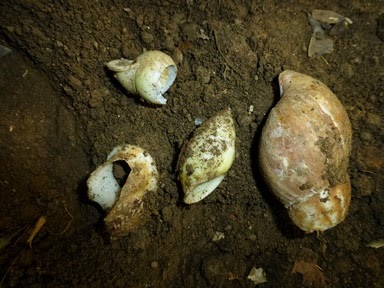
I've just spent a few days caving in the Merapoh area of Pahang, followed by a trip to Perak. I saw a variety of snail shells, and took some photos of the larger ones.
This group of shells are the ones commonly seen in photos associated with Perak Man -
The yellow shell is Amphidromus atricallosus perakensis , and is also found across the border in Pahang!
This looks like the African land snail, though they are far smaller than the ones I've seen in Africa -
although this one is bigger -
The next photo shows a shell I collected in Madadascar above one I collected in Perak -
I would welcome any identifications for the above shells.
It was rainy season, July, but there were less leeches than I expected. And sadly we saw no live snakes, just the dead one. As usual in this part of Perlis, I heard gibbons calling every morning but only managed to see them once when I went out early to track them. We did see some macaques and some dusky langurs, and one night a mouse deer ran in front of my car.