© Liz Price . No reproduction without permission
For more photos see gold mine .
Looking for gold and finding bat poo

Seeking adventure: The writer at the entrance to the cave.Picture: The Brunei Times
Sunday, June 8, 2008
WHEN I heard there was an old abandoned gold mine in Negeri Sembilan in Malaysia, I wanted to take a look as I have an interest in caves and mines. I knew there would be no gold lying around for the taking, but I was curious to see the site.
According to a newspaper report, the locals want to turn this mine into a tourist attraction and they claimed the tunnels extend 80 kilometres. I knew this was not possible but could find very little information about the place except that it was worked many years ago. I didn't even know if the tunnels are still accessible. We drove to Tampin which is south of Kuala Lumpur and then headed to Air Kuning as I knew the mine should be in that area. Of course there was no sign of it so we asked some locals and luckily found someone who knew the mine. When I mentioned I was a writer for a newspaper, he seemed pleased and immediately called a friend and asked him to lead us to the mine. Halim and his two sons took us to a rubber plantation, and having parked the cars, we set off on foot, soon being attacked by mosquitoes. After just a few minutes walk we arrived at the entrance to one of the tunnels. We all went into the entrance chamber and could immediately hear the sound of hundreds of bats. It was also apparent we would need shoes and torches, so we went back to the car to get prepared, saying goodbye to Halim who didn't want to join us, even though he had never been in the mine before.
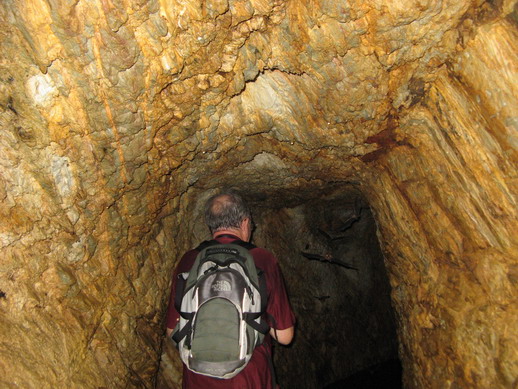
Back inside we realised we had a choice of two passages. Both were wet with dubious looking muddy water so we chose one and plunged in. Luckily the water was initially only ankle depth. The Bomba or fire department had been here recently for a tour, and had left plastic tape marking a route through the tunnels, and closing off some passages. So we followed their path. As we ploughed through the water we stirred up a foul smell which reminded me of human sewage and was unlike anything I'd ever smelt before in a mine. I hoped it was just natural impurities in the water.
The tunnels are now home to hundreds of bats and they were flying all around us, disturbed by our presence. As the tunnels are not much larger then ourselves, a few of the bats collided with us in their attempts to pass us. Since there was a network of passages the bats were soon able to get out of our way. The bats are harmless and there was no need for us to be frightened of them.
The rock seemed quite soft and there was little sign of how the miners dug out the passages. Halim had told us the mine closed down by the Second World War and had been worked by the British. The tunnels were of uniform size. In a few places there were shafts leading down to lower levels, and some going up to daylight. After walking around for a short time we came back to the entrance chamber, having done a circular trip. So we decided to go back in and this time check out some of the passages taped off by the Bomba. This was actually far more pleasant as the water was cleaner and less muddy and that awful smell disappeared. I reckon it was due to having dozens of feet passing through recently which had stirred up the mud and sediments, including the bat poo in the water!
As we walked through I wondered what life was like for the miners who worked here. As none of the passages seemed far from an entrance or an open shaft, the air was fresh. I'd heard that the miners transported the ore out by rail, but now there is no sign of any rail tracks. When we emerged out from the mine our shoes were plastered in mud so we went down to the nearby stream to wash. Then we climbed the hill above the mine and found lots of shafts had been dug. Some were just trial holes, whereas others led down into the mine below, and we could see bats flying underneath our feet.
It had been an interesting visit, to see the old workings of this historical site. It is good to know that bats have taken up residence, as bats are important to humans, as they control the insect population and help to pollinate fruits and other crops. Despite the mud, it had been a fun day.
The Brunei Times
According to a newspaper report, the locals want to turn this mine into a tourist attraction and they claimed the tunnels extend 80 kilometres. I knew this was not possible but could find very little information about the place except that it was worked many years ago. I didn't even know if the tunnels are still accessible. We drove to Tampin which is south of Kuala Lumpur and then headed to Air Kuning as I knew the mine should be in that area. Of course there was no sign of it so we asked some locals and luckily found someone who knew the mine. When I mentioned I was a writer for a newspaper, he seemed pleased and immediately called a friend and asked him to lead us to the mine. Halim and his two sons took us to a rubber plantation, and having parked the cars, we set off on foot, soon being attacked by mosquitoes. After just a few minutes walk we arrived at the entrance to one of the tunnels. We all went into the entrance chamber and could immediately hear the sound of hundreds of bats. It was also apparent we would need shoes and torches, so we went back to the car to get prepared, saying goodbye to Halim who didn't want to join us, even though he had never been in the mine before.
Back inside we realised we had a choice of two passages. Both were wet with dubious looking muddy water so we chose one and plunged in. Luckily the water was initially only ankle depth. The Bomba or fire department had been here recently for a tour, and had left plastic tape marking a route through the tunnels, and closing off some passages. So we followed their path. As we ploughed through the water we stirred up a foul smell which reminded me of human sewage and was unlike anything I'd ever smelt before in a mine. I hoped it was just natural impurities in the water.
The tunnels are now home to hundreds of bats and they were flying all around us, disturbed by our presence. As the tunnels are not much larger then ourselves, a few of the bats collided with us in their attempts to pass us. Since there was a network of passages the bats were soon able to get out of our way. The bats are harmless and there was no need for us to be frightened of them.
The rock seemed quite soft and there was little sign of how the miners dug out the passages. Halim had told us the mine closed down by the Second World War and had been worked by the British. The tunnels were of uniform size. In a few places there were shafts leading down to lower levels, and some going up to daylight. After walking around for a short time we came back to the entrance chamber, having done a circular trip. So we decided to go back in and this time check out some of the passages taped off by the Bomba. This was actually far more pleasant as the water was cleaner and less muddy and that awful smell disappeared. I reckon it was due to having dozens of feet passing through recently which had stirred up the mud and sediments, including the bat poo in the water!
As we walked through I wondered what life was like for the miners who worked here. As none of the passages seemed far from an entrance or an open shaft, the air was fresh. I'd heard that the miners transported the ore out by rail, but now there is no sign of any rail tracks. When we emerged out from the mine our shoes were plastered in mud so we went down to the nearby stream to wash. Then we climbed the hill above the mine and found lots of shafts had been dug. Some were just trial holes, whereas others led down into the mine below, and we could see bats flying underneath our feet.
It had been an interesting visit, to see the old workings of this historical site. It is good to know that bats have taken up residence, as bats are important to humans, as they control the insect population and help to pollinate fruits and other crops. Despite the mud, it had been a fun day.
The Brunei Times