sign in a cave in Laos
Showing posts with label Rapat gunung. Show all posts

5 July 2019

Update on the writing in Gua Datuk, Gng Rapat

The Star on 27 April 2019 had an article about writing found in Gua Datuk, near Ipoh, in Perak, Malaysia. See my blog.

On 2 May The Star had a further article, "Japanese writings found on cave walls". There is an interesting photo of some of the writing with the translation.

"The cave, where the Japanese writings were discovered, is believed to have once housed a temple started by a Nichiren Shu priest.
Nichiren Shu is a Buddhist school in Japan, founded by Nichiren Daishonin, that teaches and practises the Lotus Sutra (Buddha’s teachings) more than 750 years ago.
Experts from the state Park Corporation, Tourism Perak, Minerals and Geoscience, Heritage and Museum departments visited the cave last Friday.
Penang Nichiren Shu Temple committee member and a researcher (for the temple) Alexandar Ang said that he and several members discovered the inscriptions in 2011 after an extensive nine-year search.
This had come about after a priest mentioned to them about an old temple located within a hot spring area in Ipoh.
Ang said the inscriptions were in kanji, a system of Japanese writing using Chinese characters.
There was an inscription stating the “second year of Taisho era in 1913”, which was a form of Japanese calendaring, he said.
“The temple was founded in 1913 by a priest referred to as Rev Baba from Kumamoto, Kyushu in Japan.
“It was named Ganryuzan Hokekyoji, and at a point in time the temple had 290 devotees comprising 80% local Chinese and Indians, 5% Japanese and 15% foreign nationals,” he said.
However, local experts and historians have yet to verify the writings.
There are currently three Nichiren Shu temples in the country – Klang, Penang and Kuala Lumpur.
Ang said the temple served as a place to learn and practise Shakyamuni Buddha’s Dharma.
Another committee member, William Tan, hoped that the writings would be preserved as a living heritage.
He said the cave was mainly used as a temple to propagate Buddhist teachings.
Last week, state Tourism, Arts and Culture Committee chairman Tan Kar Hing had spoken about the writings found in the cave.
The inscriptions, he said, were made before World War I.
He said the soldiers at the cave were probably intelligence troops then.
The cave is not open to the public for now."

28 April 2019

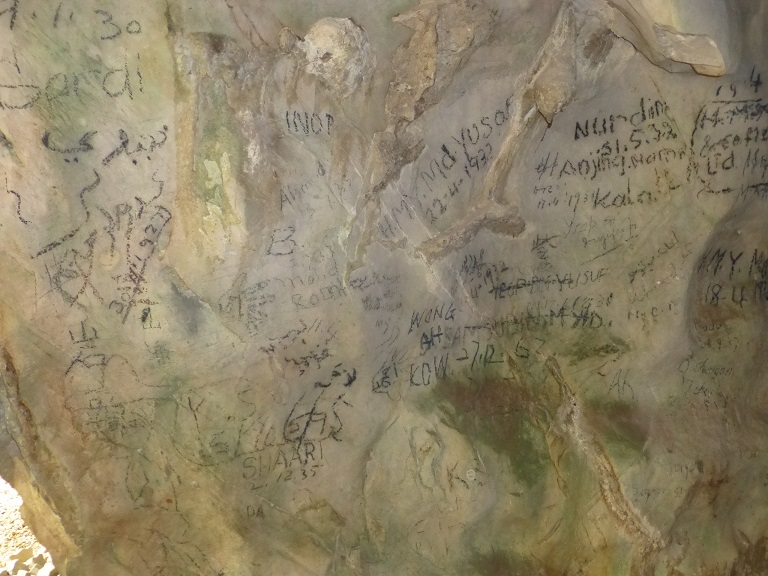
Chinese and Japanese writing in Perak caves

The Star on 27 April 2019 had an article "Japanese, Chinese writing dating back to 1913 found in Tambun's Gunung Datok cave".

The article, by Manjit Kaur, says writing believed dating back to 1913 has been found inside Gunung Datok in Tambun. This would pre-date WW1 and is from the Japanese Taisho period.

I first visited Gua Datuk in 1991 but don't have any photos of the graffiti.

Other caves in the Kinta Valley have a mix of Chinese and Japanese writing, which I was told by a Japanese friend Menju, that the writing is Kanji. Kanji means Chinese characters in Japanese. In the Japanese writing system, the characters are adopted from Chinese ones. Caves on the west side of Gunung Lanno show these characters. Although much of the graffiti there dates between 1930-50.

Gua Pulau (Prk 18/16) and Gua Batu Nesan (Prk 18/17) and Gua Selari (Prk 18/15) all have graffiti. My friend Law Siak Hong translated some Chinese characters as "continue to fight the battle" and "may our comrades continue to strive [for the cause]". There are also lot of names - Chinese, Malay and Sikh, also police.


There is also what we guess to be war graffiti, of a soldier shooting a man

See my more detailed blog about these caves, "Lanno revisited" in 2013.

© Liz Price
No reproduction without permission

--
This is the majority of the Star article :
"Japanese and Chinese writing believed dating back to 1913 has been found inside Gunung Datok in
Tambun near here.
State Tourism, Arts and Culture Committee chairman Tan Kar Hing said the inscriptions that were written in charcoal mentioned the year 1913 and the Taisho period.
"1913 is even before World War 1. We believe soldiers were at the cave probably as intelligence troops.
However, we need more experts to come down and have a look, especially the Japanese embassy," he said.
He said the cave is located within the Banjaran Hotsprings Retreat.
"However, we will be writing to the embassy, and we will get experts to tell us what the writing is
about," he added.
The Taisho period in Japanese history dates from 1912 to 1926, coinciding with the reign of the Emperor Taisho."

20 November 2017

Da Seng Ngan cave temple with blue haired Buddha

In 2014 I posted about the blue haired Buddha in cave temples around Ipoh, Perak. The main temple to have these Buddhas is Da Seng Ngan at Gunung Rapat. In Nov 2016 I went back to have another look.

Tokong Da Seng Ngan is next to Kwan Yin temple. There used to be access between the two but now it seems they have been separated off.

Da Seng Ngan is thought to have been established over 100 years ago but in 1974, the bund of a retention pond for tin mine tailings broke its banks. The resulting mud slide buried all the cave temples in this area at the foot of Gunung Rapat. Other temples were soon dug out, but Da Seng Ngan remained buried for 32 years. When the Ipoh Benevolent Society were building a second pond they came across the buried temple. The walls and facade of the temple were all intact. Artefacts found included copper statues of the Buddha, porcelain statues of Kuan Kong (God of War), urns, candleholders and chinaware.  The Star newspaper had several articles in March 2006.

Over the years the temple has developed with buildings and lots of new statues. There are now lots of these mass produced Buddhas by the car park.


I don't think much has changed inside the cave area. Although some of the Buddhas now have more decorative robes, such as this black haired Buddha -

Black haired Kwan Yin made of fake (?) wood -

And a group of different hair colours, white, blue and black -
Here the blue haired Buddha is holding a golden ball
and this one a blue ball
Note there is also a bald patch on top of the head!

The newer statues seem to look more feminine. I don't know if this is intentional or just the production.

Whilst in Ipoh we had a look at a couple of shops that sell temple paraphernalia and saw just a few blue hair statues -

Again I have tried to find the significance of the blue hair but there is very little info. Some sites suggest the blue is favoured by people in Tibet and Nepal, as those people favour the blue mineral  lapis lazuli. It reminds them of the azure sky in those high altitude regions, and it is said that the hair of their goddess had this colour. Both men and women wore it on their heads. And statues prepared in Tibet and the Himalayn kingdom of Nepal have their hair painted blue.

Other say lapis is the color of the principal Medicine Buddha, making this stone an important one in Buddhist mysticism. The Lapis Healing Master is one of the most honored figures in the Buddhist pantheon.

It is surprising why so few other temples feature this blue hair.

My 2014 blog on the blue hair Buddha

© Liz Price
No reproduction without permission

7 January 2016

Iron Hill at Gunung Rapat, Perak

Iron Hill is an area of Gunung Rapat that presumably was mined for iron. A trail leads up the hill through 3 wangs. First time I visited in Feb 2010 access to the trail was behind the Poh Yeh Ngam temple (aka Porok Giam in 2015). The path led past a series of shrines built against the cliff, Wat Putabatwanapuparam, Deep Jungle Mountain Buddhist Feet, aka Tokong Siam.

The start of the trail -


On my next visit in Aug 2015 I discovered that the trail has now been incorporated into part of the
Qing Xin Ling complex and there is an entry fee - the above photo is the back lake at Qing Xin Ling.

The first part through a small gorge is lined with displays of old shops and artifacts


 In the first wang are some dinosaurs! -


From here concrete steps lead on up the hill but there is no further developments. You come to the second level as indicated by the red writing


The flora is interesting. There are lots of monophyllaea

 this one I call the jelly plant as the stem is very soft, I don't know its real name -


After climbing up and up you reach this point with a view


Unfortunately the heavens opened and we were unable to go on up to the triangulation point, instead we made a hasty but careful descent as the trail was really slippery.
Old cables left by the miners

We sheltered below one of the old huts used by the miners and watched the rain


Back to the tourist part -


© Liz Price
No reproduction without permission

Qing Xin Ling village, Gunung Rapat

Qing Xin Ling Leisure and Cultural Village

Qing Xin Ling Leisure and Cultural Village is a newish attraction at Gunung Rapat, near Ipoh, in Perak, Malaysia. The complex consists of a lake surrounded by limestone hills and has been developed into a tourist attraction. It has been described as a mini Guilin although this isn't a very apt description.

There is a path right around the lake. When I visited in Aug 2015 the lake was a dirty green colour and there was quite a bit of rubbish on the water. The front section has chalets built by the water and there are hawker stalls. The chalets are all built in different designs but are a bit gaudy.


There were a couple of goats and they had obviously been drugged so people could touch them, which was really sad to see

The next section, the walk around the back lake was very enjoyable, as there are several types of plants and some interesting rock formations, ducks and geese (and rubbish). 

Murals have been painted on the rocks, depicting tin mining and rubber tapping, pomelos, etc


There is a small museum in a rock shelter, with old photos of Ipoh area, artifacts and rock samples
 Looking down on the complex-

At the car park there are some strange statues

There is a RM4 entry to the place. There are bikes for hire to go around the area.

In the next valley is a trail up to Iron Hill. This used to be free access but now the start of the trail has been taken over by the Qing Xin Ling complex, so you can only get there by paying the entry fee. See next blog on Iron Hill.