sign in a cave in Laos
Showing posts with label Tempurung gua. Show all posts

4 May 2015

Gua Tempurung price increase

Gua Tempurung has jumped on the greed band wagon and has introduced dual pricing, for Malaysians and foreigners.

Since the introduction of GST on 1 Apr 2015, Gua Tempurung started dual pricing, for locals and foreigners.
For example the cost of Tour 3 has increased from RM11 to RM40 and add on GST at 6% makes the price RM42.40 for foreigners.
See letter on Ipoh Echo 211.

I hope foreigners will boycott the place!

Pre GST prices -


16 April 2012

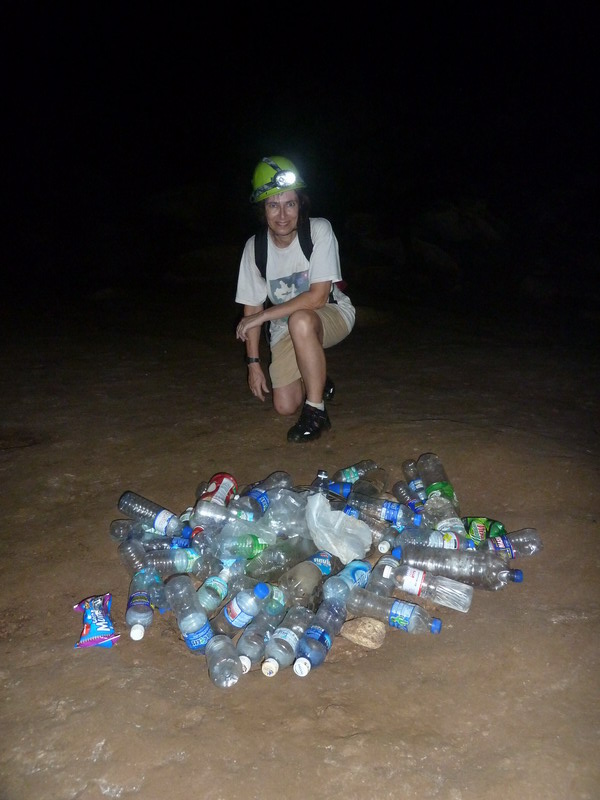
Tempurung Cave Cleanup - Earth Day 2000

In the days when the Malaysian Nature Society had active cave groups in Perak and Selangor, they used to remember Earth Day by cleaning up places such as caves.

On Earth Day 2000, Saturday April 22 was the 30th Anniversary of Earth Day. On the following day, which was Easter Sunday, a group of about 20 cavers and volunteers gathered at Gua Tempurung in Perak to clean the cave.

We split up into 3 teams. On group followed the streamway, another the walkway, and the third concentrated on the steeper parts. Some of the Selangor Group members had brought ropes and SRT gear in order to reach rubbish in deep crevices.
The streamway group -

See my write up in The Star.

See more on Gua Tempurung rubbish.

© Liz Price
No reproduction without permission

Tempurung Cave Cleanup 2000 - Star

The Star
Saturday, May 13, 2000
Off The Beaten Track

Spring cleaning a cave
© Liz Price

EASTER Sunday saw a motley group of cavers armed with black plastic
rubbish bags and pink rubber gloves descend on Gua Tempurung in Perak.
Whilst many people throughout the Christian world were hunting for
chocolate Easter eggs on that day, we were hunting for something less
palatable ........rubbish. We were remembering Earth Day.

Saturday April 22 was the 30th Anniversary of Earth Day and this year's theme was climate change. Earth Day began with some small protests in a couple of cities 30 years ago. But on this weekend, millions of people in
more than 100 countries took part in what's now known as "Earth Day." People picked up garbage, planted trees, and found ways to get around that didn't use gasoline -- from jogging to canoeing. Religious leaders offered prayers for the Earth.

US President Bill Clinton called global warming the most crucial environmental challenge now facing the world. "If we value our coastlines or farm lands and our vital biodiversity, we must build a national consensus to reduce our emissions of greenhouse gases," he said. Many scientists believe greenhouse gases, made up mainly of carbon dioxide from burned fossil fuels, are responsible for a slow but risky increase in the Earth's average temperature.

As part of Earth Day 2000, we had opted to do our bit by collecting rubbish from the cave. Gua Tempurung is West Malaysia's finest show cave, but unfortunately the spectacular views within are often marred by unsightly rubbish dropped by thoughtless visitors. So we decided to give the cave a spring clean.

A bunch of cavers from Kuala Lumpur and Ipoh turned up bright and early, having camped outside overnight, and were ready and waiting even before the cave was open for visitors. There were about 20 cavers and volunteers from the Malaysian Nature Society Selangor and Perak branches, as well as the media to record this event. We broke up into three teams and set off.

One group followed the streamway, another the walkway, and a third abseiled down some of the steeper parts, in an attempt to collect the rubbish dropped by careless visitors. Despite the notice boards placed outside the cave, reminders by the guides not to drop rubbish, and the rubbish bins placed throughout the cave, visitors still drop their trash anywhere. The cave is beautiful, so why do people spoil it by dumping their unwanted items.

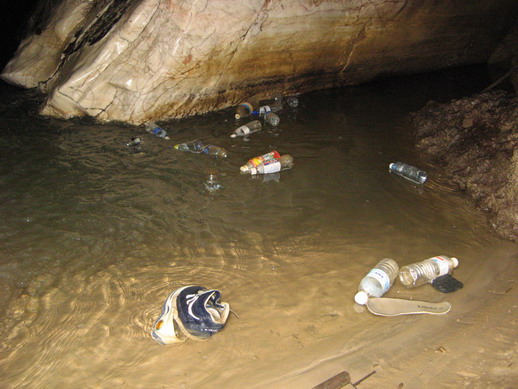
The streamway group found most of their rubbish consisted of plastic water bottles and old shoes. Shoes have a habit of falling apart in caves, and are often dumped by inconsiderate visitors. The opther groups found that their refuse was mainly tissues, sweet wrappers, and drink containers -- cans, boxes and plastic bottles. People were too lazy to use the garbage bins, preferring to throw the rubbish anywhere rather than carry it to the next bin. And as expected, much of the rubbish was thrown down holes or the steeper parts. Out of sight is definitely not out of mind in this cave, as we still made an effort to remove whatever was accessible.

One other more natural problem is waste matter getting washed into the cave. Gua Tempurung has two entrances, with a river flowing in one end and out the other. The eastern entrance where the stream enters the cave is below the North - South Highway. A lot of debris and pollutants get washed in, such as oil, diesel spillages, tree branches and even timber planks. Following the landslide on the highway in January 1996, the road was re-routed, and therefore a lot of contractors were called in to do the work. Some of the debris they left behind got washed into the cave over the following months, even large diesel drums have been found in the cave streamway.

The cave is rich in indigenous fauna, and goodness only knows what is
happening to it now. The water looks quite clear, but knowing that oils and diesel do get washed into the cave, I don't know how the cave fauna is coping.

After a few hours of hard work, we were "rewarded" by about 10 sackfuls of rubbish. We hauled it out of the cave, much to the amazement of incoming visitors. I felt like warning them all not to drop any more trash. Even as we went out, we were faced with freshly dropped litter, which had been dropped by tour groups entering during the day after us. It seemed our task was never ending. However we had had a satisfying day, knowing we had done our bit for Earth Day.

Star Publications (Malaysia) Bhd. (Co No. 10894-D)
All rights reserved.

9 April 2012

Gua Tempurung fauna

I've been going to Gua Tempurung for years. In the days before it was a show cave, it was easy to see lots of fauna on the walls, especially in Top of the World below Rolls Royce garage.

Nowadays there is far less fauna there. Also on my most recent visit in March 2012 there seemed to be less bats generally throughout the cave - and I was caving in areas off the show cave route.

The cave has one "claim to fame" in that it has a trapdooor spider named after it, Lipthistius tempurung.

I have not taken many fauna photos, despite having visited Gue Tempurung many times.

millipedes

whip spider

cricket

cricket feeding on a dead bat

scorpion.

I rarely see scorpions in Malaysian caves. See more on my webpage.

© Liz Price
No reproduction without permission

4 April 2012

Gua Tempurung graffiti

When does graffiti become 'historical'? Some of the graffiti in Gua Tempurung was done by the Communists when they used the cave as a hide out. In some places, early explorers wrote their names and where they were from.

Now that Gua Tempurung is a show cave, there should, in theory, be no more graffiti placed in the cave. Proper control by the cave guides should ensure this. However there seems to be a lack of control, as can be seen by the recent graffiti, as well as the rubbish.

Recent graffiti by UTAR, Universiti Tunku Abdul Rahman. It is sad that university students do this.

New graffiti above the drawings of the cars made by the Communists

And more modern stuff above the 1960 explorers names


© Liz Price
No reproduction without permission

Gua Tempurung rubbish

Gua Tempurung is a popular show cave in Perak, Malaysia. Located about 24 km south of Ipoh it attracts large groups of visitors and is ideally situated midway between Kuala Lumpur and Penang. There are very few show caves in the Malaysian peninsula.

I used to go caving in Gua Tempurung before it became a show cave at the end of 1997. It was initially run by Heritage Acres and Yayasan Perak, and right from the beginning the cave suffered from lack of maintenance and lack of control by the guides.

In 2004 the State Government appointed APT Consortium Sdn Bhd to take over the management and maintenance of Gua Tempurung.

My most recent visit was in March 2012. There was a large number of visitors that day, and there seemed to be little control of the groups by the guides.

The requirements of things to bring for tours 3 and 4 are torch light and proper sports shoes. However very few people had torches, and many had unsuitable footwear.

The biggest problem is littering, and to a lesser extent, graffiti. I was shocked at the amount of rubbish in the show cave. Considering it was a Saturday morning and only just the start of the weekend I dread to think how much more rubbish would accumulate over the weekend.
Items left behind by the painters

Maybe the rubbish bins have not been emptied for a while. But why are visitors allowed to dump their rubbish, mainly plastic bottles, in the cave. They should be told to take all rubbish out with them.

The light at the top of Gergasi is broken

The above photos were all taken in the show cave.

As we left the walkway and went into the undeveloped parts of the cave, I was shocked at the number of water bottles that had been dumped. These had been put in many of the pits dug by the tin miners in the past.


Another big problem is the number of broken shoes, and soles from shoes, that are littering the cave - mostly in the 'adventure' areas of the cave.

Rubbish dumped by the workmen

This oil drum has been here a while.

An additional problem is visitors are given stickers denoting which tour they are on, but these stickers fall off and there are so many lying on the walkways.

Considering Gua Tempurung is being promoted as a major attraction for Visit Perak Year 2012, the rubbish is not a good advert for this, nor for Malaysian show caves.

See Gua Tempurung graffiti.

In 2000 we cleaned the cave for Earth Day.

© Liz Price
No reproduction without permission

27 July 2008

caving is fun - Brunei Times

Published on The Brunei Times (http://www.bt.com.bn/en)

Mud bath, facial for Perak cave explorers


Adventure caving: The rock forming the caves in the Kinta Valley is some 200 million years old. Although caving is not advisable for the unprepared, it can easily be made safe. The golden rule is to have enough lights. Picture: Liz Price

© Liz Price

Sunday, July 27, 2008


I WAS crawling on hands and knees through gooey mud, with my face just inches from the muddy floor, and the boots of the person in front were dangerously close to rearranging my nose. And I was doing this for fun. "Don't worry about the mud, think of it as a free facial," said a witty person behind. As the people in front of me slowly disappeared one by one through the small hole between the rocks, I consoled myself thinking that a mud pack must be good, after all this was free and with no added chemicals, whereas in the beauty salon I could pay a lot of money for such a treatment. So I laid face down and started sliding through the mud bath.

I was with a group of friends adventure caving in Perak. Several Malaysian states are blessed with a profusion of limestone caves. In many places the landscape is dominated by impressive limestone towers rising majestically above the plains. The Kinta Valley surrounding Ipoh is renown for its limestone hills. Many of the hills are riddled with caves, some of which are famous temples, others such as Gua Tempurung are open for tourism, with electric lighting and walkways. And of course there are the wild or undeveloped caves.

Many of the caves are spectacular, with stalactites and stalagmites and other fine formations. Some such as Gua Tempurung have an underground river. This has to be one of my favourite caves in the Peninsula. The total cave is some four km long, and the river flows right through the cave from one end to the other, for a total distance of about 1.6 km. It is really fun to go caving here. Some of the cave chambers are really huge, one is appropriately named Gergasi, or giant.

The rock forming the caves is ancient, with some as old as 200 million years. This limestone rock was originally formed from layers of shells and corals which were deposited under the sea.

These layers compacted, and later on the rock was uplifted into hills and mountains seen today. All the caves are formed by water. Over the years, water gradually eroded the rock, enlarging small cracks and fissures into the passages and chambers seen today. Then the calcite formations developed into stalagmites and stalactites. These formations are wonderful: long stalactites hanging down from the ceiling with the often stumpy stalagmites rising up from the floor to meet them. If they join they become columns. They can be of various shapes and sizes and colours, some glisten as the calcite crystals reflect from the torchlight. Each cave is different, each is a natural wonder. I am often asked why I like to go into caves, and I think part of the reason is the fact that every one is different, and they are all of various shapes and sizes, some are wet, some are dry, some have only horizontal passages whilst others have vertical drops and climbs. And some have cave fauna. It is always wonderful to see the animal life which inhabits caves. Bats are often found in caves, and if they are present there is often a whole variety of animals living on the floor below, feeding on the bat guano. These creepy crawlies include bugs and beetles, spiders, cockroaches, centipedes, flies, and others. In turn larger animals such as frogs and maybe small mammals feed on these. At the top of the food chain is the cave racer snake. Caves are totally dark, and it is amazing to think how these creatures are totally adapted to spending their life in this darkness.

We had been lucky enough to see a cave racer in another cave in Perak. This snake is about 2 m long and feeds on bats. It is non-poisonous and we were able to get some good photos of it as it seemed quite placid and didn't really mind our presence, although I suspect the flashlights disturbed it.

Some caves are of archaeological importance. The oldest inhabitant of Peninsula Malaysia was found in a cave in the Lenggong Valley in Perak. He is known as the Perak Man, his skeleton is estimated to be about 11,000 years old. Several other caves in the area have yielded traces of prehistoric man. Traces of ancient lifestyle, such as pottery, tools, rock paintings and burial sites, have been found in caves.

Caves are fascinating places and caving is a great sport. There are many caves in Malaysia to choose from. It is always good to go with a group of friends and explore different sites. Although caving is potentially dangerous for the unprepared, it can easily be made safe. The golden rule is to have enough lights. Caves are totally dark, so each person must be equipped with their own torch, preferably mounted on a helmet to keep the hands free. And a spare torch should also be taken, along with extra batteries and bulbs. Although caves are made of rock, their environment is still fragile. The calcite formations should never be touched as they are easily damaged and broken. And you should never write on the walls. If you want to mark your route as you go through a cave, use string or paper, and make sure you remove the markers before you leave the cave.

Sometimes you get very muddy and dirty, but it is all part of the fun. That is how I found myself crawling through such a small passage with my face in the mud. For some people it was the first time since childhood that they had crawled and played in the mud. If only our mothers could see us now.The Brunei Times


--------------------------------------------------------------------------------

Source URL:
http://www.bt.com.bn/en/en/life/2008/07/27/mud_bath_facial_for_perak_cave_explorers