sign in a cave in Laos
Showing posts with label Tambun Gua. Show all posts

4 August 2018

Gua Tambun closed again

Gua Tambun is closed again. Once again, the reason is lack of maintenance. The site was closed in July 2018.

Ever since the rock art at Gua Tambun was discovered in 1959, the site has not been looked after. Over the years the Perak state government and / or Ipoh town council have made attempts, which are more verbal than practical.

I've written about the lack of protection in 2009. The steps are often overgrown -

Ipoh City Council is supposed to be doing the latest clean up, let's see what  happens............

See more on SEAArch 17 July 2018.

23 March 2014

Rock art v graffiti in Malaysian caves

My article which compares rock art to modern graffiti was published in The Star on 22 March 2014.


Gua Badak: Cave art from the past
Significant scribblings: This was how the Gua Badak drawings on the cave face looked like in 1992. Now they have faded. - Photos LIZ PRICE


Pre-historic drawings in some caves spark the imagination.


IMAGINE a family of cave men sitting in their cave shelter at the end of the day. The hunters have been successful and managed to catch some prey for the evening meal. The gatherers have gathered enough vegetables to supplement the meat. Everyone is contented.
The sun has not yet set over the plains. One or two people decide to while away their time by drawing. Paper hasn’t been invented yet. Pens and ink are unheard of. So what do the budding artists do? Pick up small pieces of red stone and draw on the cave walls.
Back then, people led a simple life so the objects they drew were limited to what they could see in everyday life. This, of course, was predominately food. And so the people drew animals they hunted and could eat.
Today, thousands of years later, these drawings still exist. What might have been the cave man’s doodles have become important archaeological art.

One man's dugong is another man's alien creature - the famous painting in Tambun, Perak.
One man’s dugong is another man’s alien creature — the famous painting in Tambun, Perak.

The cliff face at Gua Tambun in Perak is a great example. The pre-historic drawings are located high up the face of a cliff that rises 50m above ground level. You have to climb a steep staircase to reach the cliff; be careful, as parts of these steps are covered by undergrowth.
At the top of the steps, you will come to the wide ledge in front of the cliff. The ancient paintings are mostly situated about 7m above this present-day floor level, and most depict animals. The main picture, featured in many articles and tourist brochures, is thought to depict a dugong.
It’s always interesting to view the paintings with other people as everyone has different ideas on what they represent. It can turn out to be quite a guessing game.
I imagine them to be a pig, a deer, and a round one looks like a turtle. Another seems to be a giant catfish – so were there large catfish in the rivers in those ancient days? There is even what appears to be a man with enlarged genitals!
Other motifs show abstract shapes, even a row of exclamation marks. It’s nice just to sit and gaze at the drawings and let your imagination come up with all sorts of ideas. Even archaeological researchers, who have recorded more than 500 individual drawings, are not really sure what some of the pictures represent.
Thought to be about 2,000 years old, the artwork was drawn probably with haematite. This red-coloured iron-based rock can be found around Gua Tambun, so the “artists” didn’t have too far to go for their materials.

Does this look like a scene from a Beano or Dandy comic? Paintings of figures in Niah Painted Cave, Sarawak.
Does this look like a scene from a Beano or Dandy comic? Paintings of figures in Niah Painted Cave, Sarawak.

Presumably, back then, the floor level was much higher, enabling the artists to draw on the rock wall. At the same time, they would have had a wonderful view of the plains which are now Ipoh and its surroundings.
Fast-forward to the present day. Graffiti is generally frowned upon, especially when drawn on buildings and walls without permission. Some exceptions are when the art is particularly good and admired, such as the recent paintings on walls in Kuala Lumpur, Ipoh and Penang.
These city paintings are becoming a trend and, in the last few months, more and more have appeared. Some are now considered tourist attractions, and have even been sponsored by paint companies. So I wonder if, when the ancient cave people started to draw, did those around them scold them and tell them to stop. Or was it considered an art form even then?
Unlike drawing on paper or building walls, cave walls have limited space. After a while, there would be no more room for new drawings. It is rare to see ancient cave drawings that have been drawn over existing ones.
However, cave drawings can last over a millennia and are unlikely to be destroyed compared to those on buildings.


The Merapoh stick figure.

Apart from Gua Tambun’s drawings, the Painted Cave at Niah National Park in Sarawak is another good example of cave art. The paintings there are thought to be 1,200 years old and show “death ships” that carried the dead to the after-life.
To get there, you have to go through the Great Cave of Niah, which is famous for its archaeology and collection of birds nests. The Painted Cave is just beyond the ‘back door’ of the Great Cave.
At first, it is hard to see anything in the dark but, as your eyes adjust to the conditions in the cave, you can make out the red drawings on the wall at the back of the chamber, drawn with haematite. The “boats” are quite curved and show what I imagine to be rows of oarsmen. Interspersed with the boats are other shapes that are hard to determine, as well as several human figures. I would guess these represent hunters and warriors.
Drawings of animals can also be seen on the wall. I thought I spotted a sun with rays, but when I looked closer, I decided it was a person’s head with hair sticking up; further below, it looked like a human torso.
On the floor below are the remains ofthose “death ships”. They are actually boat-shaped coffins containing the remains of the deceased and a selection of items considered useful in the after-life, such as Chinese ceramics, ornaments and glass beads. These relics have been removed and sent to museums.
Some of the “coffins” have been dated as more than 700 years old. However, Niah Cave has an older history – a skull found there in 1958 is around 40,000 years old and it is thought that humans used the cave as far back as 46,000 years ago.

There's a whole lot of things going on here. It would be fascinating to uncover the stories behind these cave drawings in Merapoh.
There’s a whole lot of things going on here. It would be fascinating to uncover the stories behind these cave drawings in Merapoh.

Apart from the pre-historic drawings, there are examples of modern “rock art”. These are thought to have been done by the Orang Asli, maybe 100 years ago. The best known of these are at Gua Badak in Lenggong, Perak. These charcoal drawings depict everyday happenings, such as a monkey climbing a coconut tree, people fishing, animals such as a horse and turtles, mats with patterns, and even cars.
Sadly, these drawings have really faded over the years; today, it is hard to see them clearly. Also the hill has been quarried, resulting in many fallen boulders in front of the rock face. Gua Badak is now part of the Lenggong World Heritage Site, but visitors are often disappointed with the sorry state of the place.
Over in Pahang, in the Merapoh area close to the Kelantan border, are more examples of pre-historic drawings. These have not been studied but are also thought to be modern and drawn in charcoal. These were only found in the past year, during our frequent trips to look for caves in the Merapoh area.
There are about six caves or rock shelters in Merapoh with drawings but, unlike those at Lenggong, the Merapoh ones are not easy to decipher. Some seem to show stick figures in strange positions; one looks like a skier, but I can’t believe it can be in tropical Malaysia!

Gua Badak has been quarried, showing how much we appreciate our natural and historical legacy.
Much of Gua Badak has been quarried.

There are lots of squiggles, including what looks like a railway line that runs through Merapoh. Maybe it was drawn when the Orang Asli first saw the railway constructed. They all seem to be drawn in charcoal.
Across the border in Kelantan there is at least one cave near Gua Musang with drawings similar to those in Merapoh. It would be good to get them professionally dated.
So this begs the question, when does graffiti become archaeological artefact and have historical significance?


Related story:

Getting to the caves
         

Gua Tambun       
This cave is located just outside Ipoh and is easily accessible to the general public. Head towards Tambun – the Gua Tambun rock shelter is in the hill behind the army camp. You can either park by the petrol station, or turn into the housing area behind it and park there. The trail is sign-posted and follows the edge of the stables and horse exercise area, then over a small stream and leads to the stairs that go up to the rock shelter. There is a small pondok and information board. Entrance is free.
As the drawings are located on the cliff face, you don’t need a torch to see them.

Painted Cave At Niah
The Painted Cave is part of Niah National Park. Niah is 110km south-west of Miri and 130km from Bintulu. The Park is located about 3km from the small town of Batu Niah. There is a regular bus service from Miri and Bintulu, to Batu Niah; taxis are also available. From Batu Niah, if arriving by bus or taxi, you can take a long-boat along the river, or take a taxi, or walk.
The park has a visitor centre, cafeteria and accommodation consisting of chalets and hostel-type rooms. There are no cooking facilities. There are also small hotels and eating places in Batu Niah.
The Great Cave of Niah is about 3.5km from the Park HQ and can be reached by a network of plank walks. The path takes you through the rock shelter of Trader’s Cave and then the West Mouth of the Great Cave. You have to walk through the Great Cave, then continue through another short section of forest to reach the Painted Cave. Do take a torch with you as you will need it to go through the Great Cave.
You can visit Niah as a day trip from Miri, but it is nicer to stay overnight in the park. Then you don’t have to rush and you can also watch the evening swiftlets and bats fly in and out of the cave.
There is an entry fee to the park, payable on arrival at HQ. Fees (subject to change): for adults – RM10 (locals) and RM20 (foreigners); for children (over six) – RM3 (locals) and RM7 (foreigners).
National Parks Booking Office
c/o Visitors Information Centre
Lot 452, Jln Melayu,
98000 Miri, Sarawak.
Tel: 085-434184
Fax: 085-434179
The office is closed on Sat, Sun and public holidays.

Gua Badak
It is located a few kilometres north of Lenggong town, in a kampung of the same name. There is no signboard on the main road, only on the kampung road. A narrow track leads to a small parking area where a new pondok has been built. It is only a couple of minutes walk to the rock face with the paintings. Do take care as there are many fallen boulders. Entrance is free.


© Liz Price
--------

28 July 2011

Rock art in Perak's limestone caves

I wrote this article for the Brunei Times, Jan 11, 2009 .

Rock art in Perak's limestone caves
Gua Tambun & Naga Mas


Tambun cliff

THE state of Perak in central Malaysia has some important cultural and natural relics. The cultural antiquities are seen in the form of rock paintings, the natural ones are the fossil bones of a big cat. These two sites are an important part of Perak's heritage, but nothing is done to protect either site.

The Perak Heritage Society recently held an outing to these locations, to get interested people together in the hope that something can be done to preserve these places. On my earlier visits to both sites, I had found the access steps to be very overgrown. So it was a pleasant surprise on this trip to find that the staircases to both places had been very recently cleared. There was even a new gravel path leading to the Tambun staircase, so we were able to avoid all the muddy and swampy land. Presumably some official entourage had been here very recently.

The ancient rock paintings are found on a limestone cliff at Tambun, east of the city of Ipoh. These paintings were discovered in 1959 by Lt Rawlings and at the time were the only known coloured paintings in Malaya. They differ from the more recent charcoal drawings made by the "Orang Asli".


Rawlings found a wide ledge about 30m above the valley floor. The limestone cliff towers above this ledge and it was on the rock face that he noticed the paintings. The pictures depict men and animals, and were reported then to be in colours of dark purple and dull red. However today, due to exposure to the elements, such as wind, rain and sun, the reds have faded and become more orange in colour. The paintings are estimated to be around 2,000 years old. Some of the animals are easily identified, such as a civet, deer, wild boar and a "tapir". There is also a prominent painting that looks like a "dugong", although others suggest it could be a giant catfish.

There are not many pictures of people, although one man is shown with long genitalia. Other shapes are not really understood, one could be a bunch of bananas. It is not known for sure the medium used to create these paintings. It was originally assumed to be hematite, which is found in the area, but now the suggestions leads towards natural pigments from fat, blood or iron oxide. As the paintings are all much higher than the present day floor level, it is not known how ancient man was able to reach so high up on the cliff. In Australia it is thought that the Aborigines built scaffolding to do their rock art.

The Tambun paintings do show that humans were living in the Kinta Valley during this period. They may have been farmers rather than hunters and gatherers and it is thought that the animals they drew were the ones they saw and probably ate.

From ancient paintings we turned our attention to some fossil bones. Gua Naga Mas, south of the city of Ipoh, is a cave situated in a small limestone hill. In 1992 some people from the Malaysian Nature Society were visiting the cave and noticed some bones in the ceiling.


The vertebrate bones are about five metres above the floor and are embedded in travertine. Further studies revealed that they are probably the remains of a large cat, such as a tiger or leopard. These observations were made on the shape and size of the bones, and a lower premolar tooth was recognised as belonging to a big cat. The skeleton is about 98cm long, and although it is not easy for the layman to clearly make out the bones, the scientists have been able to identify each of the parts. A rough estimate suggests they are 10,000 years old.

Since the discovery more than 15 years ago, no detailed studies have been made on the bones, and the identity and age are still not known for sure. It is the only such fossil known in Malaysian caves.

The vertebrate bones and rock paintings are both unique parts of Perak's prehistory, and hopefully they will last for the eons to come.

© Liz Price
No reproduction without permission

See more on my website Caves of Malaysia and more on Gua Tambun rock paintings.

16 August 2009

Gua Tambun overnight trip 2009

In Jan 2009 I went to Gua Tambun rock paintings to see Noel's erection Gua Tambun scaffolding. August 14-15 he was spending 24 hours at the site to do some data recordings, so I joined him along with Law Siak Hong, Juliana Rahim and her husband Ikmail.

Noel was there from around 9am on Fri morning, and I arrived at 1pm, having had a nice lunch in Ipoh, whereas Noel was heating his chunky soup and instant couscous on a brand new stove.

The others arrived during the late afternoon and time passed quickly as we chatted and had a look around. The pondok at the base of the steps has been constructed since my last visit in Jan, though the info board is still empty, and the roof tiles are already covered in moss or algae.

Noel was taking readings of temperature, humidity and luminosity every hour.


Surprising the site was quite dry as the humidity was around 60% during the afternoon, compared to much higher readings of 90+ in other places such as Penang. The temperature only once reached 33C in the afternoon. The meters were positioned on the cliff face. It was quite hazy and the views to Keledang hills were disappointing.

We had set up tents on the stony floor.


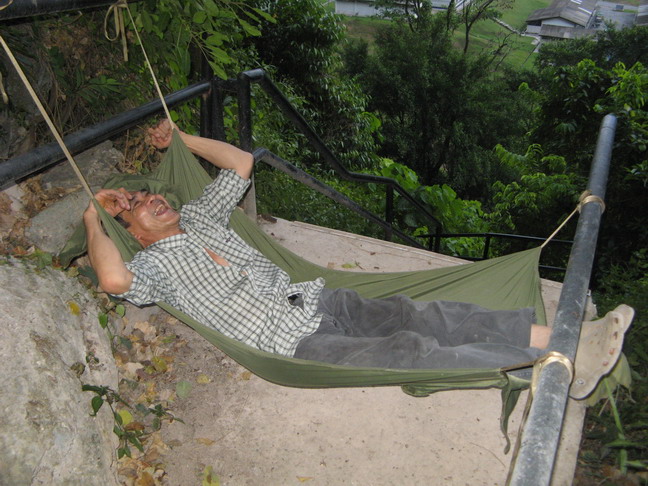
It was the first time I had used my tent since I was in Madagascar in 1999 - luckily it hadn't rotted. Hong put up a hammock on the steps, so we declared him our guard dog. Incidentally there were no signs of the dog family we had seen in Jan. At the end of the cliff area, some people have scattered a lot of textbooks (English and Chinese). We couldn't understand why people would carry books up to this site and then destroy them there.


By 10pm we had all gone to bed, but it was too hot to sleep inside the tent. There was no need for a fly sheet as we were protected from any rain being under the huge overhang of the cliff. At 11pm our peace was shatterd as the soldier boys in the army camp directly below us started karaoke. It was BAD. Really bad. Absolutely awful. It lasted about 2 hours, then after that, there was still noise as stragglers returned to the army camp in cars and noisy bikes.

Also the floodlights from the army camp remained on all night except for one hour. These lights were so bright that we hardly needed torches depsite there being no moon. Part of the cliff face was really illuminated, but luckily not the main area where the paintings are.


Even then it was not a peaceful night as the birds were calling the whole night. I think they are swifts. Why do they spend the night calling when they should be sleeping. I wondered if it was because of the floodlights. Noel had set his alarm for every hour on the hour. Then we heard the loud crunching of his footsteps on the stones as he went to read the 2 meters. So I didn't get much sleep.

We got up around 7am, and the last reading was taken at 9am. We said our goodbyes to the paintings, then left and went to town for breakfast and durians.


examining the paintings with a magnifier

goat droppings


some of the noisy birds


© Liz Price
No reproduction without permission

17 January 2009

Tambun & Naga Mas - Ipoh Echo

An article I wrote on Gua Tambun and Gua Naga Mas in Ipoh Echo , Jan 16-31, No 66, p11

11 January 2009

Gua Tambun and Naga Mas - BT

Published on The Brunei Times (http://www.bt.com.bn/en)

Rock art in Perak's limestone caves

Natural relics: The Tambun cliffs; entrance to Naga Mas cave; ancient cave drawing of the Tambun 'dugong'. The Kinta Valley is an important heritage site for Malaysia. Picture: Liz Price

Sunday, January 11, 2009

THE state of Perak in central Malaysia has some important cultural and natural relics. The cultural antiquities are seen in the form of rock paintings, the natural ones are the fossil bones of a big cat. These two sites are an important part of Perak's heritage, but nothing is done to protect either site.

The Perak Heritage Society recently held an outing to these locations, to get interested people together in the hope that something can be done to preserve these places. On my earlier visits to both sites, I had found the access steps to be very overgrown. So it was a pleasant surprise on this trip to find that the staircases to both places had been very recently cleared. There was even a new gravel path leading to the Tambun staircase, so we were able to avoid all the muddy and swampy land. Presumably some official entourage had been here very recently.

The ancient rock paintings are found on a limestone cliff at Tambun, east of the city of Ipoh. These paintings were discovered in 1959 by Lt Rawlings and at the time were the only known coloured paintings in Malaya. They differ from the more recent charcoal drawings made by the "Orang Asli".

Rawlings found a wide ledge about 30m above the valley floor. The limestone cliff towers above this ledge and it was on the rock face that he noticed the paintings. The pictures depict men and animals, and were reported then to be in colours of dark purple and dull red. However today, due to exposure to the elements, such as wind, rain and sun, the reds have faded and become more orange in colour. The paintings are estimated to be around 2,000 years old. Some of the animals are easily identified, such as a civet, deer, wild boar and a "tapir". There is also a prominent painting that looks like a "dugong", although others suggest it could be a giant catfish.

There are not many pictures of people, although one man is shown with long genitalia. Other shapes are not really understood, one could be a bunch of bananas. It is not known for sure the medium used to create these paintings. It was originally assumed to be hematite, which is found in the area, but now the suggestions leads towards natural pigments from fat, blood or iron oxide. As the paintings are all much higher than the present day floor level, it is not known how ancient man was able to reach so high up on the cliff. In Australia it is thought that the Aborigines built scaffolding to do their rock art.

The Tambun paintings do show that humans were living in the Kinta Valley during this period. They may have been farmers rather than hunters and gatherers and it is thought that the animals they drew were the ones they saw and probably ate.

From ancient paintings we turned our attention to some fossil bones. Gua Naga Mas, south of the city of Ipoh, is a cave situated in a small limestone hill. In 1992 some people from the Malaysian Nature Society were visiting the cave and noticed some bones in the ceiling.

The vertebrate bones are about five metres above the floor and are embedded in travertine. Further studies revealed that they are probably the remains of a large cat, such as a tiger or leopard. These observations were made on the shape and size of the bones, and a lower premolar tooth was recognised as belonging to a big cat. The skeleton is about 98cm long, and although it is not easy for the layman to clearly make out the bones, the scientists have been able to identify each of the parts. A rough estimate suggests they are 10,000 years old.

Since the discovery more than 15 years ago, no detailed studies have been made on the bones, and the identity and age are still not known for sure. It is the only such fossil known in Malaysian caves.

The vertebrate bones and rock paintings are both unique parts of Perak's prehistory, and hopefully they will last for the eons to come.

The Brunei Times


9 January 2009

Gua Tambun scaffolding aka Noel's erection


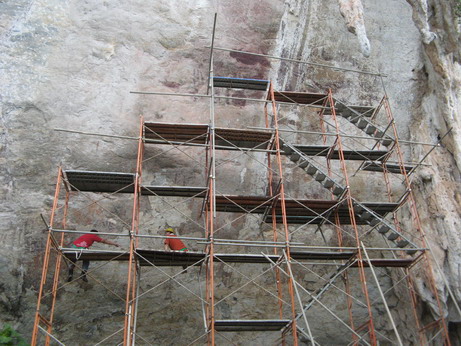
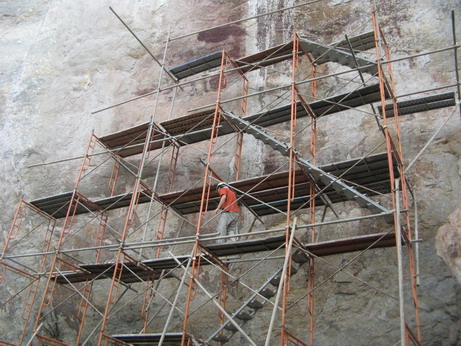
I went up to Ipoh to see Noel's erection. I knew he has a very big one, and it's likely to last a week or even longer if he can maintain it..........so of course I just had to see it, as it is probably a once in a lifetime occurance. But due to safety reasons, no one was allowed to mount it unless authorised by him. It was certainly an impressive sight.

And in case you are wondering, I am talking about the scaffolding at Gua Tambun. Noel Hidalgo Tan, an archaeologist from Singapore, is doing his PhD at USM Penang, on rock art in Malaysia and is currently documenting the rock paintings at Gua Tambun in Perak.


The paintings were found in 1959 but still have not really been researched or documented. And nothing has been done to protect them. Being on a cliff face, they are exposed to the elements such as sun, rain, wind and other environmental damage. Fortunately the paintings are quite high from the ground, so can't be reached by people, hence the need for the large 30' erection !


The team have made some new discoveries but are not allowed to reveal anything until the official results are published. It is an exciting time for Malaysia's prehistory.


Locking the site. The scaffolding was made secure to stop unwanted visitors when no one was working at the site.

A semi-feral family of dogs is living on the cliff. Mum recently gave birth and there are 8 small pups. She must have a hard time looking after them and finding enough food for herself.


I later returned to Tambun in Aug 2009 when Noel was doing some data recordings on an overnight trip .

Update -
The team made some new discoveries which is an exciting time for Malaysia's prehistory. They recorded a count of just over 500 distinct rock art elements.
---------
My article was published in Brunei Times .
--------

Gua Tambun register number Prk 25/01.

------------

© Liz Price
No reproduction without permission