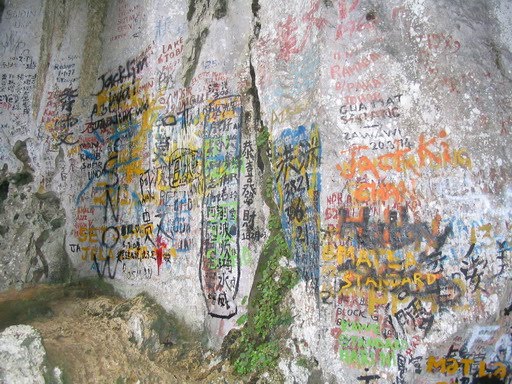
sign in a cave in Laos
Showing posts with label Kelantan. Show all posts

23 November 2017

New Liphistius spider L. priceae named after me

I am honoured to have a new species of Liphistius spider named after me in 2017. The trapdoor spider, Liphistius priceae sp. nov. has recently been described in a new paper, Revue suisse de Zoologie (September 2017) 124(2): 391-445, A revision of the trapdoor spider genus Liphistius (Mesothelae: Liphistiidae) in peninsular Malaysia; part 1, by Peter J. Schwendinger.

There are 5 species groups of Liphistius in peninsular Malaysia : the trang group, the malayanus-group, the batuensis-group, the tioman-group and the linang-group. L. priceae sp. nov. belongs to the linang-group.

The specimens were collected by Dr Peter Schwendinger. They are known only from two caves in the
same limestone hill at Dabong in Kelantan - Gua Keris and Gua Pagar. None were found in the associated rain forest so they may be confined to caves, although show no noteworthy cave adaptations.

Unfortunately there are no photo of the live specimens, only those in alcohol -


Extracts from the paper :

(Location):
Malaysia, Kelantan, about 5 km
S of Dabong, Gua Keris (= Kris Cave) and Gua Pagar
(locally also called Gua King Kong), 130 m; 8.-9.
VI.2004; leg. P.J. Schwendinger. The precise type
locality is Gua Keris.

Etymology: 
The new species is named in honour of
Liz Price (London, UK), a former long-time resident
in Kuala Lumpur, and a very active speleologist who
over 30 years explored and published on caves and cave
faunas all over Southeast Asia. She was also involved
in conservation and trying to save some caves from
destruction by quarrying in Malaysia.

Diagnosis: 
Small to medium-sized, light-brown coloured
species, similar and closely related to
L. tempurung. Both sexes slightly smaller than those
of L. tempurung.


This is the second specimen to have been named after me. The first was a snail from Laos, called Sinoennea lizae

A big thank you to Peter Schwendinger for honouring me with this cave spider.

--

UPDATE Feb 2018

2 specimens of Liphistius priceae Schwendinger 2017 have been catalogued by the Senckenberg Museum in Frankfurt :


And NMBE catalogue


And a Wikipedia entry on L.priceae.


6 October 2013

Gua Musang railway station, Kelantan, Malaysia

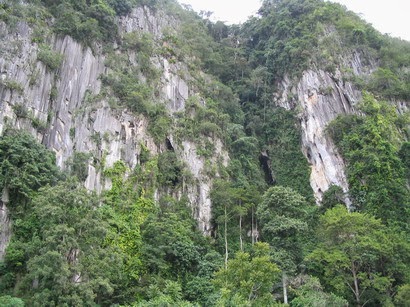
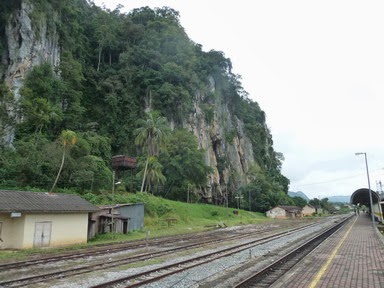
Anyone who has been to Gua Musang in Kelantan, Malaysia, will know that the town is surrounded by limestone hills. The main street of the old town is quite scenic with a backdrop of a large karst tower at the end. Between the end of the street and the hill is the railway line. The old Gua Musang railway station is particularly iconic, but has now closed down and is no longer in use. The new station is about 1 km to the south.

One of the best known caves in the area is also called Gua Musang and to reach it, you have to walk along the railway platform and cross the lines before climbing the hill. See my blog on Gua Musang cave.

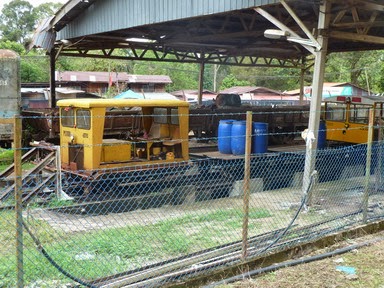
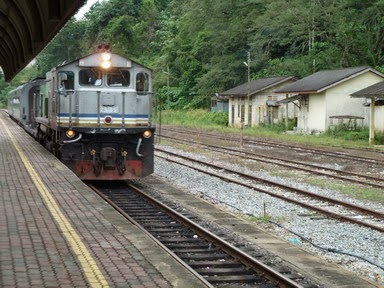
On a recent visit to Gua Musang town, we stopped for breakfast at the food stalls right by the old station and I used the opportunity to take some photos of the now abandoned station.


13 February 2013

Caves around Gua Musang, Kelantan

The town of Gua Musang in Kelantan, Malaysia is surrounded by limestone hills. The most famous cave is also called Gua Musang and is in the hill right behind the railway station.

In 2005 I spent a few days caving with some friends from Ipoh and we took time to look for other caves in the area. There are many listed in my Cave register but none seem to have been documented otherwise.

We stayed in chalets in Taman Ethnobotani. The park has some small limestone outcrops used for rock climbing and abseiling. There is a short tunnel cave


We went to the small town of Pulai, south of Gua Musang and to Princess Mountain, Bukit Tok Cu.

At the time, a temple was being built up on the hill. Apparently in 1984 a man had a vision of stairs being built and in 1997 the building was started - concrete steps lead up to a small Taoist temple, Gung Ju San.


There is an upper level cave passage and you can look down into a big chamber.

We looked at other hills in the area but I didn't take many photos (I was still new to digital cameras in those days!). In Gua Sidang we found some charcoal cave drawings, Jawi writing and Chinese graffiti.

Next cave we visited I named Bombed Cave - apparently it was bombed by the British during the Emergency, as they thought Communists were hiding inside. [This was possibly 1950 when there was a lot of fighting in the area, e.g. the battle of Ulu Semur]
Some enormous slabs had fallen from the roof at some time.

The cave is a large chamber with a small stream running through. There were lots of sacks of guano.

We nicknamed this hill (Gua Serai) in Gua Musang as Mangy Dog hill!

In the Chin Teck plantation we went to Gua Batu Hijau


There are fruit and insect bats and lots of brown stains


© Liz Price
No reproduction without permission

18 December 2011

Gua Musang, Kelantan

Gua Musang is the name of a town and area in Kelantan, Malaysia.

It is also the name of a well known cave in the town. The name translates as Civet Cave.

The cave is located high in the hill right behind the railway station.

To reach the cave you walk along the railway platform, cross over the lines and follow the path past the houses, then climb steeply up the hill.

The cave entrance is a narrow rift which leads up and into a large chamber.
Climbing along the right side leads to the main chamber. This is a huge passage running through the hill. It's big.

In the entrance is a mass of multicoloured graffiti

The passage is high,

There are a few crickets and whip spiders in a side chamber. On the floor we saw lots of moth wings

The passage leads up to a back entrance

From the entrance there is a route to the top of the hill, but it was too wet and slippery to do when we visited.

Gua Musang register number Ktn 136/01.

© Liz Price
No reproduction without permission