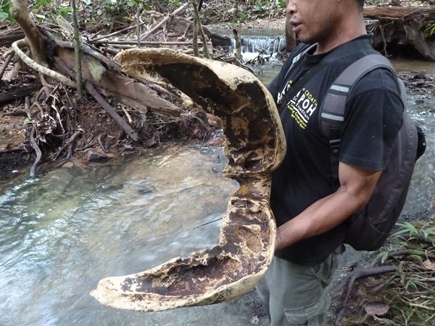
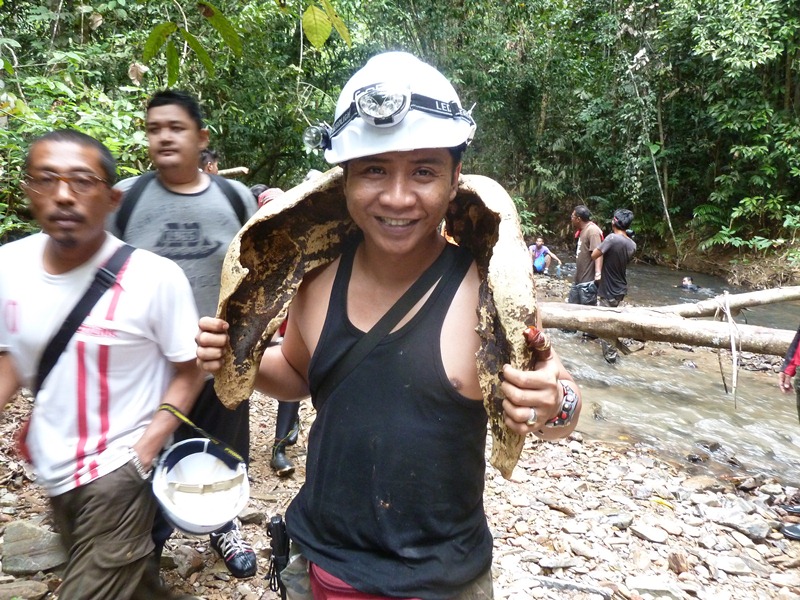
sign in a cave in Laos
Showing posts with label elephant. Show all posts

25 November 2013

More elephants in Merapoh caves

Earlier this year, in Feb 2013, I did a post on elephants in and around Merapoh caves. Since that blog I went back to Gua Gajah Marah in Nov. My earlier posting on this cave was in Sept 2012.

On this latest visit, I was shocked to find the whole area outside the cave had been completely cleared. See post on deforestation.

There was a lot less elephant dung in the entrance and none of it was fresh. So it looks like the animals have stopped going to that cave.

The day before, on 18 Nov we went to Gua Cadu. This is well visited by elephants as the
entrance slope was like a mine field, with droppings everywhere.
 The top of the entrance slope ends in a climb up so this is as far as the elephants can go -
However there was a small passage leading down, with a drop of about 1.5m into a small chamber. Sadly I found the bones of a probably young elephant in this chamber. It must have gone in and been unable to get out, and probably suffered a very slow lingering death as it starved. Found many of the bones but not the skull.


There were even piles of droppings on a ledge, not sure how it got there, I assume the
elephants just stick their backsides over the ledge.

As in the other Merapoh caves used by elephants, there is no sign of them digging for salts from guano or rocks. However you can see the rub marks below the ledge (above). And this tree trunk is covered in mud from elephants.
There is new life growing in the fresh droppings -


 There were fresh droppings on the logging trail, these smelt as if they had been deposited very recently -

© Liz Price
No reproduction without permission

4 October 2013

Merapoh 2013 - more cave drawings, Gua Lima area

At the end of Sept 2013 I was back in Merapoh. We spent a couple of days caving in the Gua Lima area, which is just outside Kpg Merapoh. We found a few more caves with black drawings on the walls. They are similar to those at Gua Badak in Lenggong, Perak, although those have more recognisable objects such as people, animals, bicycles, trees etc.

It is not known if the Merapoh drawings are the same age as the Lenggong ones, but the latter have deteriorated over the years and are now really faded. It is thought the drawings may have been made by the local orang asli.

The first ones are on the wall of a long rock shelter, Gua Gajah Gosok, this is near a cave we named as Gua Empat Tingkat.


Some of the drawings look like people -

Various human like shapes can be seen as well as one set of squares -

There were also sign of elephants having rubber along the centre hanging rock -


From here we moved onto another hill in the area

and we named the cave Gua Jambatan Batu from this bridge -


There were drawings in the upper section
The one on the top right looks like the sun

One the next 2, the left one looks like a deer from outer space, the one on the right Habli said is a tiger eating a person!

The cave has some nice formations -

 and a few bats -

One wall was blackened from soot from fires. Outside I found a piece of pottery

A short, but interesting cave.

Another cave in the area with drawings. This is Gua Lima, aka Gua Terowong Felcra. I first visited this cave in 1996 but missed the drawings then as they are on the upper level above the entrance. I also came back in Sept 2013 and again didn't know the drawings were there.


-------------

See Feb 2013 blog of Gua Seribu Cerita for more cave drawings.

-------------

October 16 2013, Noel has now blogged about this rock art on his site, SEAArch, and put forward interesting suggestions. See Rock Art from Merapoh, Pahang.

-------------

Blog on Batek orang asli who may have done the drawings

------------

© Liz Price
No reproduction without permission

27 February 2013

Elephants in and around Merapoh caves

The Merapoh area in northern Pahang is situated on the boundary of Taman Negara, Malaysia's largest and oldest national park. The park is home to large mammals such as elephants and big cats. Of course these animals are not restricted to the park and are found in other places in Malaysia.

Elephants are known to go into caves, the most famous example being the Kitum Caves at Mount Elgon in Kenya. In Taman Negara, Malaysia many years ago I was camping alone in Gua Kepayang Besar and when I left in the  morning there was a steaming pile of elephant dung in the cave entrance. I later saw an elephant as I was trekking.

In Merapoh in Sept 2012 we found elephant dung in Gua Gajah Marah

 and in Gua Putera Mandi in Nov -

Whilst visiting to Gua Hari Malaysia in Sept 2012 we found elephant bones both downsteam and upstream of the cave.


This is the tooth of an elephant -

In June 2013 I visited the Natural History Museum in London, and took this photo of the tooth of an Asiatic elephant.

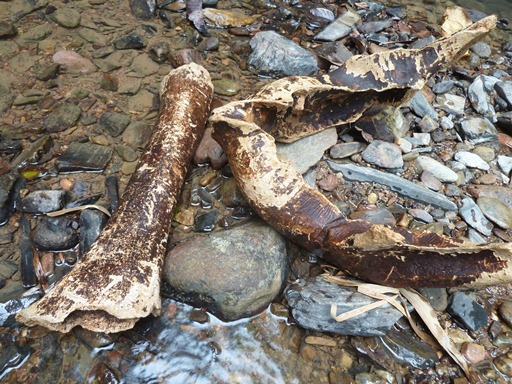
When we visited Gua Hari Malaysia in Feb 2013, we found a lower jaw and a leg bone from an elephant. I wonder if all the bones came from the same elephant.


The leg bone

The bones were taken back to the Merapoh hostel

© Liz Price
No reproduction without permission

20 August 2008

Chasing tigers and elephants - Star

THE STAR
Saturday July 17, 2004
Chasing tigers and elephants

By Liz Price

Tiger, tiger burning bright
In the middle of the night
What immortal hand or eye
Could frame thy fearful symmetry?
– from The Tiger, by William Blake (1757-1827)

EVER since my first visit to Asia two decades ago, it has been my ambition to see a wild elephant, and, even more than that, a tiger in the wild.

As I spent months backpacking around India, I visited several nature parks and wildlife sanctuaries. I went to the Jim Corbett National Park where many people managed to see tigers. Indeed the day I arrived, a group of European visitors had just seen a mother tiger with cubs in the morning. This got my hopes up, and I eagerly went in search the next day. I saw nothing.

There were small reptiles, many species of birds, several types of deer, but no tigers. Those feline creatures were certainly elusive. This was the first national park in India, situated in the north of Uttar Pradesh, 300km from Delhi. It was here that Project Tiger was launched 30 years ago with the aim of saving the tiger from extinction. Had they suddenly became extinct on the eve of my visit?

I didn’t even see any wild elephants there, and the park is actually known for its elephants. Where were they all?

I had the choice of doing an elephant safari, which meant riding an elephant in order to spot other wildlife, but opted to do a jeep safari, in the hope that I would cover more terrain. I did, but it was unsuccessful and I was unlucky.

Later on my Indian travels, I went to the Sunderbans Tiger Reserve, the world’s largest delta and mangrove swamp, and the world’s largest estuarine sanctuary, situated 130km from Calcutta in West Bengal. There are an estimated 270 Royal Bengal tigers in the wildlife sanctuary, so I had high hopes. Many of these tigers are man-eaters. They are prone to attacking humans for food, and the locals resort to wearing masks on the back of their heads when working in their fields, in an attempt to put off the tigers.

The tigers usually become man-eaters due to the lack of other suitable prey in the area. There are an average of 40 maulings a year here.

I spent several days in the park, accompanied by armed officers. I slept in remote huts, climbed up watchtowers, sat up overnight. But nothing. Even a dead goat tied to the lower branches of a tree as bait didn’t attract any striped visitors. The Sunderbans is home to spotted deer, wild pigs, monkeys, herons, kingfishers and eagles, and although I saw most of those creatures, the 270 tigers were in hiding.

In Nepal I went to the Royal Chittwan Reserve. This park is noted for its one horned rhino, but it also has tigers. I did a safari on elephant-back to go animal-spotting. Yes I saw the rhinos, which was really wonderful and exciting. But once again, the tigers were conspicuous by their absence.

So I moved on to Thailand, and saw neither of the large mammals I was seeking in the wild. Next stop – Malaysia. I knew Malaysia still had wild tiger and elephant populations, but sightings were not particularly common. I backpacked around Malaysia for two months, and saw neither creature in the wild. I travelled on to Indonesia, knowing I wouldn’t see those creatures there either. In Australia I saw wild camels, but of course no elephants or tigers. I had seen scores of wild elephants in Africa, but my desire was to see the Asian or Indian elephant.

I returned to Malaysia and spent some time doing voluntary projects with WWF Malaysia. This involved camping out in the jungle for days on end, up to 10 days at a time. We saw virtually every creature that lives in Malaysia, except for the rhino and . . . yes, you guessed it, the tiger and elephant.

My closest sighting was in Kelantan when I was on a caving trip. The scientist in the group, Dr Dionysius Sharma (Dino) spotted elephant AND tiger footprints right outside a cave. I was so excited because this was my closest to sighting either of these creatures. There was one print of each, and they were quite fresh. We went into the cave, which emerged on the other side of the hill, where we found mouse-deer, tapir and pig tracks, and more excitingly, three or four fresh elephant footprints.

We decided to go animal spotting that night. We set up camp a safe distance away in some rubber trees, then returned to the area to wait. When I heard a noise, I was convinced it was an elephant, until Dino told me it was a frog. Oh well, try again! We stayed there for several hours, but saw nothing. Once again those pachyderms were not going to show themselves to me.

Over the years I made several trips to Taman Negara, staying up to a month at a time. I spent several nights trekking with one of the rangers, Mat Zin, but we didn’t see what I was looking for – although I did have a nose-to-nose encounter with a large, bird-eating spider which was dangling from a tree. Zin told me that it was very rare for even the rangers to see tigers nowadays. They occasionally see the tracks but not the actual animal.

It was getting frustrating.

I did a lot of trekking alone, and stayed in the hides. I was lucky, and saw the “rarer” mammals such as the tapir and even a panther on one occasion. And I saw elephant footprints and even took photos as evidence. And then Lady Luck smiled on me. I trekked out to the caves in the Kepayang area in Perak, and slept overnight in Gua Kepayang Besar.

Actually I didn’t sleep, as it was the most terrifying night of my life. I was all alone. Firstly, I was startled by lights flashing above my head, until I realised they were merely fireflies, and then I laughed at myself for being so stupid. But after I had settled down to sleep I was disconcerted to hear scuffling and rustling noises close by. I kept shining my torch but could see nothing. The noises continued, and my fears mounted, and then I saw them – porcupine going about their normal nights business, totally unfazed by my presence.

I decided they were quite cute and nothing to worry about. But I still couldn’t sleep.

Outside there was the sound of snuffling and movement and branches cracking. No way was I going out to find out what was there, and I spent the rest of the night restlessly tossing and turning as if I was on a bed of nettles.

As soon as the sun came up, I packed my bags, not wishing to spend a moment longer there than I had to. As I left the cave I walked straight into a pile of fresh, still steaming, elephant dung. That would explain the sound of cracking branches during the night.

I set off on my trek, and about 30 minutes later I suddenly realised there was a large grey form ahead of me. My mind was still unsettled after my scary night and I was still rubbing sleep from my eyes. I wondered what was ahead of me in the gloom of the forest. And then I realised it was the donor of the steaming dung left outside the cave. Eureka! I had found my elephant.

But I am ashamed to say that I ran away. I was so on edge, with nerves as taut as violin strings, that as soon as I saw the creature, I turned tail and quietly hurried away. My mind was telling me stories of how elephants sometimes attack humans, and because I was all alone, I wasn’t prepared to stay and find out. Once I was a safe distance away, I really regretted my action, as I hadn’t even stopped to take a photograph. But better safe than sorry.

Since then, I have been lucky enough to see the wild elephants in the Kinabatangan area of Sabah. I saw a total of about 15, and was able to get very close indeed to some of them. And it was exciting to learn, a month after my visit, that these elephants have been declared to be a new, distinct subspecies, the Pygmy elephant. Originally it was thought they were a member of the Asian elephant group. I was fortunate to have seen them, as not all visitors to that area are so lucky.

So finally, I have seen the Asian elephant and its cousin the Pygmy elephant in the wild. I have seen the African elephant in its natural surroundings. And I’ve ridden the tamed Indian elephant. All that remains now is to track down that elusive tiger . . .

8 June 2008

Chasing tigers and elephants - Brunei Times

Published on The Brunei Times (http://www.bt.com.bn/en)

Chasing Bengal tigers and Indian elephants
Liz Price

KUALA LUMPUR


Sunday, November 18, 2007


EVER since my first visit to Asia two decades ago, it has been my ambition to see a wild elephant, although this was lower on my list than to see a tiger in the wild. That was my priority, to see a wild tiger, unchained and uncaged. In India, I visited several nature parks and wildlife sanctuaries. I went to the Jim Corbett National Park where many people manage to see tigers. Indeed the day I arrived, a group of European visitors had seen a mother tigress with cubs. This got my hopes up, and I eagerly went in search the next day, and saw nothing. I saw small reptiles, many species of birds, several types of deer, but no tigers. Those feline creatures were certainly elusive. This was the first National Park in India, and is situated in the north of Uttar Pradesh, 300km from Delhi. It was here that Project Tiger was launched 30 years ago, aimed at saving the tiger from extinction. I was wondering if they suddenly became extinct on the eve of my visit.
I didn't even see any wild elephants in the Jim Corbett Park, and the park is known for its elephants. Where were they all? I had the choice of doing an elephant safari, which meant riding an elephant in order to spot other wildlife, but instead I opted to do a jeep safari, in the hope that I would cover more terrain. I did, but it was unsuccessful and I was unlucky.

Later on my Indian travels, I went to the Sunderbans Tiger Reserve, the world's largest delta and mangrove swamp, and the world's largest estuarine sanctuary, situated 130km from Kolkata in West Bengal. There are an estimated 270 Royal Bengal tigers in the wildlife sanctuary, so I had high hopes. Many of these tigers are man-eaters. They are prone to attacking humans for food, and the locals resort to wearing masks on the back of their heads when are working in their fields, in an attempt to scare the tigers away. The tigers have become man-eaters due to the lack of other suitable prey in the area. There is an average of 40 maulings a year.

I spent several days in this park, accompanied by armed officers. I slept in remote huts, climbed up watchtowers, sat up overnight. Nothing. Even a dead goat tied in the lower branches of a tree as bait didn't attract any striped visitors. The Sunderbans is home to spotted deer, wild pigs, monkeys, herons, kingfishers and eagles, and although I saw most of those creatures, the 270 tigers were in hiding.

In Nepal I went to the Royal Chittwan Reserve. This park is noted for its one horned rhino, but it does also have tigers. I did a safari on elephant back to go animal spotting. Yes, I saw the rhinos, which was really wonderful, and exciting. But once again, the tigers were conspicuous by their absence.

I moved on to Thailand, and saw neither of my sought-after large mammals in the wild. The next destination was Malaysia. I knew Malaysia does have wild tiger and elephant populations, but sightings are not particularly common. I backpacked around Malaysia for two months, and saw neither creature in the wild. I travelled on to Indonesia, knowing I wouldn't see those creatures there. I had seen scores of wild elephants in Africa, but my desire was to see the Asian or Indian elephant.

I returned to Malaysia and spent some time doing voluntary projects with WWF Malaysia. This involved camping out in the jungle for up to 10 days at a time. We saw virtually every creature that lives in Malaysia, except for the rhino — and the tiger and elephant. My closest sighting was in Kelantan when I was on a caving trip. The scientist in the group, Dr Dionysius Sharma (Dino) spotted elephant and tiger footprints right outside a cave. I was so excited! This was my closest sighting to either of these creatures. There was one print of each, and quite fresh. We went into the cave and emerged on the other side of the hill, where we found mousedeer, tapir and pig paw marks, and more excitingly, three or four fresh elephant footprints.

We decided to go animal spotting that night. We set up camp a safe distance away in some rubber trees, then returned to the area to wait and look for animals. I heard a noise and was convinced it was an elephant, until Dino told me it was a frog. Oh well, try again! We stayed there for several hours but saw nothing. Once again those pachyderms and felines were not going to show themselves to me.

Over the years I made several trips to Taman Negara, staying up to a month at a time. I spent several nights trekking with one of the rangers, but we didn't see what I was looking for. The ranger told me that it is very rare for even the rangers to see tigers nowadays. They occasionally see the tracks but not the actual animal.

I did a lot of trekking alone, and stayed in the hides. I was lucky, and saw the "rarer" mammals such as tapir and even a panther on one occasion. I saw elephant footprints and even took photos as evidence. Then my luck changed. I did a trek out to the caves in the Kepayang area, sleeping overnight in Gua Kepayang Besar. Actually I didn't sleep, as it was the most terrifying night of my life. I was all alone. Firstly I was startled by lights flashing above my head, until I realised they were merely fireflies. I laughed at myself for being so stupid. But after I settled down to sleep I was disconcerted to hear scuffling and rustling noises close by. I kept shining my torch but could see nothing. The noises continued, and my fears mounted, and then I saw them — porcupine going about their normal night business, totally unfazed by my presence. I decided they were quite cute and nothing to worry about. But I still couldn't sleep.

Outside there was the sound of snuffling and movement and branches cracking. No way was I going out to find out what was there, and I spent the rest of the night restlessly tossing and turning as if on a bed of nettles. As soon as daylight broke through the trees I packed my bags, not wishing to spend a moment longer there than I had to. As I left the cave I walked straight into a pile of fresh, still steaming, elephant dung. That would explain the sound of cracking branches during the night!

I set off on my trek, and about 30 minutes later suddenly realised there was a large grey form ahead of me. Still unsettled after my scary night and rubbing sleep from my eyes, I wondered what was ahead of me in the gloom of the forest. Then I realised it was the donor of the steaming dung left outside the cave. Eureka! I had found my elephant. But I am ashamed to say that I ran away. I was so on edge, with nerves as taut as violin strings, that as soon as I saw the creature, I turned tail and quietly hurried away. My mind was telling me stories of how elephants sometimes attack humans, and because I was all alone, I wasn't prepared to stay and find out. Once I was a safe distance sway, I really regretted my action, as I hadn't even stopped to take a photograph.

Since then, I have been lucky enough to see the wild elephants in the Kinabatangan area of Sabah. I saw a total of about 15, and was able to get very close indeed to some of them. It was exciting to learn, a month after my visit, that these elephants have been declared to be a new, distinct subspecies, the Pygmy elephant. Originally it was thought they were a member of the Asian elephant group. I was fortunate to have seen them, as not all visitors to that area are so lucky.

Finally, I have seen the Asian elephant and its cousin the Pygmy elephant in the wild. I have seen the African elephant in its natural surroundings. And I've ridden the tamed Indian elephant.

All that remains now is to track down that elusive tiger.

The Brunei Times


-------------------------------------------------------------

Source URL:
http://www.bt.com.bn/en/en/travel/2007/11/18/chasing_bengal_tigers_and_indian_elephants

10 November 2007

Chasing tigers and elephants - jphpk

http://www.jphpk.gov.my/English/Jul04%2017d.htm

My article on Chasing tigers and elephants was stolen and put on the above site.

----------
I've always wanted to see a tiger and elephant in the wild. I've succeeded in seeing elephants on a couple of occasions, but am still searching for the elusive wild tiger.