sign in a cave in Laos
Showing posts with label racer. Show all posts

22 June 2024

Cave racers mating

In 2000, in Dark Cave at Batu Caves in Malaysia, I saw 3 cave racers mating.  I put some photos on my cave website -


The cave racer used to be classed as Elaphe taeniura but is now known as Orthriophis taeniurus. It inhabits limestone caves all over Asia ranging from China, down through the Asian mainland to Malaysia and Borneo. It is commonly seen in caves. There are around 10 species.

I wrote a note on the mating racers in The Malaysian Naturalist, 2002, Dec, 56(2)8 -


In 2023, on 25 Oct The Thaiger (in Thailand) published this article "Explorers ‘rattled’ with excitement as rare Blue-tailed Cave Racer snakes spotted mating in Krabi". It records two Blue-tailed Cave Racer snakes mating in a cave in Ao Luek district, in Krabi province, in southern Thailand. 

The article describes these snakes as endangered and a rare protected species listed in CITES (Convention on International Trade in Endangered Species). However when I looked on CITES, Elaphe taeniura is not listed in the CITES Appendices, nor are other species of Elaphe genus. Orthriophis taeniurus is not mentioned either.

29 October 2016

Cave snakes grabbing bats video

The cave racer catches its prey as it flies by. Racers have been observed to hang over ledges and catch bats flying by. I have seen them climbing cave walls with ease.

The cave racer in Malaysia, Orthriophis taeniurus, is commonly known as a rat snake. Rat snakes are found in many countries. In Oct 2016 National Geographic published a 2 minute video of yellow-red rat snakes (Pseudelaphe flavirufa) catching bats in a cave near the town of Kantemó in southern Mexico’s Yucatan Peninsula. See the article and video here.


Watch Snakes Grab Cave Bats From Mid-air
The mysterious Kantemó Bat Cave, or Cave of the Hanging Serpents, is home to unique (and rather creepy) wildlife.

27 February 2013

Elephants in and around Merapoh caves

The Merapoh area in northern Pahang is situated on the boundary of Taman Negara, Malaysia's largest and oldest national park. The park is home to large mammals such as elephants and big cats. Of course these animals are not restricted to the park and are found in other places in Malaysia.

Elephants are known to go into caves, the most famous example being the Kitum Caves at Mount Elgon in Kenya. In Taman Negara, Malaysia many years ago I was camping alone in Gua Kepayang Besar and when I left in the  morning there was a steaming pile of elephant dung in the cave entrance. I later saw an elephant as I was trekking.

In Merapoh in Sept 2012 we found elephant dung in Gua Gajah Marah

 and in Gua Putera Mandi in Nov -

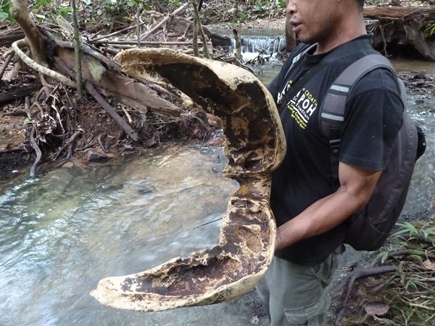
Whilst visiting to Gua Hari Malaysia in Sept 2012 we found elephant bones both downsteam and upstream of the cave.


This is the tooth of an elephant -

In June 2013 I visited the Natural History Museum in London, and took this photo of the tooth of an Asiatic elephant.

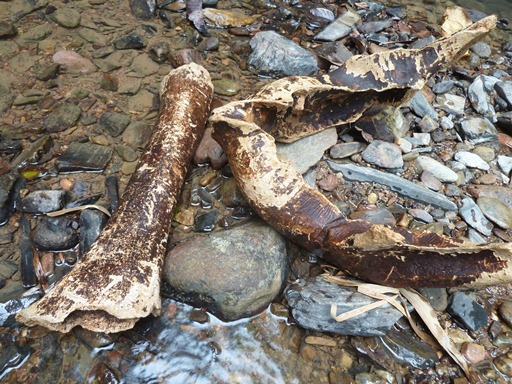
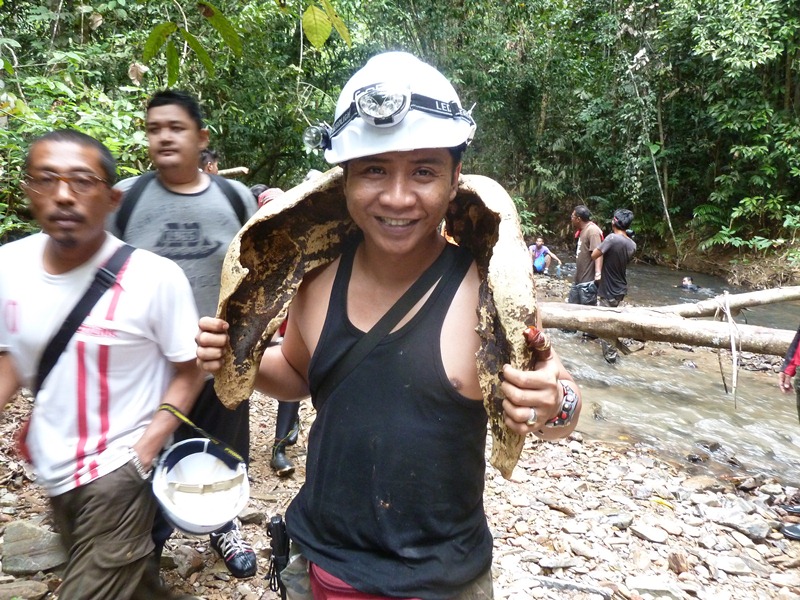
When we visited Gua Hari Malaysia in Feb 2013, we found a lower jaw and a leg bone from an elephant. I wonder if all the bones came from the same elephant.


The leg bone

The bones were taken back to the Merapoh hostel

© Liz Price
No reproduction without permission

25 September 2012

Merapoh 2012 - pt 8, cave fauna

During the caving expedition in Merapoh we saw a variety of cave fauna. Here are a few of the critters that we found. Frogs and toads were quite common.
These are all Phrynoides aspera

This pretty frog is Hylarana labialis

We saw cave racers in 3 caves. One had more of a yellow colour than the other two. Two were coiled up on ledges so it was not easy to get photos.

Normally crickets are common in Malaysian caves, but these caves in Merapoh had very few of the common Diestrammena crickets. This is a large species
Whip spiders (Amblypygids) were quite common.


Gua Jinjang Pelamin had quite a lot of scorpions, probably a Lychas species
The one above is eating a cockroach and the one below is eating a newly moulted spider

There were long legged centipedes, Thereuopoda
Huntsman spiders, this one is missing a leg
and this one is sitting on an egg sac
A web spider, probably Psechrus

There were very few millipedes


Of course there were bats in most of the caves. The majority were insect eating bats.


There were goat droppings in several caves (above). And in Gua Gajah Merah we saw elephant droppings -
Termite trails going around one cave entrance
and these tunnels seem to be made by ants, not termites

I saw lots of gecko eggs, but no geckoes
A (bird) nest


Outside one cave we saw bear prints in the soil

There were lots of yellow shells outside the caves, Amphidromus atricallosus perakensis (thanks to Reuben Clements for ID)


© Liz Price
No reproduction without permission