sign in a cave in Laos
Showing posts with label whip spider. Show all posts

26 February 2014

Cave fauna in lava tubes in Vietnam

The lava tubes we explored in south Vietnam are quite rich in cave fauna, mainly invertebrates. We were based in Than Phu, in Dong Nai province, about 125 km northeast of Ho Chi Minh City in south Vietnam. We were there in February which is the dry season and the whole area was incredibly dry.

We saw very little fauna above ground, just the occasional lizard. There was far more life underground, in the cooler and damper lava tubes. However the tubes are quite warm compared to limestone caves.

There was no water in any of the tubes we visited, though some had damp mud. Many had roots coming in through the ceiling and walls.

There were surprisingly few bats in these lava tubes, though there was evidence that they had been hunted, as there were many wooden poles and nets lying around in various caves.

We saw a variety of invertebrates.
Spiders were always noticeable by their eye shine in our lights. In many caves they were throughout the cave, but in the longest cave they were only seen near the entrance. They are Sparassidae: Heteropodinae (thanks to Peter Jaeger for the ID) -


Web spiders were far fewer in numbers.

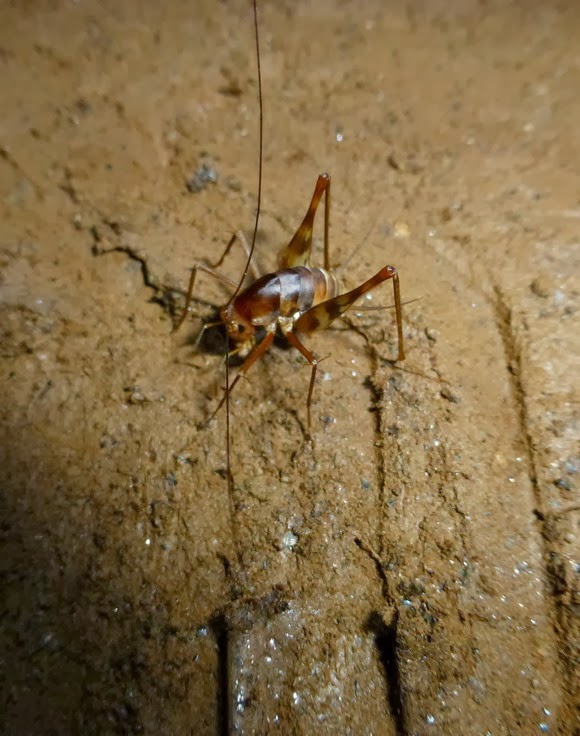
I saw 2 types of cricket -


They are probably Rhaphidophoridae , Subfamily Aemodogryllinae .

I only saw a couple of long legged centipedes. They are a different colour from those in Malaysia.
This one was climbing up tree roots -


Whip spiders were particularly common -
One was identified by Michael Seiter as Phrynichus orientalis.

This was a dead one being eaten by millipedes -


 And another live one -

There were also whip scorpions (Uropygi) -


Millipedes were only seen in 2 caves.
Jean-Jacques Geoffroy (France) identified them as belonging to the family Cambalopsidae. The genus could be Glyphiulus or Plusioglyphiulus (or even Trachyiulus or Hypocambala).

Cockroaches were only seen in one cave. That cave was close to houses so they could have come from there. They are Periplaneta Americana

There were surprisingly few frog species. These tiny little guys - Micryletta inornata - were cute and quick to hop away from the camera  -

 This larger one - Polypedates leucomystax - was close to an entrance (thanks to Lee Grismer for frog ID) -

I was looking for scorpions but saw none. The only ones we came across were these large ones found when digging open a cave -

Some mammals use the caves. In several caves I saw rats, with white chests, Niviventer spp. .
I'm think this is one as well -

This might be a rat -

This skull may be a dog

Porcupine also use the caves and the locals put traps at the entrances to catch them. This is a quill -
These droppings could be from porcupine -

A pile of droppings covered in fungus, note the polished rock above the droppings-

In one cave the locals collected the porcupine droppings to use as fertilizer.

Bats were less numerous than expected. All were insect eating bats. As there were signs of the locals trapping them in nets, maybe that accounts for less bats than a year ago when some of the cavers visited (at the same time of the year). Surprisingly the most bats seemed to be in a cave with very bad air. This cave was also particularly warm. And at the entrance we saw quite a few dead bats, Pomona Roundleaf Bat (Hipposideros pomona) -


There are 6 bats flying in this photo -


Surprisingly I only saw 1 gecko in the caves , Cyrtodactylus -


See more on the lava tubes :

Part 1 Gia Ray area

Part 2 Than Phu area

Shapes of lava tubes

© Liz Price
No reproduction without permission

4 December 2012

Whip spider mother and babies

This is my first sighting in a cave of a whip spider with babies. Whip spiders or amblypygids are arachnids.
ambly = blunt, and pygi = rumps
Unlike true spiders which have 8 legs, with whip spiders the first pair of legs has developed into long whiplike feelers that are three to four times longer than the remaining three pairs of legs.

Having been caving in Merapoh a few times  recently, I have noticed that there are a lot of whip spiders in the caves. They are of the genus Stygophrynus.

It was very exciting to see this mother with her babies on her back. After the eggs hatch, the babies climb onto the mother's back.


This is a close up of the young. The pink 'strings' are the legs of the babies. The babies are newly moulted and are not yet fully pigmented and sclerotised.


The whip spider was seen in Gua Hanuman in Merapoh.

See more pictures on this site.

© Liz Price
No reproduction without permission


Merapoh 2012 Nov, Pt 5

On the 2nd day, we tried to find Gua Jebuk, but didn't find any caves after a morning of searching. We had parked at an orang village and the men there said there were no caves.

After lunch we went to some un-named hills on the east side of the road and had better luck, finding some nice caves.

Gua Sungai Babi had lots of pig footprints in the mud. There were sacks of guano. A small river went through the cave.


We then climbed up the cliff using tree roots to haul ourselves up and walked into probably the largest cave on the hill.

The chambers were huge, cathedral like. We named it Gua Hanuman. Guano had been extensively dug from the cave and there were dozens of sacks still in place, more than 10 years old.


There are the remains of a wire cable outside, used for getting the sacks down the cliff.
There are some nice formations inside the huge chambers.

 Yellow nuggets!


This is the rock that looks like the Hindu monkey god Hanuman

This is the Hanuman statue at Batu Caves -
We saw a mother whip spider carrying her babies on her back. This is the first time I have ever seen this in a cave . See more on the whip spider.

A nice series of stal and a calcite water urn !

 Back at the entrance
We went on to the next hill. Found a nice river cave, the river cuts through a corner of the hill and has created a great phreatic passage. We named the cave Gua Hantu Menari, as the silhouette looks like a friendly dancing ghost.


millipede

                                 the smoking ledge !

 bird nest


The last cave of the day was Gua Patung Kembar. Habli's photos -


See previous day, Bukit Katak.

© Liz Price
No reproduction without permission