I wrote this article for the Brunei Times, Jan 11, 2009 .
Rock art in Perak's limestone caves
Gua Tambun & Naga Mas
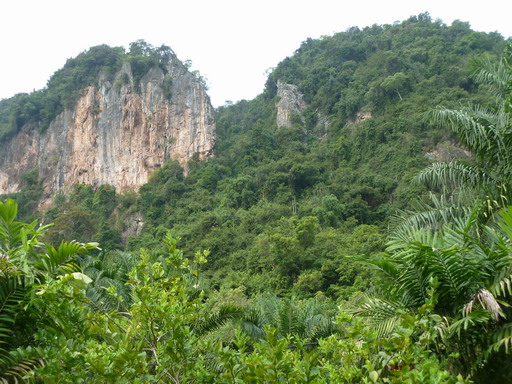
Tambun cliff
THE state of Perak in central Malaysia has some important cultural and natural relics. The cultural antiquities are seen in the form of rock paintings, the natural ones are the fossil bones of a big cat. These two sites are an important part of Perak's heritage, but nothing is done to protect either site.
The Perak Heritage Society recently held an outing to these locations, to get interested people together in the hope that something can be done to preserve these places. On my earlier visits to both sites, I had found the access steps to be very overgrown. So it was a pleasant surprise on this trip to find that the staircases to both places had been very recently cleared. There was even a new gravel path leading to the Tambun staircase, so we were able to avoid all the muddy and swampy land. Presumably some official entourage had been here very recently.
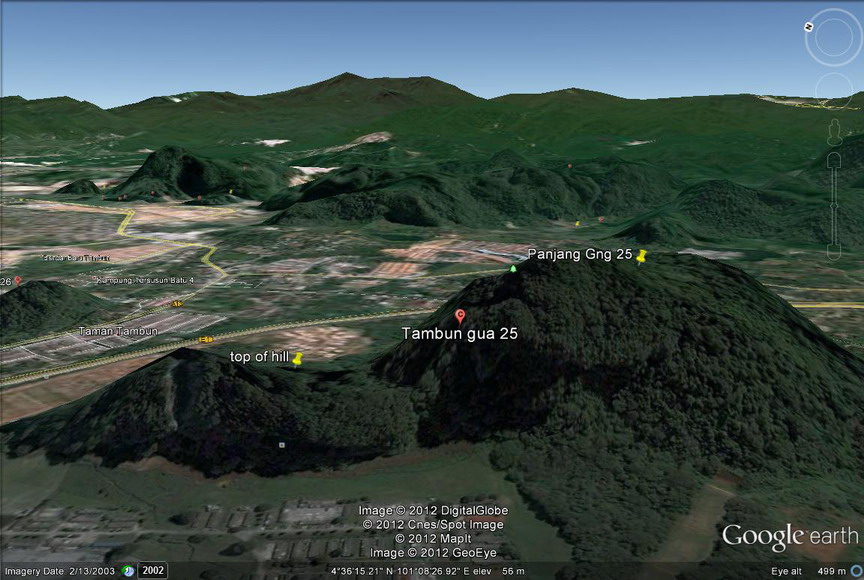
The ancient rock paintings are found on a limestone cliff at Tambun, east of the city of Ipoh. These paintings were discovered in 1959 by Lt Rawlings and at the time were the only known coloured paintings in Malaya. They differ from the more recent charcoal drawings made by the "Orang Asli".
Rawlings found a wide ledge about 30m above the valley floor. The limestone cliff towers above this ledge and it was on the rock face that he noticed the paintings. The pictures depict men and animals, and were reported then to be in colours of dark purple and dull red. However today, due to exposure to the elements, such as wind, rain and sun, the reds have faded and become more orange in colour. The paintings are estimated to be around 2,000 years old. Some of the animals are easily identified, such as a civet, deer, wild boar and a "tapir". There is also a prominent painting that looks like a "dugong", although others suggest it could be a giant catfish.
There are not many pictures of people, although one man is shown with long genitalia. Other shapes are not really understood, one could be a bunch of bananas. It is not known for sure the medium used to create these paintings. It was originally assumed to be hematite, which is found in the area, but now the suggestions leads towards natural pigments from fat, blood or iron oxide. As the paintings are all much higher than the present day floor level, it is not known how ancient man was able to reach so high up on the cliff. In Australia it is thought that the Aborigines built scaffolding to do their rock art.
The Tambun paintings do show that humans were living in the Kinta Valley during this period. They may have been farmers rather than hunters and gatherers and it is thought that the animals they drew were the ones they saw and probably ate.
From ancient paintings we turned our attention to some fossil bones. Gua Naga Mas, south of the city of Ipoh, is a cave situated in a small limestone hill. In 1992 some people from the Malaysian Nature Society were visiting the cave and noticed some bones in the ceiling.
The vertebrate bones are about five metres above the floor and are embedded in travertine. Further studies revealed that they are probably the remains of a large cat, such as a tiger or leopard. These observations were made on the shape and size of the bones, and a lower premolar tooth was recognised as belonging to a big cat. The skeleton is about 98cm long, and although it is not easy for the layman to clearly make out the bones, the scientists have been able to identify each of the parts. A rough estimate suggests they are 10,000 years old.
Since the discovery more than 15 years ago, no detailed studies have been made on the bones, and the identity and age are still not known for sure. It is the only such fossil known in Malaysian caves.
The vertebrate bones and rock paintings are both unique parts of Perak's prehistory, and hopefully they will last for the eons to come.
© Liz Price
No reproduction without permission
See more on my website
Caves of Malaysia and more on
Gua Tambun rock paintings.