sign in a cave in Laos
Showing posts with label archaeology. Show all posts

20 January 2025

Inauguration of Leang-Leang Archaeological Park, Sulawesi

 VOI - Waktunya Merevolusi Pemberitaan 14 Jan 2025 had this article "Symbol Of World's Oldest Civilization In The Archipelago, Minister Fadli Zon Inaugurates Leang-Leang Archaeological Park". 

"The Minister of Culture of the Republic of Indonesia, Fadli Zon, inaugurated the Leang-Leang Archological Park and the Prehistoric Image Information Center in the Maros-Pangkep karst area, South Sulawesi. This inauguration is a symbol of the Ministry of Culture's commitment to preserving cultural heritage, as well as affirming the position of the archipelago as the center of the oldest civilization in the world."

See article to read more.

13 November 2023

Oldest human fossils found in Vietnam

 The VnExpress on 2 Nov 2023 reported on "Vietnam uncovers oldest human remains". 

Skeletal human remains dating back 10,000 years have been found in a cave, making them the oldest human fossils ever unearthed in Vietnam. The remains were found last March at the Tam Chuc Pagoda Complex in Kim Bang District, in the northern province of Ha Nam.

At the Tam Chuc complex, archaeologists discovered three graves of children and adults, with the people buried in a kneeling position. There were also mollusc shells and teeth bones of small animals, which could have been food sources for ancient people. There were sea molluss shells along with stream snails. At the top of the mountain they found pieces of pottery lying alongside mollusc pieces.

At 10,000 years, these are the oldest human remains to be found in Vietnam. This means they date back to the late Pleistocene to late Holocene age, or 10,000-12,000 years ago.

Excavations at two caves in Kim Bang revealed prehistoric paleontological and material culture remains including animal fossils and reddish-brown rope pottery fragments belonging to the Dong Son culture. Dong Son was a Bronze Age culture in ancient Vietnam centered in the Red River valley of northern Vietnam from 1000 BC until the first century AD.

Photo taken from VnExpress -


21 September 2020

Guar Kepah skeleton, Kedah, Malaysia

Not cave related, but still interesting. 

A human skeleton was found at the construction site of the Guar Kepah archaeological gallery in Kedah, on 17 April 2017. Guar has nothing to do with a cave, and the word doesn't translate into English. 

The skeleton was sent to Florida where it was dated at 5,710 years old, which makes it Neolithic. Scientists also found the person had eaten a shellfish diet. Photo taken from Borneo Post -


In addition to the skeleton, a 5.49 m high shell midden was found at the base of the site. This contained artefacts such as pottery, stone tools and food remnants. The finding of this midden revealed the human burial process in the Neolithic age. It is the only evidence of a burial under a shell midden in Malaysia.

The only other skeleton found of a similar age was Perak Woman found in Lenggong in Perak, but this one was buried in a cave. It was dated at 8000 years old. 

Guar Kepah historic site is older than the Bujang Valley and Sungai Batu in Kedah, and is the only location in Peninsular Malaysia which shows evidence of ancient human settlements close to the sea.

See more on the Guar Kepah skeleton in NST and the shell midden in Malay Mail 2013 .


17 May 2017

Penang Woman dated at 5710 years old

Although not cave related, I am posting it as it is archaeological and refers to human remains.

Human remains were found when the area was dug up to lay the foundations for the Guar Kepah Archaeological Gallery, Kepala Batas, near the Penang-Kedah border, about 28km from Butterworth. The bones were found in April 2017 and radiocarbon dated in the US, giving an approximate age of 5710 years. Further samples have been sent to Denmark and will take 6 months for results.

The sex of the bones isn't confirmed, but they have been called "Penang Woman".

Read more on The Star 13 May 2017.

16 April 2015

Little Foot & Lucy v Perak Man and Niah skull

Malaysia's oldest human remains are the skull at Niah, dated at about 40,000 years, and the complete skeleton of Perak Man which is about 11,000 years old. See my website.
The oldest 'confirmed' site of  human inhabitation in Malaysia is in the Lenggong Valley in Perak, said to be 200,000 years old (Bukit Jawa). And there is the controversial Bukit Bunuh meteor impact site that Malaysians claim to be 1.86 million years old, although as far as I am aware, no scientific reports have been published since the find in 2000.

Even if the age of Bukit Bunuh is correct, it is still far younger than the finds made in Africa.

The most famous African fossil is Lucy, from Ethiopia, a species of Australopithecus afarensis.

Little Foot, a member of the species Australopithecus prometheus / Australopithecus africanus, was found in the 1990s in the Sterkfontein Caves in South Africa. The nearly complete Little Foot fossil skeleton has recently been re-dated with new techniques and is roughly 3.7 million years old. It was the hardened sediments surrounding the fossil that gave this reading. If the skeleton is the same age, this means South Africa has the oldest existence of human evolution! However there is the possibility that the skeleton itself is not as old as the sediments that surround it.

Both species blended ape-like and human-like traits but with different features. They lived about the same time. However Lucy herself lived about 500,000 years later than Little Foot. Little Foot is also female and according to researchers, was bigger and taller than Lucy.

Little Foot has well over 90% of its bones intact, whereas the Lucy skeleton is only 40% complete and lacks a head.

They both come under the Homo genus. Our species of Homo, Homo sapiens, only appeared about 200,000 years ago.

It is interesting that at least two Australopithecus species lived at the same time in different parts of Africa, about 3.67 million years ago. Maybe there are more waiting to be found...........

See full reports in Nature (published online 1 April 2015 and Nat Geog News.

Archaeology at Krabi, Thailand

The popular tourist destination of Krabi in southern Thailand is surrounded by limestone hills and islands and there are many caves. It is also an archaeological site. I've blogged about it a few times. 

There was an interesting article in the Bangkok Post travel section on 7 April 2015, "Krabi's hidden wonder. The province is home to several major archaeological sites, some of which are under threat from human activity ".

It is worth seeing the whole article,
Krabi's hidden wonder | Bangkok Post: travel

And my blogs on caves and areas mentioned in the article, see my links in the labels list on the right of the page, Krabi, Phi Hua To tham, Bokkhorani .

9 October 2014

Sulawesi cave paintings now older than first thought

Exciting news about the age of the cave paintings at Maros in Sulawesi, Indonesia. They are now said to be older than first thought.

I saw some of these paintings in 1994. My blog on Cave of Hands and an article I wrote for The Star.


The paintings at Leang Burung 2 were originally dated by Glover to between c.31,000-20,000 BP. The paintings are quite well known and include red ochre hand stencils and paintings of animals such as babirusa - an endemic wild suid [Encyclopedia of Caves and Karst Science, 2004].

Now Dr Maxime Aubert of Griffith University, Queensland, Australia has redated the paintings. The oldest is at least 40,000 years old. The minimum age for the hand stencil is 39,999 years old, which makes it the oldest hand stencil in the world. The babirusa or pig has a minimum age of 35,400 years. Other paintings are 27,000 years old, which means the inhabitants were painting for at least 13,000 years.

Until now, paintings this age have only been known from caves in Western Europe.

These new dates for the Sulawesi caves mean that ideas about our evolution will have to be revised. Maybe art came out of Africa, not from Europe.

In northern Spain, cave paintings at El Castillo have been dated at 37,300 years old (41K). They are similiar to the ones at Bone, which is 100 km north of Maros. The famous paintings of animals at Chauvet Cave in France are about 37,000 years old. Some Australian rock art is thought to be of a similiar age but the dates are not confirmed. The oldest confirmed Australian rock painting is 27,000 years old at the Arnhem Land site of Nawarla.

The Maros ages were determined by measuring ratios of isotopes of uranium and thorium in tiny stalactites that had formed on top of the paintings.

The paintings at Bone could not be dated because the stalactite growths do not occur.

The scientific paper was published in Nature 514, 9 Oct 2014.

Other refs :

SEAArch

BBC    (it is worth watching the video on this link)

 Australian Geographic

The Guardian 

National Geographic


© Liz Price
No reproduction without permission


27 March 2013

Lenggong archaeological gallery, again

Went back to Lenggong Musuem again - or I should say gallery, as that is now its new name.


New sign on the junction to the museum


However at the museum, the new signs have not been put up yet - there is still a blank white space below the roof
 the old name -


It has been 6 months since my last visit (see link above) and 8 months since I posted a general blog.

The upstairs gallery is now open. However it is not especially exciting, it is just a series of posters of Malaysian World Heritage sites and many posters on how Lenggong achieved its recognition. There are just 3 small display cabinets and a video.


There was one "politically correct" poster showing people praying for Lenggong to be inscribed as a World Heritage, and shows people of 4 religions praying - Muslims, Christians in a church, Chinese in a temple and Indians -


At least all the posters are recent and mention Bukit Bunuh at 1.83 myo (unlike the displays downstairs).


As usual the English on the posters wasn't proofread and there are mistakes.

© Liz Price
No reproduction without permission

29 July 2012

Bukit Jawa, Lenggong, 2012

I first visited Bukit Jawa in 2007.

Bukit Jawa is the oldest Paleolithic site in Malaysia along with the neighbouring Temelong and Lawin areas. It has been dated at around 200,000 years old. It is located at Kampung Gelok, about 7 km north of Lenggong in Perak. It is not cave related.

On 30 June 2012 the Lenggong Valley was listed as a UNESCO World Heritage site. I visited Bukit Jawa again on 20 July 2012.

There had been a few changes over the 5 years. I was surprised to see a large wooden shelter
whereas on my previous visit a simple attap roof just covered the dig site
The simple 6 runged wooden ladder had gone and a more elaborate wooden staircase with hand rails had replaced it, BUT this was in pieces and roped off.
We had to walk up the slope on the left side of the building. The dig site was the same
but there was no fence around it as there was in this 2007 photo
I wondered why such a large shelter had been built, considering the dig only occupied a very small area.
There was a notice inside but it was quite hard to read in the relative dark and it was hard to take photos with the reflective surface
There were many signs of termites attacking the wood
and I wondered how long the structure would last, considering the stairs have already broken in less than 5 years. Also the concrete supports for the posts seem to be just placed on sand, and I wonder how long they will last.

Considering Bukit Jawa is such an important place in Malaysia's prehistory, and now that Lenggong has got World Heritage status, it is such a pity that this site is not maintained.

© Liz Price
No reproduction without permission

28 July 2012

Archaeology in Perak Darul Ridzuan Museum

The Perak Darul Ridzuan Museum is located in the city of Ipoh, in Perak, Malaysia.
The museum building was originally the house of a rich tin miner. Ipoh developed due to tin. The museum used to have a collection of historical artifacts on tin mining.

In early 2012 the museum was closed for a while for upgrading and to turn it into the Perak Archaeological Museum. This was in the expectation of Lenggong Valley getting Unesco World Heritage status. This listing was declared on 30 June 2012.

The museum is now open again and a large area is devoted to the archaeology display. The newly renovated interior is bright and with good displays and lighting.

Universiti Sains Malaysia agreed to hand over archaeological items found in the Lenggong Valley to be exhibited at the museum.
Stone tools in chronological order, but no information on what they are.

The displays are in Bahasa Malaysia and English.
There are good video presentations
The museum information is up to date and features all the recent finds, unlike the Lenggong Museum, which does not mention Bukit Bunuh.
A display of stone tools -


There is a replica of the Perak Man skeleton. Talking to the caretaker, he told us that this is the real skeleton. However the real one is on display in the National Museum in Kuala Lumpur. Although there are calls to take 'him' home to Lenggong.
The caretaker also told me that Perak Man had been tortured and then tied up. It is a pity that the staff are not trained about the exhibits.

The central hall features rock paintings and some of the Tambun drawings are displayed on easels
There are many video displays. Fortunately the sound was controlled so they were not a nusiance
The upper floor features more modern times. Sadly there is not much on display about tin mining, no lumps of tin ore etc. However outside is a display of tin mining equipment.
Lumps of tin ore (photo taken in 2006).

In the entrance hall is a large time chart, from the beginnings through to current times.
Unfortunately, the 2nd and 3rd entries have been switched and are therefore showing against the wrong dates!!!


© Liz Price
No reproduction without permission

4 July 2012

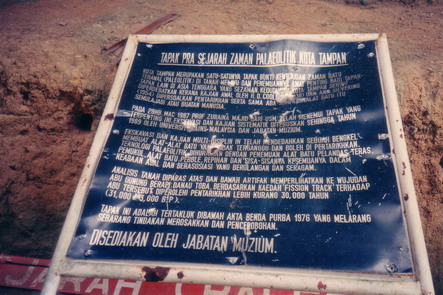
Kota Tampan, Lenggong, Malaysia

Kota Tampan, although not a cave site, is an important archaeological site in Malaysia. It is located in the Lenggong Valley in Perak, Malaysia. The Lenggong Valley was listed as a UNESCO world heritage site in June 2012.

Archaeologists digging at Kota Tampan unearthed evidence of a 34,000-year-old pre-historic workshop for making stone tools. Excavations revealed an undisturbed stone tool production area, where pebble tools were made. Some 50,000 pieces of stone were found. The age of the site was redated at 75,000 years. In 1992 Kota Tampan was was considered the earliest known site of human inhabitation in Malaysia.

Kota Tampan is located about 5 km south of Lenggong. I visited the site in January 1994. There was not much to see, apart from a small dig covered by a roof in the middle of an oil palm plantation.
Entrance to the site
The information sign was rather battered and just propped up at the back of the hut


It looked like nothing was being done to preserve the site. And apparently when the Lenggong Musuem was constructed, it was built over the Kota Tampan site!!!!

© Liz Price No reproduction without permission

1 July 2012

Bewah & Taat caves, Kenyir, Terengganu

In November 1999 I went to Tasik Kenyir in Terengganu to survey some caves. I went with cavers from the Malaysian Nature Society. We had been invited by Ketengah to look at the caves with a view to them being developed for tourism.

Since our visit, Ketengah (Terengganu Tengah Development Authority) has come up with various ideas to improve tourism and develop Kenyir Lake.

Tasik Kenyir is the largest man-made lake in Southeast Asia. The area was flooded between 1978 and 1985 as part of a hydro electric scheme.

After flooding many of the hilltops and highlands remained above water level, creating about 340 man-made islands.

Before the creation of the lake there were several caves and some of archaeological importance. However after flooding most were lost underwater.

There are 2 caves still accessible and these have been developed for tourism. Gua Bewah is the largest and is located in Bukit Bewah. Gua Taat is nearby. Both are located at the southern end of the lake.
Our visit started at Pengkalan Gawai (Gawai jetty) which is the main gateway to Tasik Kenyir.
We loaded our equipment and supplies onto a houseboat,

but we travelled by speedboat for a fast ride of 70 minutes to Bukit Bewah.

Bukit Bewah and the area to the south is actually within Taman Negara, the national park. We went to have a look at the back (west side) of the hill before going back around to Gua Bewah on the east side.
The floating jetty at Gua Bewah was sitting on top of a large rock, presumably left there are some high water levels. From the boat we could smell the guano in the cave. It was quite a hike up all the steps to the entrance about 40 m up the hill.
Old sacks of guano showed that people used to enter the cave to collect guano, and the sacks on the floor made a convenient staircase. The cave is basically one huge chamber. At the back is another big chamber and a pitch down but would need bolting. There was the remains of electric lighting. We surveyed the cave, it is only about 150 m long.

The archaeological digs are in the left corner of the entrance.


We could hear the bats but they were too high to see. Other fauna included lots of crickets, large huntsman spiders, large cockroaches with a blue end and some large crabs.

Gua Taat is in the hill across from Bewah and has 2 entrances.
The main entrance was reached by a wooden step ladder which would be underwater during high water levels. The entrance is quite small and low and the cave floods easily. Again there are archaeological pits in the floor by the entrance. The cave was first dug in 1959.

A passage with flat roof leads to a second entrance. There was no cave fauna.
We had a quick look at Gua Taat 2 which is basically a rock shelter.

On our caving days we used a small speedboat to get to the caves
and this was our houseboat
We slept in chalets at Tanjung Mentong.

UPDATE

Since our visit in 1999 there have been many plans for Kenyir. Gua Bewah has now been more developed for tourism. See my friend Jan's photos from June 2012.

See more on cave archaeology at Kenyir, including the remains of Bewah Man found in 2010.

© Liz Price

No reproduction without permission