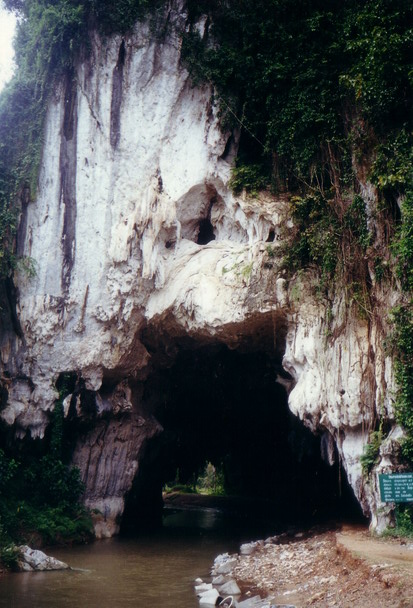
In the 1990s I went caving in Yala province on several occasions. One cave I visited several times was Tham Krachaeng.
At the time (1993) Tham Krachaeng was the 6th longest cave in Thailand (now it is 7th) at 5,633m. It is located near Ban Than To in Yala province. Ban Than To is roughly halfway between Yala and Betong on route 410[6].
There are two main entrances, the side entrance sink, Tham Lod, and the
resurgence, Tham Krachaeng. By road these are 10 km apart.
To reach Tham Krachaeng resurgence, you walk through Krachaeng Arch which is a 100m long natural arch.
View from inside
Having gone through this cave, turning to the right, steps lead up to the Buddhist temple which was constructed in 1995. The cave consists of one large chamber, and a climb at the back leads up to a tunnel about 20m long.
However Tham Krachaeng is straight ahead following the river. The entrance is blocked by gours so you have to climb up and over them. The large river passage can be followed to a boulder choke and a route up leads to the continuation of the passage and then the confluence with Tham Lod.
Tham Lod is a sink and a 620m long passage leads to the main confluence. This passage is very flood prone and great care should be taken during the rainy season.
There are huge tree trunks and branches and other debris. I even saw banana plants struggling to survive
and coconuts that were shooting - note they have been deposited on a high ledge at least 2 m above the floor
The water is deep in some areas
The place where the water sinks is some distance away and is impenetrable
See more on the ACG expedition 2000.
© Liz Price
No reproduction without permission
Pictorial blogs on some of the interesting caves I have visited around Southeast Asia. On some blogs I have included photos taken over the years.
Although this blog was only born in 2011, I have now included older posts from my Multiply blog which closed in March 2013. This includes articles I have written. I am now also adding news relating to caves I have a particular interest in.
See my website on Caves of Malaysia.
sign in a cave in Laos
Showing posts with label Yala. Show all posts
29 January 2012
25 December 2011
Wat Khuha Phimuk, Yala, Thailand
Wat Khuha Phimuk, also called Wat Na Tham, is a cave temple in Yala province.
It is about 5 km west of Yala, lying to the south of the 409 Yala to Hat Yai road near Na Tham.
I've been there twice, in 1993 and 2000.
Stairs lead up to the main cave temple and in 1993 the dragon handrail looked quite new.
The 1st pic was taken in 1993, the next 2 in 2000
The statue is large as you can see people at the base in 2 photos.
The cave is full of Buddhas of different kinds including a fat Chinese one, one wearing a crown, some less attractive ones and a thin one.
The last Buddha was seen in 2000.
The main Buddha is reclining and 24.5 m long. This is believed to have been constructed in 757 A.D. and is of Sivichaya style Reclining Buddha.
There is a nice marbled floor but lots of bats mean the floor gets covered in guano.
Further along the hill is Shop Cave, just a small chamber with Buddhas and a Goddess of Mercy.
And walk a bit more and you reach the main cave. It is very extensive and maze like. It is electrically lit but is not used as a temple. The stal is old and dry but the floor is damp.
There is a second entrance by the lake and there are statues of Chinese mandarins. When I was back in 2000 this cave was locked.
© Liz Price
No reproduction without permission
It is about 5 km west of Yala, lying to the south of the 409 Yala to Hat Yai road near Na Tham.
I've been there twice, in 1993 and 2000.
Stairs lead up to the main cave temple and in 1993 the dragon handrail looked quite new.
The 1st pic was taken in 1993, the next 2 in 2000
The statue is large as you can see people at the base in 2 photos.
The cave is full of Buddhas of different kinds including a fat Chinese one, one wearing a crown, some less attractive ones and a thin one.
The last Buddha was seen in 2000.
The main Buddha is reclining and 24.5 m long. This is believed to have been constructed in 757 A.D. and is of Sivichaya style Reclining Buddha.
There is a nice marbled floor but lots of bats mean the floor gets covered in guano.
Further along the hill is Shop Cave, just a small chamber with Buddhas and a Goddess of Mercy.
And walk a bit more and you reach the main cave. It is very extensive and maze like. It is electrically lit but is not used as a temple. The stal is old and dry but the floor is damp.
There is a second entrance by the lake and there are statues of Chinese mandarins. When I was back in 2000 this cave was locked.
© Liz Price
No reproduction without permission
3 September 2008
Krachaeng, Yala (caves Thai www)
THAM KRACHAENG, YALA
By Liz Price, 2002
Tham Krachaeng is the 6th longest cave in Thailand at 5633m long and is situated near Ban Than To in Yala province. Ban Than To is roughly halfway between Yala and Betong on route 410. From Betong it is 79 km by the old road, 62 km by the new one. Than To is a small town with a strong Moslem influence. It has a hospital and a fisheries department. Khao Tham Krachaeng is a large limestone hill to the north, and Bang Lang National Park lies to the northwest. This is an area of tropical rain forest.
The Tham Krachaeng system is situated near Ban Than To. More than 5 km was explored and surveyed during 1993 by British, Australian and Malaysian cavers, resulting in a length of 5516m. Only the active part of the system was explored and a high level fossil passage was seen but not entered. In December 2000 some British and German cavers pushed a side passage, the cold water inlet, but were only able to survey 117m as the following day the cave was in flood. There are two main entrances, the side entrance sink, Tham Lod, and the resurgence, Tham Krachaeng. By road these are 10 km apart. The main river sink is situated a few kilometres away south of Ban Than To, near Ban Pu Yut, but is impenetrable to cavers. Tham Krachaeng survey
Tham Lod entrance - From Ban Than To go north about 5 km to Bang Lang National Park. A few metres south of the bridge before the park, turn right and follow the track for about 2 km, turning left at a small bridge. The track ends at the river which leads to the cave. Tham Lod is a sink and a 620m long passage leads to the main confluence. This passage is very flood prone and great care should be taken during the rainy season.
Tham Krachaeng entrance - go north from Ban Than To, through Ban Ka Sod, then right following the signs. Krachaeng Arch is a 100m long natural arch. Follow the river upstream to the main cave entrance. The entrance is blocked by gours so you have to climb up and over them. The large river passage can be followed to a boulder choke and a route up leads to the continuation of the passage and then the confluence with Tham Lod. The upstream Krachaeng water is noticeably warmer than that in Tham Lod. The cave is generally a straight line passage running S - N. It is constantly large and has some fine flowstones and gours. The upstream boulder choke has been pushed 3 times but remains impenetrable. We have tried to enter the cave from the upstream side where the river sinks, but again this is impenetrable.
Notes - There are 2 spellings used : Krachaeng and Krasang. The river caves are very flood prone as they are part of the catchment for the Bang Lang park. The caves should be avoided during unsettled weather. The monsoon season here is Dec - Jan.
Other caves: Tham Wat Krachaeng, aka Tham Morakhot (Emerald Cave) Go through Krachaeng Arch. Steps lead up to the Buddhist temple which was constructed in 1995. The cave consists of one large chamber, and a climb at the back leads up to a tunnel about 20m long. Upper Meditation Cave Situated above Tham Morakhot. A huge chamber slopes steeply up, and a wooden ladder leads up to a higher chamber which leads to a back entrance. This is used by the monk for meditation. There is a parallel passage with some fine formations. Tham Hma (Dog Cave) Just north of the Ban Lang Park, the entrance can be seen by the left side of the road. Cave was explored in 2000 and is about 120m long.
Nearby attractions : Bang Lang dam - the first hydro-electric project in the southern region. There are magnificent views and recreation facilities including fishing. Bang Lang National Park - includes the 9- tiered Than To waterfall. Sakai Village - a village inhabited by indigenous people. There is a small museum and souvenir shop.
Posted on Caves of Thailand www by Dean Smart and Matt London, 2001.
By Liz Price, 2002
Tham Krachaeng is the 6th longest cave in Thailand at 5633m long and is situated near Ban Than To in Yala province. Ban Than To is roughly halfway between Yala and Betong on route 410. From Betong it is 79 km by the old road, 62 km by the new one. Than To is a small town with a strong Moslem influence. It has a hospital and a fisheries department. Khao Tham Krachaeng is a large limestone hill to the north, and Bang Lang National Park lies to the northwest. This is an area of tropical rain forest.
The Tham Krachaeng system is situated near Ban Than To. More than 5 km was explored and surveyed during 1993 by British, Australian and Malaysian cavers, resulting in a length of 5516m. Only the active part of the system was explored and a high level fossil passage was seen but not entered. In December 2000 some British and German cavers pushed a side passage, the cold water inlet, but were only able to survey 117m as the following day the cave was in flood. There are two main entrances, the side entrance sink, Tham Lod, and the resurgence, Tham Krachaeng. By road these are 10 km apart. The main river sink is situated a few kilometres away south of Ban Than To, near Ban Pu Yut, but is impenetrable to cavers. Tham Krachaeng survey
Tham Lod entrance - From Ban Than To go north about 5 km to Bang Lang National Park. A few metres south of the bridge before the park, turn right and follow the track for about 2 km, turning left at a small bridge. The track ends at the river which leads to the cave. Tham Lod is a sink and a 620m long passage leads to the main confluence. This passage is very flood prone and great care should be taken during the rainy season.
Tham Krachaeng entrance - go north from Ban Than To, through Ban Ka Sod, then right following the signs. Krachaeng Arch is a 100m long natural arch. Follow the river upstream to the main cave entrance. The entrance is blocked by gours so you have to climb up and over them. The large river passage can be followed to a boulder choke and a route up leads to the continuation of the passage and then the confluence with Tham Lod. The upstream Krachaeng water is noticeably warmer than that in Tham Lod. The cave is generally a straight line passage running S - N. It is constantly large and has some fine flowstones and gours. The upstream boulder choke has been pushed 3 times but remains impenetrable. We have tried to enter the cave from the upstream side where the river sinks, but again this is impenetrable.
Notes - There are 2 spellings used : Krachaeng and Krasang. The river caves are very flood prone as they are part of the catchment for the Bang Lang park. The caves should be avoided during unsettled weather. The monsoon season here is Dec - Jan.
Other caves: Tham Wat Krachaeng, aka Tham Morakhot (Emerald Cave) Go through Krachaeng Arch. Steps lead up to the Buddhist temple which was constructed in 1995. The cave consists of one large chamber, and a climb at the back leads up to a tunnel about 20m long. Upper Meditation Cave Situated above Tham Morakhot. A huge chamber slopes steeply up, and a wooden ladder leads up to a higher chamber which leads to a back entrance. This is used by the monk for meditation. There is a parallel passage with some fine formations. Tham Hma (Dog Cave) Just north of the Ban Lang Park, the entrance can be seen by the left side of the road. Cave was explored in 2000 and is about 120m long.
Nearby attractions : Bang Lang dam - the first hydro-electric project in the southern region. There are magnificent views and recreation facilities including fishing. Bang Lang National Park - includes the 9- tiered Than To waterfall. Sakai Village - a village inhabited by indigenous people. There is a small museum and souvenir shop.
Posted on Caves of Thailand www by Dean Smart and Matt London, 2001.
Subscribe to:
Posts (Atom)