sign in a cave in Laos

28 July 2012

Archaeology in Perak Darul Ridzuan Museum

The Perak Darul Ridzuan Museum is located in the city of Ipoh, in Perak, Malaysia.
The museum building was originally the house of a rich tin miner. Ipoh developed due to tin. The museum used to have a collection of historical artifacts on tin mining.

In early 2012 the museum was closed for a while for upgrading and to turn it into the Perak Archaeological Museum. This was in the expectation of Lenggong Valley getting Unesco World Heritage status. This listing was declared on 30 June 2012.

The museum is now open again and a large area is devoted to the archaeology display. The newly renovated interior is bright and with good displays and lighting.

Universiti Sains Malaysia agreed to hand over archaeological items found in the Lenggong Valley to be exhibited at the museum.
Stone tools in chronological order, but no information on what they are.

The displays are in Bahasa Malaysia and English.
There are good video presentations
The museum information is up to date and features all the recent finds, unlike the Lenggong Museum, which does not mention Bukit Bunuh.
A display of stone tools -


There is a replica of the Perak Man skeleton. Talking to the caretaker, he told us that this is the real skeleton. However the real one is on display in the National Museum in Kuala Lumpur. Although there are calls to take 'him' home to Lenggong.
The caretaker also told me that Perak Man had been tortured and then tied up. It is a pity that the staff are not trained about the exhibits.

The central hall features rock paintings and some of the Tambun drawings are displayed on easels
There are many video displays. Fortunately the sound was controlled so they were not a nusiance
The upper floor features more modern times. Sadly there is not much on display about tin mining, no lumps of tin ore etc. However outside is a display of tin mining equipment.
Lumps of tin ore (photo taken in 2006).

In the entrance hall is a large time chart, from the beginnings through to current times.
Unfortunately, the 2nd and 3rd entries have been switched and are therefore showing against the wrong dates!!!


© Liz Price
No reproduction without permission

Gunung Panjang climb to new cave

Gunung Panjang is a large limestone hill in the Kinta Valley, near Ipoh in Perak, Malaysia. Panjang is best known for the rock paintings at Gua Tambun - although the drawings are actually on a cliff face, not in a cave.

In the past Gunung Panjang has been mined for iron ore. There was an iron mine on the northwest side, around the area where the paintings are. And in several places the red colour can be seen on the rock face.
At the end of 2011 I was told that a man living in the housing estate at the base of the northeast side of the hill had found a cave. In Dec 2011 I went with Hong to see if we could find it. However we didn't know the location and it was a bit daunting looking at the steep hill
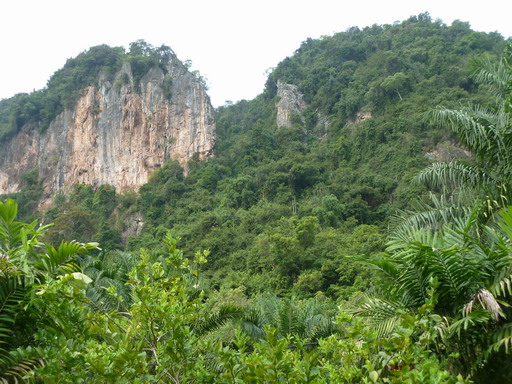
We bashed our way through the vegetation upto the base of the cliff but found nothing, so gave up. In July 2012 we returned, this time led by Brett, the guy who found the cave. This is the view of the area from his house
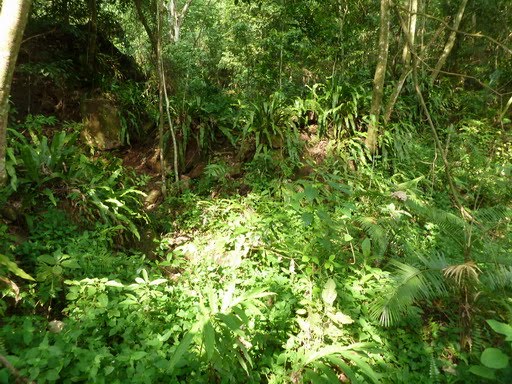
The trail starts in the park
Almost immediately we had to start climbing. The route was very steep. Thankfully Brett had brought along some secateurs which he used to remove rattan and other thorns and creepers. This really helped.
We entered the gap in the hill and went on up to a tunnel. This tunnel was used by the miners, presumably to extract the iron ore from the wang inside. There are still signs of cables on the hill, it seems the miners hauled their machinery up the hill and blasted the tunnel to access the wang.
These shot holes show the tunnel has been blasted.
View into the wang from the tunnel We went down into the wang heading towards the cave in the left wall. It was more or less across on the other side
The cave entrance is rather small. It leads to a passage which slopes down to a drop which I couldn't descend without a rope. There were some nice crystals
View looking up to the entrance. We made our way back, checking one wall for caves but found nothing. There were some monophyllaea on the wall

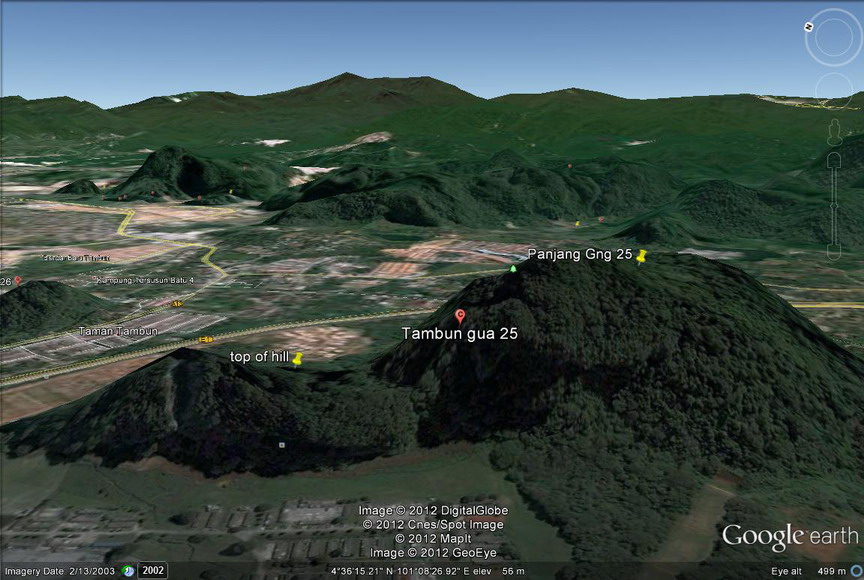
These google earth images show roughly where we went, almost across the hill from the rock paintings


I named the cave Panjang Wang Cave.

© Liz Price
No reproduction without permission

27 July 2012

Lime kilns in Perak, Malaysia

Last week I had an interesting visit to some old fashioned lime kilns in Perak, Malaysia. The kilns are used to make quick lime.

Quick lime is produced by heating limestone. Today most companies use state-of-the-art high tech modern lime kilns to make the quick lime. However in Perak there are still some old fashioned, cottage industry type lime kilns.

Limestone is CaCO3. Quick lime or burnt lime is calcium oxide (CaO). It is white, alkaline and crystalline. It is made by the thermal decomposition of limestone in a lime kiln. It needs to be heated above 825°C .

CaCO3 + heat = CaO + CO2

In the Bercham area, north of Ipoh in Perak, Malaysia, there are still working lime kilns. There are 2 rows of kilns.
The open area in front of the kilns housed the logs for burning, quick lime stones and bags of the finished product, the quick lime.

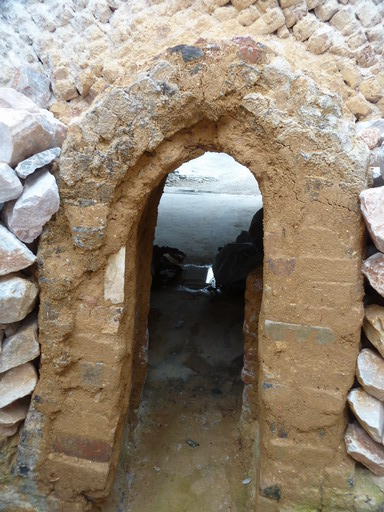
There are 3 kilns in a row. A short tunnel leads via a low access arch to a circular brick lined kiln. The brick work was amazing. Such orderly patterns. The fire bricks looked smaller than normal house bricks.

The shafts seem almost circular. The arch in the second kiln was made of red bricks.

Men carefully stack the limestone at the bottom of the kiln, building up the domed layers, which gradually slope in, with a timber centre. Once the layers meet in the middle they can then throw down more limestone from the top.
Air has to pass freely to provide combustion and the layers need to maintain their shape throughout the burning process to avoid collapse. Wood is used to produce the heat. Excessive temperatures product unreactive "dead burned" lime. Extra wood could be fed in through the access tunnel. Lumps of CaO fall to the bottom.
The arch in the third kiln -


The process is quite slow -
5-6 days to stack the kiln
1 week to burn
3 days to cool
remove the lime on the next day.

We went up to the top to see the loading area.
This photo is looking straight down -
Piles of limestone waiting to be used
and reject quicklime that has not burnt properly

UPDATES
These kilns stopped working sometime in 2013.

See blog on more lime kilns in Perak, at Gunung Panjang. These kilns have been abandoned for some time.

© Liz Price No reproduction without permission

------------------------------------------------------------------------------------------------------------------------

6 comments:

  1. You look like a Greek Kore...:-)
    ReplyDelete


  2. Very interesting!
    Do they load the kilns from the top or through the entrance tunnel?
    ReplyDelete


  3. They start loading from the bottom, building up the layers which gradually slope in, till they meet in the middle, then when they've reached a certain height, they add the rest of the stones from the top.
    ReplyDelete


  4. My relative lives in Bercham Garden. I didn't know anything about this. What is it for anyway ?
    ReplyDelete


  5. To make lime, which is used in a lot of industries , for building and engineering materials , waste water treatment, etc.
    ReplyDelete