Gua Bama is a small limestone hill in the Kuala Lipis area of Pahang, Malaysia.
I visited the hill in Oct 2001. It is located near Kg Relong, about 10 km NW of K. Lipis.
A large opening can be seen from the distance.
There is a separate small hill at the north end.
Concrete steps go up through the valley separating the hills.
Gua Bama is a single high chamber, almost circular. It is an old archaeological dig site. There are lots of bats, as well as cockroaches and crickets.
This suspension bridge is near the waterworks.
We then drove round to Gua Sai
There are lots of bats
These peaks at Gua Sai have been damaged by quarrying.
Reading more recent blogs, it seems Gua Bama is a tourist attraction but has been neglected, and also has a lot of rubbish and graffiti.
Gua Bama register number Phg 15/01, Gua Sai Phg 16/01.
© Liz Price
No reproduction without permission
Pictorial blogs on some of the interesting caves I have visited around Southeast Asia. On some blogs I have included photos taken over the years.
Although this blog was only born in 2011, I have now included older posts from my Multiply blog which closed in March 2013. This includes articles I have written. I am now also adding news relating to caves I have a particular interest in.
See my website on Caves of Malaysia.
sign in a cave in Laos
23 January 2012
11 January 2012
Gua Kelawar, Langkawi, Malaysia
Gua Kelawar or Bat Cave is a popular show cave on the holiday island of Langkawi, in Kedah, Malaysia.
To reach the cave you have to go by boat, and it is a very scenic journey.
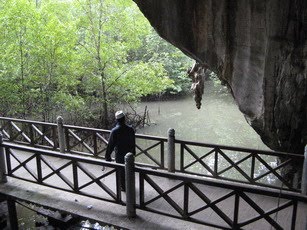
As our boat headed up a tributary of the Kilim River, we could see a wooden boardwalk running alongside a cliff face and disappearing into a cave entrance.
A wooden jetty led to a shelter with an information board. The cave is actually a tunnel through the hill, and despite the large numbers of human visitors, is still home to a sizable colony of bats.
As soon as we entered the cave, we could hear the squeaks of the bats and the rustle of their wings. As far as I could see, the bats were all insect eating bats.
The population in Gua Kelawar wasn’t so big, and according to the locals there are less now than in previous years. Maybe the human visitors have taken their toll after all and the bats have moved to other quieter caves.
The cave was quite dry although I could see it would get wet in the rainy season. The boardwalk means visitors don’t have to step into the mud or the guano on the floor.
I saw a gecko that had lost its tail
© Liz Price
No reproduction without permission
To reach the cave you have to go by boat, and it is a very scenic journey.
As our boat headed up a tributary of the Kilim River, we could see a wooden boardwalk running alongside a cliff face and disappearing into a cave entrance.
A wooden jetty led to a shelter with an information board. The cave is actually a tunnel through the hill, and despite the large numbers of human visitors, is still home to a sizable colony of bats.
As soon as we entered the cave, we could hear the squeaks of the bats and the rustle of their wings. As far as I could see, the bats were all insect eating bats.
The population in Gua Kelawar wasn’t so big, and according to the locals there are less now than in previous years. Maybe the human visitors have taken their toll after all and the bats have moved to other quieter caves.
The cave was quite dry although I could see it would get wet in the rainy season. The boardwalk means visitors don’t have to step into the mud or the guano on the floor.
I saw a gecko that had lost its tail
© Liz Price
No reproduction without permission
Boat trip to Gua Kelawar, Langkawi, Malaysia
To get to Gua Kelawar on the main island of Langkawi you have to take a boat. There are around 100 islands in the Langkawi group off the coast of Kedah in northern Malaysia. They have been listed as a Geopark. The main island is called Langkawi and has a lot of limestone and caves.
Gua Kelawar is situated a tributary of the Kilim River. To reach this, it is a scenic journey by boat, past mangroves and limestone hills.
My friend Dr Ghani had arranged a boat for us
We started in a small stream which led to a bigger river.
On the main river
The limestone hills are quite majestic
There are many sea eagles and tourist boats feed them with scraps of chicken.
Some of the hills are round, others have pinnacles
See Gua Kelawar.
© Liz Price
No reproduction without permission
Gua Kelawar is situated a tributary of the Kilim River. To reach this, it is a scenic journey by boat, past mangroves and limestone hills.
My friend Dr Ghani had arranged a boat for us
We started in a small stream which led to a bigger river.
On the main river
The limestone hills are quite majestic
There are many sea eagles and tourist boats feed them with scraps of chicken.
Some of the hills are round, others have pinnacles
See Gua Kelawar.
© Liz Price
No reproduction without permission
7 January 2012
Geckos in Malaysian caves
I sometimes see gecko eggs in caves in Malaysia, and much less often, see the actual gecko.
Geckos are commonly seen in houses in Malaysia, where they are called cicaks, due to the call that they make.
The cave geckos belong to the genus Cyrtodactylus, commonly known as bent-toed geckos.
These geckos were seen in caves in Perlis
Eggs
This one in Perak
and some eggs
These photos were taken in Dark Cave at Batu Caves
---------------
Update :
3 new species of gecko have been found in and around Merapoh caves by Dr Lee Grismer. See article in The Star on 3 Sept 2013, "In search of herps".
---------------
© Liz Price
No reproduction without permission
Geckos are commonly seen in houses in Malaysia, where they are called cicaks, due to the call that they make.
The cave geckos belong to the genus Cyrtodactylus, commonly known as bent-toed geckos.
These geckos were seen in caves in Perlis
Eggs
This one in Perak
and some eggs
These photos were taken in Dark Cave at Batu Caves
---------------
Update :
3 new species of gecko have been found in and around Merapoh caves by Dr Lee Grismer. See article in The Star on 3 Sept 2013, "In search of herps".
---------------
© Liz Price
No reproduction without permission
5 January 2012
Tham Khao Kob or Thale Cave, Trang, Thailand
In 1999 I visited some caves in Trang province in southern Thailand. One memorable cave is Thale Cave, also called Khao Kob and also Tham Lae.
From Trang town we drove approx 40 km north towards Huai Yod. We first visited Tham Khao Pina. Next was Tham Lae which was more commonly called Tham Thale. The cave dissects the hill and seemed to be surrounded by a canal, so is a big meandering river cave.
It was a private show cave and the trip by boat was Bt200 for an 8 seater boat. We had 2 guides, one spoke some English.
The cave is electrically lit. We paddled in then at various sections we had to get out onto walkways to look at the lower chambers. Everything was covered with gooey mud. We had to walk barefoot in one section because the mud was sucking our sandals off!
The chambers are very impressive, some packed with helictites and long straws and there were some long straws coming from thick white stals.
Quite amazing. There were lots of bats in the lower chambers.
We went through 420 m of very low passage where we actually had to lie down in the boat. It was fun but not a cave to do in the wet season!
Then we went to an upper chamber, very different from the lower ones, dry with no mud, no straws or helictites.
We did a circular route which took an hour.
In 2003 I found a leaflet for the cave which was then called Tham Khao Kob or Le Khao Kob Cave.
© Liz Price
No reproduction without permission
From Trang town we drove approx 40 km north towards Huai Yod. We first visited Tham Khao Pina. Next was Tham Lae which was more commonly called Tham Thale. The cave dissects the hill and seemed to be surrounded by a canal, so is a big meandering river cave.
It was a private show cave and the trip by boat was Bt200 for an 8 seater boat. We had 2 guides, one spoke some English.
The cave is electrically lit. We paddled in then at various sections we had to get out onto walkways to look at the lower chambers. Everything was covered with gooey mud. We had to walk barefoot in one section because the mud was sucking our sandals off!
The chambers are very impressive, some packed with helictites and long straws and there were some long straws coming from thick white stals.
Quite amazing. There were lots of bats in the lower chambers.
We went through 420 m of very low passage where we actually had to lie down in the boat. It was fun but not a cave to do in the wet season!
Then we went to an upper chamber, very different from the lower ones, dry with no mud, no straws or helictites.
We did a circular route which took an hour.
In 2003 I found a leaflet for the cave which was then called Tham Khao Kob or Le Khao Kob Cave.
© Liz Price
No reproduction without permission
Subscribe to:
Posts (Atom)