STAR
LifestyleHome > Lifestyle > Travel & Adventure
Saturday March 13, 2010
Hushed Hpa An
By Liz Prize
Away from the madding tourists, Cambodia’s Hpa An is a quiet town unaffected by development with plenty of temples and caves to explore.
I normally try to avoid eating Malaysian food when I’m overseas. So when my friends suggested going for a roti canai in the heart of Myanmar, I was a bit reluctant. Luckily, by the time we had found a hotel, got our rooms, had a shower and gone out to eat, the roti shop was closed.
So we had to look elsewhere. The only shops still open were those selling Burmese food, so we chose one that had the best selection of dishes in the window. It was obviously a Muslim restaurant, so I was surprised when the man who came to take our order asked if we wanted beer.
We ordered one each. Then I was even more surprised when the man recommended pork. I was also taken aback when I found he could speak a little Bahasa Malaysia, because he had worked in Malaysia before. We were in Hpa An which is the capital of the Kayin state in southern Myanmar. Many parts of Myanmar are still off-limits to foreigners, and although it is possible for tourists to go to Hpa An, very few do.
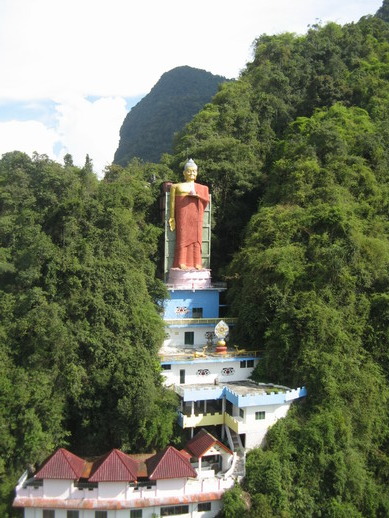
Kyaukkanlatt Lake Pagoda atop a karst tower. — LIZ PRICE
It’s a reasonably quiet town, with no high-rise buildings and not much traffic. It has a rural feel as ox carts and trucks laden with vegetables mix with an assortment of other vehicles of all ages and states of dilapidation.
The town centre has a large clock tower and one set of traffic lights. As with many towns, Hpa An’s busiest place is around the market, which is overlooked by the large red mosque. There are mosques, churches, chedi, and Chinese and Indian temples reflecting the diverse faiths practised here.
Some streets have Chinese restaurants, and there’s a small Indian section that includes the roti shop. The rest of the eating places seem to serve Burmese food. Fortunately, western-styled fast food hasn’t arrived here.
Hpa An lies on the banks of the Salween River (also known as Thanlwin). We wandered down to the river bank and found it to be a busy place with long boats going back and forth across the river, carrying people and market produce. There was a group of men playing volleyball. It was only 7.30am but people get up around 5am in these parts.
The sun was shining brightly by then and there were stunning views across the river of an imposing limestone mountain topped by a chedi. In fact, there are several limestone hills in the area, and each one has at least one chedi on top and usually a few more on the lower slopes. Some of these hills have impressive caves.
Saddan Cave is one of the most famous. It takes its name from a royal elephant that was close to the Buddha. There are two stone elephants at the base of the entrance stairs. You have to remove your shoes before entering the temple compound, sometimes at the car park. By the time we reached the main temple, our feet were dirty but nobody minded too much.
A flight of steps leads up to the cave, and the large entrance chamber contains a big reclining Buddha. Once you have passed the Buddha, you are allowed to put on your shoes again to explore the rest of the cave, which is quite long. We were lucky as the electric lighting was turned on, and we were able to appreciate the beauty of the cave.
Saddan is a fine cave, and goes through the mountain, with the far end overlooking a small lake.
Another well known cave temple is Kaw Ka Taung. Outside the compound, a long line of monk statues leads to the cave, which has lots of Buddhas. A group of locals arrived when I was there, and the resident monk switched on a tape of Christmas songs which was a bit incongruous in a Buddhist temple! I also noticed that many of the Buddha statues showed Buddha with his head tilted to the right, which I had not seen in other Buddhist countries before.
Each morning, before setting off for the caves, we would go to the market to buy lunch. I enjoyed going here as there was so much to see. The taxi stand was right in front of the mosque and consisted of a row of ancient-looking Mazdas. I wondered if they actually moved as they seemed to be there every day.
I noticed there was a collection of long red-and-white striped poles, and at the top of each was a hook and sheet of metal. Our guide told us this was firefighting equipment — a beater for the flames, and the hook was to pull away blazing timbers. As we walked round, I noticed that many buildings had such a pole outside.
The market was similar to others across Asia, with stalls selling fresh, dry and tinned foods, meat, fish, fruit and vegetable. There was an Indian area selling rice and spices, and another section for household products. Although there were only three of us, it always took ages to buy our food, as we’d get distracted and wander off to take photos.
Since we had hired a van and driver for our stay, we were able to choose our itinerary each day. One place we had to see was the archaeological site of Kaw Gon. This is a seventh century site, also known as Cave of the Ten Thousand Buddhas. Ten thousand is probably an exaggeration, but there were certainly hundreds of stone tablets carved high on the walls of the rock cliff, and there are Buddhas everywhere.
It’s the only place we visited that charged an entrance fee for foreigners — 3,000 kyat (US$3). As our car had been acting up due to dirty fuel, the driver placed incense sticks on the car wiper arms while we were in the temple.
The Hpa An area is dominated by Mt. Zwegabin (722m) and an impressively long karst ridge. Zwegabin is considered a sacred hill, and as with most hills in the area, it has many chedi and shrines and a pathway up to the top. We saw one hill near Thaton absolutely covered with white chedi. Some of the hill ranges have extensive forest cover whereas other outcrops have scant vegetation. Some of them have literally hundreds of chedi or stupa.
One colourful cave temple with hot springs around the base is Bayin Nyi Cave. As we parked the car, a few ladies tried to sell us cold drinks, snacks and souvenirs, so we knew this was a popular site. A shaded path runs alongside a pool and leads to the hot springs. There is a separate bathing area for men and women. The temple complex has a pool and lots of statues of various kinds and colours.
We agreed it was a really colourful place, and were amused by the macaques running around looking for food. One or two were sitting on the heads of the statues to eat their tidbits. Steps lead up to the cave, which also has many brightly coloured statues. The caretaker monk outside the entrance spent his time chasing away the macaques when they got too close.
Driving back to the hotel one evening at dusk, we were lucky enough to see a Thaipusam festival in a very small village. We had just missed the fire-walking but were in time to see the procession to the temple. It was quite tame compared to Batu Caves as there were no piercings, but the music and dancing of the devotees were enthralling. And the villagers seemed happy enough for three foreigners to walk amongst them and were willing to have their photos taken.
The last place of interest we visited in the Hpa An area was Kyaukkanlatt Lake Pagoda. This is an impressive solitary karst tower surrounded by manmade lakes. There is a pagoda on the tower and steps leading to the small temple halfway up. There were lots of white egrets flying around and settling on the islands, and the impressive Zwegabin mountain is right behind, forming a nice backdrop.
One of the best things about our visit to the Hpa An was the lack of tourists. We probably saw fewer than a dozen during our stay, and most of those were part of expensive tour groups. Hpa An is certainly a beautiful part of Myanmar, with some great scenery still unaffected by the developed world.
Getting there
The only direct flight from Malaysia is with MAS from Kuala Lumpur to Yangon. Alternatively AirAsia flies to Bangkok and then Thai AirAsia, Air Mandalay and Bangkok Air fly to Yangon.
VISA
Citizens of Malaysia residing in Malaysia must apply for a visa at the consulate of Myanmar in Kuala Lumpur (8C, Jalan Ampang Hilir, 03-425 16355). There is an express same day service, or a cheaper three day service. The 28-day visa is dated from the day of application, so don’t apply for it too early.
MONEY
Myanmar’s currency is the kyat. Foreign travellers are required to pay in US dollars for hotels, tourist attractions, rail and air tickets, ferry travel and sometimes for bus tickets as well, and are required to pay in kyat for most other transactions (trishaws, pickups, tips, food etc.). Take enough money to last as there are no ATMs and credit cards are rarely accepted. Take dollars or Euro in a range of denominations, and make sure the notes are in good condition.
COMMUNICATION
You won’t be able to use your handphone as foreign phones don’t work in Myanmar.
o For tourism info, visit the Myanmar Tourism Promotion Board, Traders Hotel, Level 3 — Business Centre, #223 Sule Pagoda Road, Yangon, Myanmar, Tel: (95 1) 242 828, fax: (95 1) 242 800, e-mail: mtpb@mptmail.net.mm or thwe@tradersyangon.com.mm or visit
http://www.myanmar-tourism.com/
---------