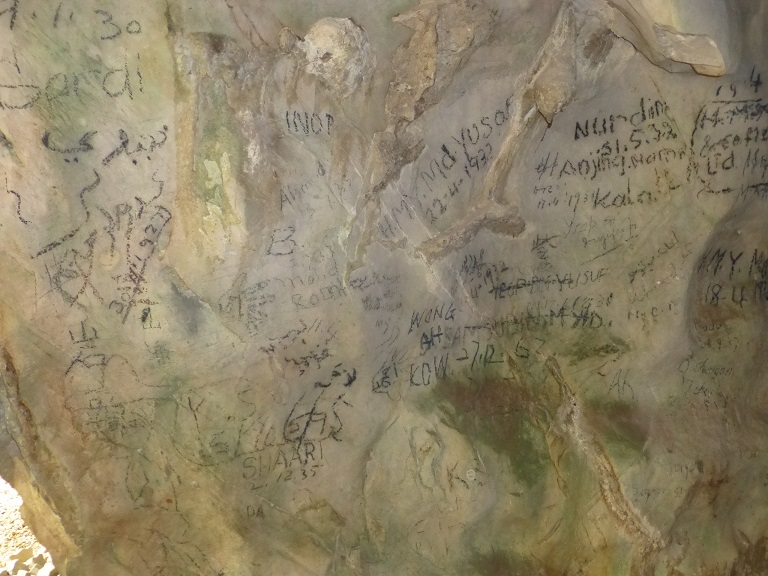
sign in a cave in Laos

28 April 2019

Chinese and Japanese writing in Perak caves

The Star on 27 April 2019 had an article "Japanese, Chinese writing dating back to 1913 found in Tambun's Gunung Datok cave".

The article, by Manjit Kaur, says writing believed dating back to 1913 has been found inside Gunung Datok in Tambun. This would pre-date WW1 and is from the Japanese Taisho period.

I first visited Gua Datuk in 1991 but don't have any photos of the graffiti.

Other caves in the Kinta Valley have a mix of Chinese and Japanese writing, which I was told by a Japanese friend Menju, that the writing is Kanji. Kanji means Chinese characters in Japanese. In the Japanese writing system, the characters are adopted from Chinese ones. Caves on the west side of Gunung Lanno show these characters. Although much of the graffiti there dates between 1930-50.

Gua Pulau (Prk 18/16) and Gua Batu Nesan (Prk 18/17) and Gua Selari (Prk 18/15) all have graffiti. My friend Law Siak Hong translated some Chinese characters as "continue to fight the battle" and "may our comrades continue to strive [for the cause]". There are also lot of names - Chinese, Malay and Sikh, also police.


There is also what we guess to be war graffiti, of a soldier shooting a man

See my more detailed blog about these caves, "Lanno revisited" in 2013.

© Liz Price
No reproduction without permission

--
This is the majority of the Star article :
"Japanese and Chinese writing believed dating back to 1913 has been found inside Gunung Datok in
Tambun near here.
State Tourism, Arts and Culture Committee chairman Tan Kar Hing said the inscriptions that were written in charcoal mentioned the year 1913 and the Taisho period.
"1913 is even before World War 1. We believe soldiers were at the cave probably as intelligence troops.
However, we need more experts to come down and have a look, especially the Japanese embassy," he said.
He said the cave is located within the Banjaran Hotsprings Retreat.
"However, we will be writing to the embassy, and we will get experts to tell us what the writing is
about," he added.
The Taisho period in Japanese history dates from 1912 to 1926, coinciding with the reign of the Emperor Taisho."

7 April 2019

Bomb-making equipment inside Krabi cave, & birds nests

Birds' nest caves in SE Asia are generally owned by local people and are carefully guarded to protect the valuable nests.

In March 2019 there was a mine explosion in a birds'  nest cave in Phang Nga Bay, Thailand. On March 20 The Thaiger reported "Investigation into mine explosion on a Phang Nga Bay bird’s-nest concession island". There was an explosion at a bird’s-nest concession area in Phang Nga bay, where two men were killed. The island is Koh Lao Dua, 6 km north of Koh Yao Noi. The mine had been planted in the beach, in a concession area that was out of bounds. The Nation Mar 19 "Investigation under way after lethal blast  in Phang-nga bird’s-nest concession area".

And in another incident also in Krabi area a week later -

The World News 28 March, "Bomb making equipment discovered in Krabi cave" -


Krabi officers have discovered bomb-making equipment inside a cave in Krabi.

Officers raided the cave on Koh Talu in Ao Lueak, Krabi after they found that the cave is part of an area of a company who received a concession to produce and farm bird nets.

Two men died from their injuries after stepping on mines along the shores of a nearby island last week that was also being used for the farming of bird nests.

Officers found 44 year old Chocknapat Khunkam and an 18 year old teenager in the cave. They told police that they had been hired to guard and protect the bird nets inside the cave.

Police also found bomb-making equipment inside the cave. The two men told police they didn’t know anything about that equipment. They have now been taken to Ao Lueak Police Station where they were charged with illegal possession of bombs and ammunition. Police are continuing their investigation.

At this stage police believe that items seized might be linked to the mine explosions at a bird’s-nest concession island in Phang Nga bay last week.

6 April 2019

Tin dredge in Selangor, 2019

I have posted a few times in the past about the tin dredge in Selangor, close to KLIA.

I was interested to see this article, "Anyone interested in buying Selangor’s tin dredge?" in Free Malaysia Today, published on 23 March 2019. My blog is mentioned in the article.

And the FMT article first appeared in The Thrifty Traveller's blog, "Selangor Tin Dredge", posted in 2017.

It seems that over the years, nothing has been done towards selling or preserving the dredge.

5 April 2019

Gua Air Mata Dayang, Merapoh, video

We found Gua Air Mata Dayang in Merapoh, Pahang, Malaysia, in Nov 2012. It is a water cave and now used for tube "rafting".

This is a video of exploring the cave, on youtube.

27 January 2019

Hand stencils, rock art, Anthony Gormley BBC2

An interesting documentary on BBC2 by British sculptor Anthony Gormley. Gormley is probably best known for his "Angel of the North" statue. In the documentary, he was investigating the age of art, having originally thought that Europe had the oldest art - from the cave paintings in France and Spain.

This is taken from the BBC2 webpage -
"Why do humans make art? When did we begin to make our mark on the world? And where? In this film, Britain's most celebrated sculptor Antony Gormley is setting out on a journey to see for himself the very beginnings of art.

Once we believed that art began with the cave paintings of Ice Age Europe, tens of thousands of years ago. But now, extraordinary new discoveries around the world are overturning that idea. Antony is going to travel across the globe, and thousands of years back in time, to piece together a new story of how art began. He discovers beautiful, haunting and surprising works of art, deep inside caves across France, Spain and Indonesia, and in Australian rock shelters. He finds images created by hunter-gatherers that surprise him with their tenderness, and affinity with the natural world. He discovers the secrets behind the techniques used by our ancestors to create these paintings. And he meets experts making discoveries that are turning the clock back on when art first began.

Finally Antony asks what these images from millennia ago can tell us - about who we are. As he says, 'If we can look closely at the art of our ancestors, perhaps we will be able to reconnect with something vital that we have lost."

I was particularly interested in the hand stencils, these are found on 3 continents. Firstly Gormley showed those in  Pech Merle Cave in France. Photos taken from the Pech Merle webpage -


Gormley spoke to French archaeologist Michel Lorblanchet, who has suggested that the application of the paint for some of the paintings was probably by means of a delicate spitting technique. He says the 200 black spots had the charcoal (?) applied this way, as well as the 6 hand stencils. Lorblanchet then demonstrated making his own hand stencil on a rock outside, by chewing charcoal and gently spitting onto the rock. It took about 45 minutes. The paintings are actually deep in the cave, the ancient artists would have used light from fire, and then used charcoal from the fire for their paintings.

Gormley talks about how Neanderthals are usually considered to have inferior mind and didn't produce cave art. He went to El Castillo Cave in Spain, and talked to Professor Alistair Pike, who has worked on dating techniques. There are 40 hand stencils in this cave. Some of these red stencils are now covered with calcite, dated at 37,000 years. 40,800 for the red dots. The calcite arrived after the stencils were made. These are some of the oldest of European paintings and most have been done by Neanderthals. Pike also worked at Maltraviso Cave in west Spain, where there are many hand stencils, and found calcite deposits on the stencils dating to older than 66,000 years old. This is 25,000 years before humans arrived in Spain, so must have been done by Neanderthals.

This shows art was done earlier than first thought. And was done by Neanderthals, not humans.

Gormley then went to Sulawesi, in Indonesia. Cave art has been found here, and was done at the same time as the paintings in Europe, but the people presumably had no contact. He met Maxine Aubert and sees more hand stencils. Unfortunately many of the paintings have disappeared over the last 30 years as parts of the rock surface have fallen off, probably due to pollution.

I saw some of these paintings in 1994. My blog, Cave of Hands. The babi rusa was probably painted with a brush.

They go on to Leang Timpuseng, with a babi rusa painting, dated at minimum 35k years old, as well as a hand stencil dated at 40 k, minimum . The babi rusa would be the world's oldest figurative art. There is now an archaeological dig in the cave.

So the Indonesian and Europe art is about the same age, done on opposite sides of the world. Is there similar art to be found in say Africa, India etc?

Next, Gormley went to the Kimberley in Australia. This has a huge variety of rock art, animals, plants and humans, but hasn't been properly dated yet. There are no paintings of humans in Europe, but there are in the Kimberley, showing humans "celebrating, and alive". There are also hand stencils.

As Gormley says, these separated communities of modern man left signs of being, a human need to express something. Whereas the practice of painting in Europe ended about 10 k years ago, in the Kimberley rock art is still a part of spiritual life. There is still a living connection.

--

BBC2 Antony Gormley: How Art Began,  2019, 73 minutes, official website.

6 December 2018

vale Daniel Gebauer and Dr Dieter Kock

Sadly, 2 Germans who were "involved" with Malaysian caves and bats have died in the past month.

The first I heard about was Herbert Daniel Gebauer, who died on 19 Nov 2018. Although Daniel caved mostly in the Indian subcontinent, and primarily in Meghalaya, he came to Malaysia in 1993. During his stay in Ipoh, we surveyed Gua Layang Layang as well as Gua Kelawar at Sg Siput Utara. Daniel also spent a few days surveying in Gua Tempurung and produced the first detailed survey of the cave.

Daniel came back one year later in Jan 1994 and this photo was taken in the river at Gunung Mesah, Daniel is on the left, and Liew Chin Chow on the right -

Daniel's papers relating to Malaysian caves :
GEBAUER H.D. 1994 Die Gua Tempurung im fengcong von Ipoh. Der Abseiler Jan 13, 37-43.
GEBAUER H.D. 1993 Die Gua Tempurung. Eine tunnelhohle in Perak. Mitteilungen des Verbandes der deutschen Hohlen und Karstforcher (Munchen) 39(4)84-92.
GEBAUER H.D. & PRICE Liz 1995 Gua Tempurung. JMBRAS 68(1)29-52.
PRICE Liz & GEBAUER H.Daniel 1996 Gua Tempurung, Perak. CSS Jnl, Jan, 23(5)105- 108. Reprinted  Oct, 24(1)14-16.


The second person I heard about was Dr Dieter Kock, who died on 28 Nov. Dr Kock worked in the mammals section of the Senckenberg Research Institute in Frankfurt. For many years I sent him bat skulls that I collected in Malaysian and other caves and he kindly identified them for me. We co-authored a paper, KOCK, D; ALTMANN, J & PRICE, L (2000) A fruit bat new to West Malaysia: Rousettus leschenaultii (Desmarest 1820) in Batu Caves. MNJ, 54(1)63-67.
In 2005 I took Dr Kock into Dark Cave at Batu Caves -


On that trip, we found a dead mother bat with a living baby still attached by the umbilical cord -


Thank you to both these men for their contribution to Malaysian caves and fauna!

9 November 2018

Oldest rock art of mammal in Kalimantan

In Nov 2018 it was revealed that the oldest animal drawing has been found in a cave in East Kalimantan. In Lubang Jeriji Saléh there are 3 cow-like creatures drawn on the walls and dated to 40,000. This makes them older than the babirusa drawings from Maros in Sulawesi, which are about 35,000 years old.


The drawings in Kalimantan are thought to be of banteng. Banteng, also known as tembadau, (Bos javanicus) is a species of wild cattle found in Southeast Asia. I have never seen one in the wild. They have been domesticated in places.

Also in the cave are many hand prints, dated at 52,000 – 40,000 years. See article in Nat Geog Nov 2018, and Nature.