The Croatia Malaysia Speleo Expedition to Merapoh took place 10-19 September 2012. Merapoh is in northern Pahang, just a few km from the Kelantan border. There are a lot of limestone hills in the area.
When the Croatian leader, Sinisa Jembrih, asked me for suggestions for a caving expediton, I suggested his team go to the Merapoh area, as very few of the caves have been documented. The Croatians linked up with Laili Basir in Malaysia, who organised the accommodation, food, transport and guides.
We stayed in the Taman Negara accommodation at Sg Relau at Merapoh. There were 9 Croatians, and myself, plus the Malaysians.
The first 2 days we all went together to explore known caves. Then on the following days, I did recce trips with Laili and local guides, whilst the Croatians surveyed the bigger caves. That way we had 2 or 3 teams working each day.
The first day we explored Gua Jinjang Pelamin, which the locals have already explored a few times this year. It has some nice formations, gour pools in the first section, then a stream passage, large chambers with lots of guano, and then a short swim across a pool to get to another entrance guarded by twin 16.5 m columns.
The cave fauna was varied - cave racer, toads, a terrapin, crabs, lots of bats and invertebrates such as scorpions, whip spiders, millipedes etc, as well as goat droppings.
The bat guano made some of the climbs very slippery
The next cave we visited was Gua Katak. This is a network of small interlinking passages, some of which have quite deep water.
And of course as the name suggests, there are frogs.
Both these caves were surveyed later in the week.
For dinner we drove the 7 km to Merapoh, and on most evenings visited Syukri's internet cafe to catch up on emails etc.
This is pt 1 of 8 pts of the Merapoh caves expedition.
part 2
part 3
part 4
part 5
part 6
part 7
part 8 cave fauna
Also more photos of Gua Katak taken in Nov 2012.
------------
UPDATE:
On 2 Feb 2013 we extended Gua Jinjang Pelamin when we found a new entrance and this passage links to the main river passage. See blog Feb 2013.
© Liz Price
No reproduction without permission
Pictorial blogs on some of the interesting caves I have visited around Southeast Asia. On some blogs I have included photos taken over the years.
Although this blog was only born in 2011, I have now included older posts from my Multiply blog which closed in March 2013. This includes articles I have written. I am now also adding news relating to caves I have a particular interest in.
See my website on Caves of Malaysia.
sign in a cave in Laos
25 September 2012
1 September 2012
Gua Badak drawings, Lenggong
Gua Badak, in Lenggong, ulu Perak, Malaysia, is home to some rock art. However this is modern art. The charcoal drawings were made by the Negrito aborigines, probably just over 100 years ago.
The drawings were found in the 1920s by Ivor Norman Evans and were also documented by P.D.R. Williams-Hunt in 1950. They were then thought to have been lost by quarrying before being "rediscovered" in March 1992. I first saw them in May 1992.
At that time the hill was clearly visible from the road,
but now (2012) it is more hidden by trees.
Lenggong Valley was listed as a World Heritage site in June 2012. The site is signposted from the road, but the sign near the hill has been vandalised
This is the 2007 sign -
The site is "closed off", but that didn't stop us!
There is a new pondok, but no information board
This is the signboard in 2007
The Negritos used the caves as shelters during hunting trips. The sketches depict tribal art such as animals, people, trees, mats, and even bicycles and motorcars. Apart from the charcoal drawings, they made white pictures by scrapping away the limestone rock.
These paintings have faded badly over the years, above taken in 1992 and below in 2012
The drawings are simple, featuring matchstick men. There is a man carrying a pole laden with coconuts. A bow and arrow symbolize the hunting tools which were replaced by the blowpipe. There are men on horses, a man with an elephant, a hunting party. Animals such as leaf monkeys, monitor lizards and porcupine all made for a good meal and were therefore illustrated.
View of the hill from the track to Gua Harimau
Gua Badak register number Prk 60/01.
See more on Gua Badak posted July 2011.
© Liz Price
No reproduction without permission
The drawings were found in the 1920s by Ivor Norman Evans and were also documented by P.D.R. Williams-Hunt in 1950. They were then thought to have been lost by quarrying before being "rediscovered" in March 1992. I first saw them in May 1992.
At that time the hill was clearly visible from the road,
but now (2012) it is more hidden by trees.
Lenggong Valley was listed as a World Heritage site in June 2012. The site is signposted from the road, but the sign near the hill has been vandalised
This is the 2007 sign -
The site is "closed off", but that didn't stop us!
There is a new pondok, but no information board
This is the signboard in 2007
The Negritos used the caves as shelters during hunting trips. The sketches depict tribal art such as animals, people, trees, mats, and even bicycles and motorcars. Apart from the charcoal drawings, they made white pictures by scrapping away the limestone rock.
These paintings have faded badly over the years, above taken in 1992 and below in 2012
The drawings are simple, featuring matchstick men. There is a man carrying a pole laden with coconuts. A bow and arrow symbolize the hunting tools which were replaced by the blowpipe. There are men on horses, a man with an elephant, a hunting party. Animals such as leaf monkeys, monitor lizards and porcupine all made for a good meal and were therefore illustrated.
View of the hill from the track to Gua Harimau
Gua Badak register number Prk 60/01.
See more on Gua Badak posted July 2011.
© Liz Price
No reproduction without permission
14 August 2012
Perak Woman, Gua Teluk Kelawar, Lenggong
Gua Teluk Kelawar is the cave where Perak Woman was found. Perak Woman is an 8000 year old skeleton, found in 2004. Perak Man was found in a nearby cave in 1991. Both caves are located in Bukit Kepala Gajah in Lenggong, Perak, Malaysia.
The Lenggong Valley was inscribed as a UNESCO World Heritage site on 30 June 2012. Before visiting the cave, we went to the Lenggong Museum. This has a feature on Gua Teluk Kelawar.
This is the entrance to the display - the name is written down the side wall
After lunch we went to see the cave. The cave is signposted from the road.
However we saw no more signs to Gua Ular (Snake Cave) so I don't know where it is or what it is and I don't think it is mentioned in any archaeological reports.
We parked at the end of the road and set off walking. At a junction we had the choice of straight or right. There was no sign. We went right. This was wrong! After quite a trek we ended up at Gua Ngaum. Wrong cave!
So we backtracked to the junction and took the other option. Walked through an orchard and came to a sign
We knew this was right as we reached the tall cliff face and this rather shabby sign
There was a small shelter and also a new rather large one
Inside the shelter is a new information board, made in the same style as those in neighbouring caves. They are very hard to read in the dark shelters, and with the reflective surface using a torch or flash doesn't help. And an army of mosquitoes soon made their presence known.
We had a good laugh when we read that reindeer were found here (!!).
Location of the cave
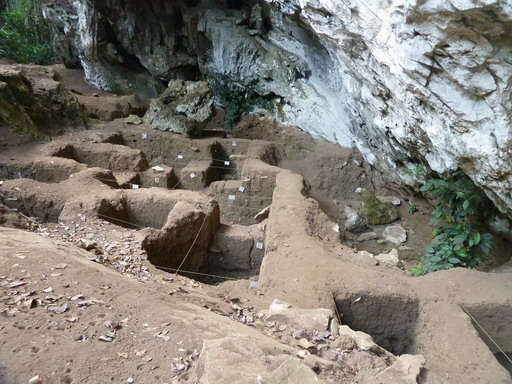
However there is no cave, it is just the site of a large rock shelter. There are many pits dug by the archaeologists
The cliff
See more on Perak Man.
© Liz Price
No reproduction without permission
The Lenggong Valley was inscribed as a UNESCO World Heritage site on 30 June 2012. Before visiting the cave, we went to the Lenggong Museum. This has a feature on Gua Teluk Kelawar.
This is the entrance to the display - the name is written down the side wall
After lunch we went to see the cave. The cave is signposted from the road.
However we saw no more signs to Gua Ular (Snake Cave) so I don't know where it is or what it is and I don't think it is mentioned in any archaeological reports.
We parked at the end of the road and set off walking. At a junction we had the choice of straight or right. There was no sign. We went right. This was wrong! After quite a trek we ended up at Gua Ngaum. Wrong cave!
So we backtracked to the junction and took the other option. Walked through an orchard and came to a sign
We knew this was right as we reached the tall cliff face and this rather shabby sign
There was a small shelter and also a new rather large one
Inside the shelter is a new information board, made in the same style as those in neighbouring caves. They are very hard to read in the dark shelters, and with the reflective surface using a torch or flash doesn't help. And an army of mosquitoes soon made their presence known.
We had a good laugh when we read that reindeer were found here (!!).
Location of the cave
However there is no cave, it is just the site of a large rock shelter. There are many pits dug by the archaeologists
The cliff
See more on Perak Man.
© Liz Price
No reproduction without permission
8 August 2012
Mulu's pinnacles on Malaysian banknotes
On 8th November 2000 Malaysia introduced a new RM1 (one Ringgit) currency note - this is the lowest value of the paper money. On the back is a 'collage' of illustrations including a Malaysian kite, the beach, Mount Kinabalu and the pinnacles of Gunung Api in Mulu National Park.
The pinnacles are rather small unfortunately, located at the top right. and a close up of the pinnacles
Bank Negara Malaysia issued a new series of banknotes on 16 July 2012. Themed 'Distinctively Malaysia', the latest banknotes series draws its inspiration from the country's diverse culture, heritage and nature. The highest value note, RM100, features the pinnacles at Gunung Api, Mulu. They are next to Gunung Kinabalu in Sabah, and actually look as big as the Kinabalu mountain! Both these are World Heritage sites. and a close up
© Liz Price
No reproduction without permission
The pinnacles are rather small unfortunately, located at the top right. and a close up of the pinnacles
Bank Negara Malaysia issued a new series of banknotes on 16 July 2012. Themed 'Distinctively Malaysia', the latest banknotes series draws its inspiration from the country's diverse culture, heritage and nature. The highest value note, RM100, features the pinnacles at Gunung Api, Mulu. They are next to Gunung Kinabalu in Sabah, and actually look as big as the Kinabalu mountain! Both these are World Heritage sites. and a close up
© Liz Price
No reproduction without permission
29 July 2012
Bukit Jawa, Lenggong, 2012
I first visited Bukit Jawa in 2007.
Bukit Jawa is the oldest Paleolithic site in Malaysia along with the neighbouring Temelong and Lawin areas. It has been dated at around 200,000 years old. It is located at Kampung Gelok, about 7 km north of Lenggong in Perak. It is not cave related.
On 30 June 2012 the Lenggong Valley was listed as a UNESCO World Heritage site. I visited Bukit Jawa again on 20 July 2012.
There had been a few changes over the 5 years. I was surprised to see a large wooden shelter whereas on my previous visit a simple attap roof just covered the dig site The simple 6 runged wooden ladder had gone and a more elaborate wooden staircase with hand rails had replaced it, BUT this was in pieces and roped off. We had to walk up the slope on the left side of the building. The dig site was the same but there was no fence around it as there was in this 2007 photo I wondered why such a large shelter had been built, considering the dig only occupied a very small area.
There was a notice inside but it was quite hard to read in the relative dark and it was hard to take photos with the reflective surface There were many signs of termites attacking the wood and I wondered how long the structure would last, considering the stairs have already broken in less than 5 years. Also the concrete supports for the posts seem to be just placed on sand, and I wonder how long they will last.
Considering Bukit Jawa is such an important place in Malaysia's prehistory, and now that Lenggong has got World Heritage status, it is such a pity that this site is not maintained.
© Liz Price
No reproduction without permission
Bukit Jawa is the oldest Paleolithic site in Malaysia along with the neighbouring Temelong and Lawin areas. It has been dated at around 200,000 years old. It is located at Kampung Gelok, about 7 km north of Lenggong in Perak. It is not cave related.
On 30 June 2012 the Lenggong Valley was listed as a UNESCO World Heritage site. I visited Bukit Jawa again on 20 July 2012.
There had been a few changes over the 5 years. I was surprised to see a large wooden shelter whereas on my previous visit a simple attap roof just covered the dig site The simple 6 runged wooden ladder had gone and a more elaborate wooden staircase with hand rails had replaced it, BUT this was in pieces and roped off. We had to walk up the slope on the left side of the building. The dig site was the same but there was no fence around it as there was in this 2007 photo I wondered why such a large shelter had been built, considering the dig only occupied a very small area.
There was a notice inside but it was quite hard to read in the relative dark and it was hard to take photos with the reflective surface There were many signs of termites attacking the wood and I wondered how long the structure would last, considering the stairs have already broken in less than 5 years. Also the concrete supports for the posts seem to be just placed on sand, and I wonder how long they will last.
Considering Bukit Jawa is such an important place in Malaysia's prehistory, and now that Lenggong has got World Heritage status, it is such a pity that this site is not maintained.
© Liz Price
No reproduction without permission
Subscribe to:
Posts (Atom)