sign in a cave in Laos

4 April 2012

Gua Tempurung graffiti

When does graffiti become 'historical'? Some of the graffiti in Gua Tempurung was done by the Communists when they used the cave as a hide out. In some places, early explorers wrote their names and where they were from.

Now that Gua Tempurung is a show cave, there should, in theory, be no more graffiti placed in the cave. Proper control by the cave guides should ensure this. However there seems to be a lack of control, as can be seen by the recent graffiti, as well as the rubbish.

Recent graffiti by UTAR, Universiti Tunku Abdul Rahman. It is sad that university students do this.

New graffiti above the drawings of the cars made by the Communists

And more modern stuff above the 1960 explorers names


© Liz Price
No reproduction without permission

Gua Tempurung rubbish

Gua Tempurung is a popular show cave in Perak, Malaysia. Located about 24 km south of Ipoh it attracts large groups of visitors and is ideally situated midway between Kuala Lumpur and Penang. There are very few show caves in the Malaysian peninsula.

I used to go caving in Gua Tempurung before it became a show cave at the end of 1997. It was initially run by Heritage Acres and Yayasan Perak, and right from the beginning the cave suffered from lack of maintenance and lack of control by the guides.

In 2004 the State Government appointed APT Consortium Sdn Bhd to take over the management and maintenance of Gua Tempurung.

My most recent visit was in March 2012. There was a large number of visitors that day, and there seemed to be little control of the groups by the guides.

The requirements of things to bring for tours 3 and 4 are torch light and proper sports shoes. However very few people had torches, and many had unsuitable footwear.

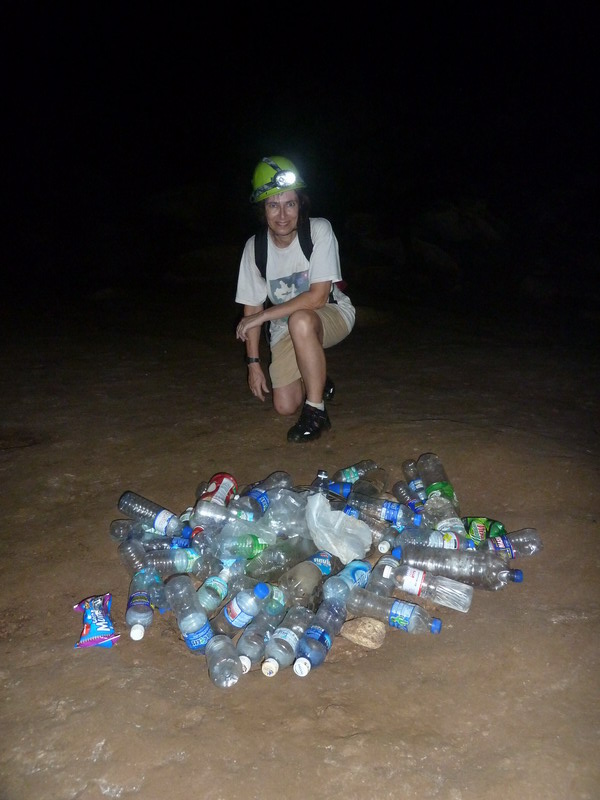
The biggest problem is littering, and to a lesser extent, graffiti. I was shocked at the amount of rubbish in the show cave. Considering it was a Saturday morning and only just the start of the weekend I dread to think how much more rubbish would accumulate over the weekend.
Items left behind by the painters

Maybe the rubbish bins have not been emptied for a while. But why are visitors allowed to dump their rubbish, mainly plastic bottles, in the cave. They should be told to take all rubbish out with them.

The light at the top of Gergasi is broken

The above photos were all taken in the show cave.

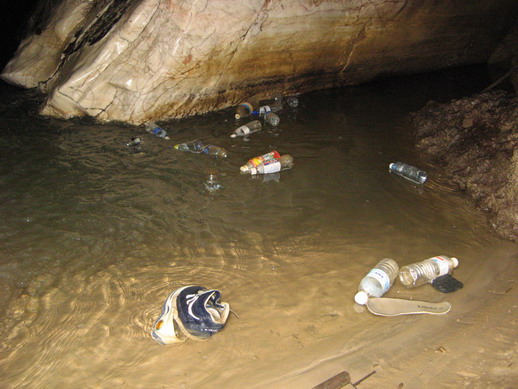
As we left the walkway and went into the undeveloped parts of the cave, I was shocked at the number of water bottles that had been dumped. These had been put in many of the pits dug by the tin miners in the past.


Another big problem is the number of broken shoes, and soles from shoes, that are littering the cave - mostly in the 'adventure' areas of the cave.

Rubbish dumped by the workmen

This oil drum has been here a while.

An additional problem is visitors are given stickers denoting which tour they are on, but these stickers fall off and there are so many lying on the walkways.

Considering Gua Tempurung is being promoted as a major attraction for Visit Perak Year 2012, the rubbish is not a good advert for this, nor for Malaysian show caves.

See Gua Tempurung graffiti.

In 2000 we cleaned the cave for Earth Day.

© Liz Price
No reproduction without permission

26 March 2012

Snoopy in Gua Batu Kuda, Mulu

Every time I went to Gua Batu Kuda, Stone Horse Cave, in Mulu, I said hello to Snoopy. Snoopy was a rock formation but it had a real likeness to the cartoon character in Peanuts.
These photos were taken in 1993
Everyone liked to pose as they kissed Snoopy.

Then on one visit in 1996 I was shocked to see that Snoopy was broken. I don't know when it happened. I don't know if it was a natural breakage.

As with Humpty Dumpty, "all the cavers couldn't put Snoopy together again"

© Liz Price
No reproduction without permission

25 March 2012

Mulu airport opening ceremony 1992

When I started going to Gunung Mulu National Park, the only way there was by boat. That was in the late 1980s and early 1990s. From Miri it was a series of 3 boats, usually overnighting in Marudi. Alternatively it was possible to fly to Marudi, and then take 2 boats to Mulu.

The travelling time has now been very reduced since the opening of Mulu airport in 1992. I happened to be in Mulu at the time and was able to go to the opening celebrations.

The first plane flew in on 29 May 1992.

Locals waiting in the new airport building. When the plane was due to arrive a welcoming group were waiting by the runway
The plane has arrived. A Twin Otter. The VIPs and photographers are waiting
Datuk Amar Dr Wong is greeted off the plane
The local ladies give small gifts (above), and Penan men (below)

The headman with long ears


At the end of my stay I was able to leave the park by plane, flying to Miri. The locals on the flight were all very excited, especially as they could see their homes from the air.

© Liz Price
No reproduction without permission

24 March 2012

Phou Khoun, Luang Prabang province, Laos

On the January 2007 caving trip to Laos, we spent a couple of days caving at Phou Khoun. Phou Khoun is in Luang Prabang province, but is not a tourist destination. It is simply a stopover on the journey between Luang Prabang and Phonsavan.

It about a 2.5 hour drive from Luang Prabang and the road is quite windy and hilly, but scenic.

Phou Khoun is a small town built along the road junction. As soon as we arrived, we checked into a guest house, then set off caving. We walked past a small hill on the way to Tham Muay, or Bear Cave.
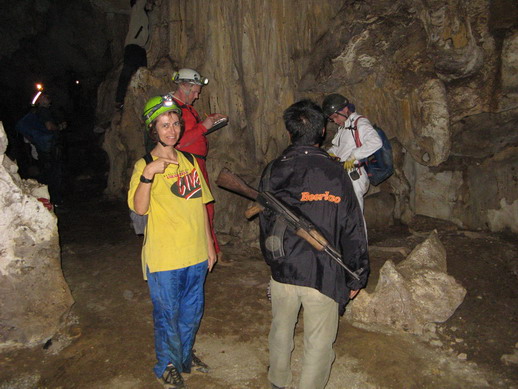
We had a few officials and even an armed guard with us

The cave is short but pretty

Next day we went to an area off Route 7. I was with the team that explored Tham Dout, or Jumping Cave. A small entrance leads to a passage with lots of stal, then there are climbs down and a low passage.
The guide caught 3 bats for his dinner.


A stream passage leads to a sump.

Next day I joined the team in the nearby Tham Deu. Very nice cave, basically one flat passage, with various holes in the floor.

We saw some pink leeches in the end stream passage


View of the Phou Khoun area

For more on Laos caves, see the BHB publications.

© Liz Price
No reproduction without permission