sign in a cave in Laos

23 January 2011

Karst Musuem, Java, Indonesia

In 2010 Indonesia opened the karst museum, which is the only one of its kind in Southeast Asia. It is centred around the Gunung Sewu karst in Java. Gunung Sewu or Thousand Hills, is well known amongst cavers and karst scientists. There are hundreds of cockpit karst hills, covering an area of about 1300 km2, which stretches 85 km from west to east and between 10 and 29 km north to south.


The museum is situated at Gebangharjo, south of Yogyakarta, and is located on 29 hectares of karst. The building is quite a strange design resembling a small pyramid on a large base, but we were given an explanation about the architecture. The main inspiration came from Indonesian temples. Although Indonesia is a Muslim country, other religions are practised in the country. So the museum was designed on different temples, religions and cultures.


The shape of the exterior of the building comes from famous Hindu and Buddhist temples in Indonesia. In the surrounding area they are in the process of building a Bali temple, a Buddhist temple, a Chinese temple and a church. There is already a mosque at the museum. It is good to see that a Muslim country is willing to embrace other religions so openly.

The displays are on 2 floors, covering karst for life and karst for science. The exhibits are well designed, and bright and informative.
Don't touch the stal!
Good signposting, easy to follow


We were told the information was prepared by Indonesians. Indonesia has a strong network of karst scientists and also cavers, and there are many caving clubs, which is rare in Southeast Asia.


The displays are in Indonesian and English language. Many examples of types of karst are shown, both from Indonesia and also worldwide. There are features on geology, types of rock etc, and everything you would expect, such as archaeology, biospeleology, use of caves, etc.
The cave looks real. Hippos -


The Indonesians have done a great job setting up with museum, with a wide range of information displayed in a pleasing way. I hope it will attract an increasing number of visitors, both locals and foreigners.

There are some caves in the area -

We went to one cave, Sodong Cave

Cute bus in the car park


Google Earth image of the Gunung Sewu karst


© Liz Price
No reproduction without permission

20 December 2010

Tin dredge at Dengkil, Selangor


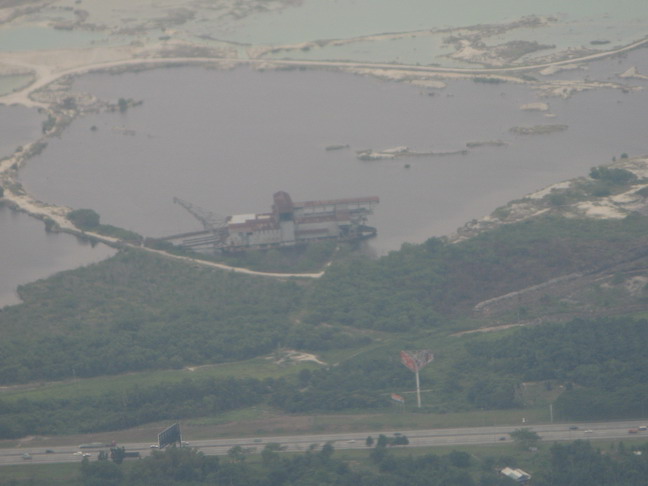
As far as I know there is only one remaining tin dredge in Selangor. I used to know of two, and have photos of them, taken from flights in/out of KLIA and LCCT.
Dredge from plane July 2007 -


When looking at Google Earth, one is still shown.
And I was able to find the location of the 2nd one by going back in the historical imagery on GE. This is quite a fascinating tool on GE. This dredge was at Payah Indah.
This is the Petaling Lake dredge -
Paya Indah July 2007

The 'missing' dredge at Paya Indah is Petaling Dredge No. 9, which as I suspected is a new one, built in 1982. This is a 5600 tonnes bucketline dredge equipped with 24 cu ft (680 litres) buckets and digs to a depth of 130 ft (40 m).

Several years ago there was talk in the press about converting this dredge into a museum. The Sun reported on this.

UPDATE January 2014 - According to Mohd Ezuddin Samian's comments below, this Petaling Dredge No. 9 had been sold and shipped overseas.

Dredges are still being constructed in Malaysia, at Port Klang (and also in Singapore). New ones have been sent to Ghana, Ecuador and Brazil.

Older Malaysian dredges have been sent overseas. One (PT7) has gone to Sierra Leone, 2 to Bangka Island in Indonesia. Another to Zaire.

Anyway on my birthday in Dec, Jan and I did a trip to see the last remaining dredge. It is located in Dengkil, and can be seen from the ELITE highway just before the last turn to the KLIA highway.

Jan photographing the dredge
highway signs

As we approached, a guard stationed on the dredge came to see who we were and immediately started talking into a walkie talkie. We talked to him across the water and asked if we could go onto the dredge, but he said no. He told us the dredge is up for sale, and might be bought by Australians, so that is why it is guarded. The Malay guard even had a dog, though the dog took no interest in us.

[The dredge was still there in Nov 2012, April 2015]

Putra Jaya behind the dredge -
tree growing on the tail
The buckets -
Front view


There are some nice pictures of the dredge on a blog, the photos were presumably taken before the dredge had any guard or fence around it.

The dredge seems to be in very good condition, especially compared to dredge T.T. No. 5 at Tanjung Tualang in Perak. I noticed it has moved slightly since the last GE image from Jan 2010.

UPDATE January 2014 - According to Mohd Ezuddin Samian's comments below, this dredge is the "Sri Banting Dredge". See details on OCIE page.

We saw a strange green building near the highway and went to have a look. Checking on GE shows it was built between 2007 and 2009. We went in and were totally amazed at the amount of stuff dumped there. Loads of childrens' toys, clothes, furniture. The place looked as if it had been almost fully constructed then was abandoned for whatever reason.
The dredge from the roof.

On the way out using a different track, we drove over a rubbish dump!
We then went to see some sand quarrying and a landfill site.
See more on Selangor Dreding history.

© Liz Price
No reproduction without permission