Published on The Brunei Times (http://www.bt.com.bn/en)
Chasing Bengal tigers and Indian elephants
Liz Price
KUALA LUMPUR
Sunday, November 18, 2007
EVER since my first visit to Asia two decades ago, it has been my ambition to see a wild elephant, although this was lower on my list than to see a tiger in the wild. That was my priority, to see a wild tiger, unchained and uncaged. In India, I visited several nature parks and wildlife sanctuaries. I went to the Jim Corbett National Park where many people manage to see tigers. Indeed the day I arrived, a group of European visitors had seen a mother tigress with cubs. This got my hopes up, and I eagerly went in search the next day, and saw nothing. I saw small reptiles, many species of birds, several types of deer, but no tigers. Those feline creatures were certainly elusive. This was the first National Park in India, and is situated in the north of Uttar Pradesh, 300km from Delhi. It was here that Project Tiger was launched 30 years ago, aimed at saving the tiger from extinction. I was wondering if they suddenly became extinct on the eve of my visit.
I didn't even see any wild elephants in the Jim Corbett Park, and the park is known for its elephants. Where were they all? I had the choice of doing an elephant safari, which meant riding an elephant in order to spot other wildlife, but instead I opted to do a jeep safari, in the hope that I would cover more terrain. I did, but it was unsuccessful and I was unlucky.
Later on my Indian travels, I went to the Sunderbans Tiger Reserve, the world's largest delta and mangrove swamp, and the world's largest estuarine sanctuary, situated 130km from Kolkata in West Bengal. There are an estimated 270 Royal Bengal tigers in the wildlife sanctuary, so I had high hopes. Many of these tigers are man-eaters. They are prone to attacking humans for food, and the locals resort to wearing masks on the back of their heads when are working in their fields, in an attempt to scare the tigers away. The tigers have become man-eaters due to the lack of other suitable prey in the area. There is an average of 40 maulings a year.
I spent several days in this park, accompanied by armed officers. I slept in remote huts, climbed up watchtowers, sat up overnight. Nothing. Even a dead goat tied in the lower branches of a tree as bait didn't attract any striped visitors. The Sunderbans is home to spotted deer, wild pigs, monkeys, herons, kingfishers and eagles, and although I saw most of those creatures, the 270 tigers were in hiding.
In Nepal I went to the Royal Chittwan Reserve. This park is noted for its one horned rhino, but it does also have tigers. I did a safari on elephant back to go animal spotting. Yes, I saw the rhinos, which was really wonderful, and exciting. But once again, the tigers were conspicuous by their absence.
I moved on to Thailand, and saw neither of my sought-after large mammals in the wild. The next destination was Malaysia. I knew Malaysia does have wild tiger and elephant populations, but sightings are not particularly common. I backpacked around Malaysia for two months, and saw neither creature in the wild. I travelled on to Indonesia, knowing I wouldn't see those creatures there. I had seen scores of wild elephants in Africa, but my desire was to see the Asian or Indian elephant.
I returned to Malaysia and spent some time doing voluntary projects with WWF Malaysia. This involved camping out in the jungle for up to 10 days at a time. We saw virtually every creature that lives in Malaysia, except for the rhino — and the tiger and elephant. My closest sighting was in Kelantan when I was on a caving trip. The scientist in the group, Dr Dionysius Sharma (Dino) spotted elephant and tiger footprints right outside a cave. I was so excited! This was my closest sighting to either of these creatures. There was one print of each, and quite fresh. We went into the cave and emerged on the other side of the hill, where we found mousedeer, tapir and pig paw marks, and more excitingly, three or four fresh elephant footprints.
We decided to go animal spotting that night. We set up camp a safe distance away in some rubber trees, then returned to the area to wait and look for animals. I heard a noise and was convinced it was an elephant, until Dino told me it was a frog. Oh well, try again! We stayed there for several hours but saw nothing. Once again those pachyderms and felines were not going to show themselves to me.
Over the years I made several trips to Taman Negara, staying up to a month at a time. I spent several nights trekking with one of the rangers, but we didn't see what I was looking for. The ranger told me that it is very rare for even the rangers to see tigers nowadays. They occasionally see the tracks but not the actual animal.
I did a lot of trekking alone, and stayed in the hides. I was lucky, and saw the "rarer" mammals such as tapir and even a panther on one occasion. I saw elephant footprints and even took photos as evidence. Then my luck changed. I did a trek out to the caves in the Kepayang area, sleeping overnight in Gua Kepayang Besar. Actually I didn't sleep, as it was the most terrifying night of my life. I was all alone. Firstly I was startled by lights flashing above my head, until I realised they were merely fireflies. I laughed at myself for being so stupid. But after I settled down to sleep I was disconcerted to hear scuffling and rustling noises close by. I kept shining my torch but could see nothing. The noises continued, and my fears mounted, and then I saw them — porcupine going about their normal night business, totally unfazed by my presence. I decided they were quite cute and nothing to worry about. But I still couldn't sleep.
Outside there was the sound of snuffling and movement and branches cracking. No way was I going out to find out what was there, and I spent the rest of the night restlessly tossing and turning as if on a bed of nettles. As soon as daylight broke through the trees I packed my bags, not wishing to spend a moment longer there than I had to. As I left the cave I walked straight into a pile of fresh, still steaming, elephant dung. That would explain the sound of cracking branches during the night!
I set off on my trek, and about 30 minutes later suddenly realised there was a large grey form ahead of me. Still unsettled after my scary night and rubbing sleep from my eyes, I wondered what was ahead of me in the gloom of the forest. Then I realised it was the donor of the steaming dung left outside the cave. Eureka! I had found my elephant. But I am ashamed to say that I ran away. I was so on edge, with nerves as taut as violin strings, that as soon as I saw the creature, I turned tail and quietly hurried away. My mind was telling me stories of how elephants sometimes attack humans, and because I was all alone, I wasn't prepared to stay and find out. Once I was a safe distance sway, I really regretted my action, as I hadn't even stopped to take a photograph.
Since then, I have been lucky enough to see the wild elephants in the Kinabatangan area of Sabah. I saw a total of about 15, and was able to get very close indeed to some of them. It was exciting to learn, a month after my visit, that these elephants have been declared to be a new, distinct subspecies, the Pygmy elephant. Originally it was thought they were a member of the Asian elephant group. I was fortunate to have seen them, as not all visitors to that area are so lucky.
Finally, I have seen the Asian elephant and its cousin the Pygmy elephant in the wild. I have seen the African elephant in its natural surroundings. And I've ridden the tamed Indian elephant.
All that remains now is to track down that elusive tiger.
The Brunei Times
-------------------------------------------------------------
Source URL:
http://www.bt.com.bn/en/en/travel/2007/11/18/chasing_bengal_tigers_and_indian_elephants

sign in a cave in Laos
8 June 2008

Rock climbing in Krabi - BT
Published on The Brunei Times (http://www.bt.com.bn/en)
The high life in Thai climbing heaven

Ascending to thrilling heights: Krabi in southwest Thailand is a paradise of tropical beaches, great rock climbing, a range of water activities and affordable room and board. Pictures: Liz Price
Liz Price
Friday, April 4, 2008
THE cliff face in front of me had dozens of ropes hanging from the rocky heights above, and attached to these ropes were human spiders. It was like the scene from a science fiction film, human spiders creating a giant size web to trap some unseen prey. These Homo-arachnids were strung at various heights up the cliff, all with one goal, to reach the top.
The spectacular limestone towers of Phra Nang in Krabi district dominate the scenery. High cliffs extend right down to the water's edge, and the Andaman sea is dotted with numerous islands of a multitude of shapes and sizes.
This limestone actually starts in Malaysia, on the islands of Langkawi and extends north into Thailand, running through the Taratao islands, and up the peninsula through Satun and Trang, and into Krabi and Phang Nga provinces.
Many climbers flock to the Krabi area to climb spectacular walls in one of the word's most beautiful tropical beach environments. The weather is ideal and there are climbs to suit all levels of skill. There are challenging 8c routes for the expert climber, but for novice there are short walls specially geared up for beginners.
One wall suitable for beginners is Muay Thai, 50m high with around 20 climbs. In the high season, as many as 300 visitors a day will climb this wall. That explains the abundance of ropes dangling down like colourful spaghetti.
For the real novice, there is a shorter wall about 15m high. I watched in fascination as one farang (foreigner) climbed towards the top of the cliff, and had to negotiate a very exposed overhang. The Thai instructor shouted encouragement and advice from below. The view from those rocky heights must be truly spectacular.
The local instructors scale the rock faces as if it was a Sunday stroll, they are such superb climbers, having developed their skills by climbing almost every day.
Rock climbing is a fast growing sport. The appeal is immediate and the rewards are addictive. People of all ages respond to the thrills, psychological challenges and exhilaration that are an integral part of every climb.
Macho strength is not necessarily required, some climbers have quite a gymnastic style. Even some young children were enjoying themselves scaling the rock faces.
The Krabi climbing industry started to boom in the 1990s, once the secret was out among the international climbing community. Word soon spread that this was a magical area, a rock heaven and Krabi soon became a Mecca for climbing enthusiasts.
Stories went around of spectacular limestone cliffs towering above golden sands and clear blue waters. The first trickle of European climbers arrived in the mid-eighties. The Phi Phi islands drew most of the pioneers and numerous routes were soon established. Then the climbers discovered Phra Nang on the mainland, where Railay beach had long been a favourite destination for backpackers, offering very cheap bamboo huts.
A talented group of young Thais soon began climbing and established a local climbing club. Although they started out as novices they studied the skills from the visiting climbers and became expert climbers themselves. They learnt the basic techniques then set about to conquer the walls. Soon they were setting up their own routes.
The cliffs of Phra Nang are well known. Although Phra Nang is part of the mainland it is effectively isolated from the outside world by the large cliffs and steep valleys.
These great walls of Phra Nang provide a stunning backdrop to the beaches that are packed with European sunbathers. These beaches, Phra Nang, Railay and Tonsai, can only be reached by boat.
I was amazed at the number of sun worshippers, there was hardly a spare metre of sand between the bronzed bodies, talk about sardines in a can.
And the enterprising Thais were walking around selling cold drinks, fresh fruits, sticky rice and even sarongs and mats, and doing quite good business. Long-tailed boats were bobbing gently in the aquamarine water, well away from the area reserved for swimming. It was good to see that safety is a prime concern here and that the boats are restricted to where they can moor.
There are now several climbing schools in operation, offering courses ranging from a half day to three days. The packages include instruction, equipment and insurance.
Or you can just rent equipment, or hire a private guide as a climbing partner. The climbing shops at Railay work closely together to provide a high standard and safe climbing practices.
There are more than 700 bolted climbs. The climbs range from easy, short pitches with relatively large hand hold and stalactites to pull up on, to desperate faces of extreme difficulty.
The routes are all named, generally very imaginatively, such as Massage Secrets, Beauty and the Beast, Getting to Know You, Lord of the Thais.
The climbing walls are generally shady, and easily accessible from the bungalows, or by long tailed boat. Certain rock walls are off limits because they are part of the Hat Nopparat Thara - Mu Ko Phi Phi National Marine Parks.
This area of Krabi is really stunning in terms of scenery and offers a range of rock and water activities. Accommodation is plentiful and caters for all budgets from simple huts through to luxury resorts.
Food is also varied; Thai, European and Muslim cuisines are found everywhere. It is certainly a great place to brush up those climbing skills.
The Brunei Times
------------------------------------------------------------------
Source URL:
http://www.bt.com.bn/en/en/features/2008/04/04/the_high_life_in_thai_climbing_heaven
The high life in Thai climbing heaven

Ascending to thrilling heights: Krabi in southwest Thailand is a paradise of tropical beaches, great rock climbing, a range of water activities and affordable room and board. Pictures: Liz Price
Liz Price
Friday, April 4, 2008
THE cliff face in front of me had dozens of ropes hanging from the rocky heights above, and attached to these ropes were human spiders. It was like the scene from a science fiction film, human spiders creating a giant size web to trap some unseen prey. These Homo-arachnids were strung at various heights up the cliff, all with one goal, to reach the top.
The spectacular limestone towers of Phra Nang in Krabi district dominate the scenery. High cliffs extend right down to the water's edge, and the Andaman sea is dotted with numerous islands of a multitude of shapes and sizes.
This limestone actually starts in Malaysia, on the islands of Langkawi and extends north into Thailand, running through the Taratao islands, and up the peninsula through Satun and Trang, and into Krabi and Phang Nga provinces.
Many climbers flock to the Krabi area to climb spectacular walls in one of the word's most beautiful tropical beach environments. The weather is ideal and there are climbs to suit all levels of skill. There are challenging 8c routes for the expert climber, but for novice there are short walls specially geared up for beginners.
One wall suitable for beginners is Muay Thai, 50m high with around 20 climbs. In the high season, as many as 300 visitors a day will climb this wall. That explains the abundance of ropes dangling down like colourful spaghetti.
For the real novice, there is a shorter wall about 15m high. I watched in fascination as one farang (foreigner) climbed towards the top of the cliff, and had to negotiate a very exposed overhang. The Thai instructor shouted encouragement and advice from below. The view from those rocky heights must be truly spectacular.
The local instructors scale the rock faces as if it was a Sunday stroll, they are such superb climbers, having developed their skills by climbing almost every day.
Rock climbing is a fast growing sport. The appeal is immediate and the rewards are addictive. People of all ages respond to the thrills, psychological challenges and exhilaration that are an integral part of every climb.
Macho strength is not necessarily required, some climbers have quite a gymnastic style. Even some young children were enjoying themselves scaling the rock faces.
The Krabi climbing industry started to boom in the 1990s, once the secret was out among the international climbing community. Word soon spread that this was a magical area, a rock heaven and Krabi soon became a Mecca for climbing enthusiasts.
Stories went around of spectacular limestone cliffs towering above golden sands and clear blue waters. The first trickle of European climbers arrived in the mid-eighties. The Phi Phi islands drew most of the pioneers and numerous routes were soon established. Then the climbers discovered Phra Nang on the mainland, where Railay beach had long been a favourite destination for backpackers, offering very cheap bamboo huts.
A talented group of young Thais soon began climbing and established a local climbing club. Although they started out as novices they studied the skills from the visiting climbers and became expert climbers themselves. They learnt the basic techniques then set about to conquer the walls. Soon they were setting up their own routes.
The cliffs of Phra Nang are well known. Although Phra Nang is part of the mainland it is effectively isolated from the outside world by the large cliffs and steep valleys.
These great walls of Phra Nang provide a stunning backdrop to the beaches that are packed with European sunbathers. These beaches, Phra Nang, Railay and Tonsai, can only be reached by boat.
I was amazed at the number of sun worshippers, there was hardly a spare metre of sand between the bronzed bodies, talk about sardines in a can.
And the enterprising Thais were walking around selling cold drinks, fresh fruits, sticky rice and even sarongs and mats, and doing quite good business. Long-tailed boats were bobbing gently in the aquamarine water, well away from the area reserved for swimming. It was good to see that safety is a prime concern here and that the boats are restricted to where they can moor.
There are now several climbing schools in operation, offering courses ranging from a half day to three days. The packages include instruction, equipment and insurance.
Or you can just rent equipment, or hire a private guide as a climbing partner. The climbing shops at Railay work closely together to provide a high standard and safe climbing practices.
There are more than 700 bolted climbs. The climbs range from easy, short pitches with relatively large hand hold and stalactites to pull up on, to desperate faces of extreme difficulty.
The routes are all named, generally very imaginatively, such as Massage Secrets, Beauty and the Beast, Getting to Know You, Lord of the Thais.
The climbing walls are generally shady, and easily accessible from the bungalows, or by long tailed boat. Certain rock walls are off limits because they are part of the Hat Nopparat Thara - Mu Ko Phi Phi National Marine Parks.
This area of Krabi is really stunning in terms of scenery and offers a range of rock and water activities. Accommodation is plentiful and caters for all budgets from simple huts through to luxury resorts.
Food is also varied; Thai, European and Muslim cuisines are found everywhere. It is certainly a great place to brush up those climbing skills.
The Brunei Times
------------------------------------------------------------------
Source URL:
http://www.bt.com.bn/en/en/features/2008/04/04/the_high_life_in_thai_climbing_heaven
Plain of Jars, Laos - Brunei Times
Published on The Brunei Times
Laos' mysterious plain of man-sized jars
Liz Price
PHONSAVAN, LAOS
Sunday, November 11, 2007

Asian menhirs: The largest and most accessible of the various Laotian jar sites is home to 250 jars that weigh mostly from 600kg to one tonne each. The biggest weighs six tonnes. Picture: Liz Price
THE Plain of Jars is one of the most enigmatic sites in Laos. It is a large area littered with huge stone jars. The jars are surrounded by mystery as no one knows their real history, although researchers and archaeologists have offered several hypotheses over the years.
The Plain of Jars covers a big area which extends around Phonsavan in northeast Laos, in Xieng Khuang province. It is divided into about 15 sites, although more than 60 sites have been recorded covering a much wider area extending to Thailand and India.
Some of the theories as to the purpose of the jars are that they were used as sarcophagi, or as wine fermenters or even for storing rice. But there is no evidence confirming one theory over another as the jars have been found empty. A few of the jars have discs lying nearby, which are thought to be lids.
The jars were carved out of solid stone boulders, some from granite, but most from a conglomerate which is similar to sandstone. Only recently researchers found the quarries (actually boulder fields) where they think the stone originated, as the site contains half finished jars. This place is west of Muang Sui.
The jars are angular or round and can weigh up to 13 metric tonnes and range from one to three metres in height. They are thought to be between 1,500 and 2,000 years old. Some of the excavated material has been dated to around 500 BC - 800 CE.
After studies in the 1930's found that the artifacts included bones, beads, bronze and iron tools, it was thought that the jars were funerary urns. Vases found lying next to some of the jars may have held human remains. Aerial photos show the jars appear to be laid in a linear path that was probably a trade route. This leads to the theory the jars were used to store rainwater to supply travellers.
Of course there are local legends associated with the jars. It is said that a race of giants once inhabited the area. Legend tells of an ancient king who fought a long, victorious battle against his enemy. He supposedly created the jars to brew and store huge amounts of lao lao rice wine to celebrate his victory. Another story says that in the 6th century a cruel chieftain, Chao Angka, ruled the area. However the Lao-Thai hero Khun Jeuam supposedly came down from southern China to help the people, and deposed Angka. To celebrate his victory, Khun Jeuam had the jars constructed for the fermentation of rice wine. According to this version, the jars were cast from a type of cement that was made from buffalo skin, sand, water and sugar cane, and fired in a nearby cave kiln, Grotte Crematoire.
Grotte Crematoire is a small cave 23m long, consisting of a single chamber with natural holes in the top. Due to the evidence of smoke it was thought the cave may have been a crematorium and maybe the jars were used to deposit cremated human remains. The cave was found to contain human remains and also burned bones and ash, as well as unburned bones.
The Pathet Lao or Lao revolutionary movement used this cave during the 1960's war as a shelter, and an American bomb supposedly damaged the cave. You can still see trenches and bomb craters in the surrounding area. The town of Xieng Khouang was destroyed during the fighting between the Pathet Lao and American-backed anti-communist troops. A new town was built in the mid 1970s, known as Phonsavan.
Not all the sites have been fully excavated and researchers are always hoping to find sealed jars whose contents might still be intact. But the dangers of unexploded ordnance (UXO) have slowed progress over the years. Only Sites 1, 2 and 3 are considered relatively free of UXO and therefore open to visitors. Even at those sites you should stick to the worn footpaths and take note of the stone markers left by the UXO teams. UXO are explosive weapons (bombs, shells, grenades, etc.) that did not explode when they were employed, and still pose a risk of detonation, decades after they were used. Laos has the distinction of being one of the world's most heavily bombed nations. During the period of the American Vietnam War, over half-a-million bombing missions dropped more than 2 million tonnes of ordnance on Laos.
Site One is the largest of the various sites and the most accessible. It is home to 250 jars that weigh mostly from 600kg to one tonne each. The biggest weighs six tonnes. Some people say this was the victory cup of the mythical King Jeuam, so it's called Hai Jeuam. Near Site One is the Lao air force base.
Two other jar sites, Two and Three, are also easily accessible by road from Phonsavan. Site Two features 90 jars scattered across two adjacent hillsides. Site Three is more interesting, it has 150 jars on a scenic hilltop. It lies 10km further south from Site Two, and 35km from Phonsavan. To reach the site you have to hike for about two kilometres along rice paddies and then up the hill. In the nearby village of Ban Sieng Di is a small monastery with remains of Buddha images that were damaged during the war. The villagers live in unusually large houses and grow rice, sugar cane, avocado and bananas.
It is possible the jars are linked with the equally mysterious stone megaliths (menhirs) found off Route Six on the way north, 57km before Sam Neua in Houa Phan province. This is Hintang archaeological park with its 2,000-year-old standing stones. The jars could also be linked to the large Dongson drum-shaped stone objects discovered in Luang Prabang province.
It will be interesting to see if archaeologists will ever discover the real truth behind the Plain of Jars.
The Brunei Times
-------------------------------------------------------------------
Source URL:
http://www.bt.com.bn/en/en/travel/2007/11/11/laos_mysterious_plain_of_man_sized_jars
Laos' mysterious plain of man-sized jars
Liz Price
PHONSAVAN, LAOS
Sunday, November 11, 2007

Asian menhirs: The largest and most accessible of the various Laotian jar sites is home to 250 jars that weigh mostly from 600kg to one tonne each. The biggest weighs six tonnes. Picture: Liz Price
THE Plain of Jars is one of the most enigmatic sites in Laos. It is a large area littered with huge stone jars. The jars are surrounded by mystery as no one knows their real history, although researchers and archaeologists have offered several hypotheses over the years.
The Plain of Jars covers a big area which extends around Phonsavan in northeast Laos, in Xieng Khuang province. It is divided into about 15 sites, although more than 60 sites have been recorded covering a much wider area extending to Thailand and India.
Some of the theories as to the purpose of the jars are that they were used as sarcophagi, or as wine fermenters or even for storing rice. But there is no evidence confirming one theory over another as the jars have been found empty. A few of the jars have discs lying nearby, which are thought to be lids.
The jars were carved out of solid stone boulders, some from granite, but most from a conglomerate which is similar to sandstone. Only recently researchers found the quarries (actually boulder fields) where they think the stone originated, as the site contains half finished jars. This place is west of Muang Sui.
The jars are angular or round and can weigh up to 13 metric tonnes and range from one to three metres in height. They are thought to be between 1,500 and 2,000 years old. Some of the excavated material has been dated to around 500 BC - 800 CE.
After studies in the 1930's found that the artifacts included bones, beads, bronze and iron tools, it was thought that the jars were funerary urns. Vases found lying next to some of the jars may have held human remains. Aerial photos show the jars appear to be laid in a linear path that was probably a trade route. This leads to the theory the jars were used to store rainwater to supply travellers.
Of course there are local legends associated with the jars. It is said that a race of giants once inhabited the area. Legend tells of an ancient king who fought a long, victorious battle against his enemy. He supposedly created the jars to brew and store huge amounts of lao lao rice wine to celebrate his victory. Another story says that in the 6th century a cruel chieftain, Chao Angka, ruled the area. However the Lao-Thai hero Khun Jeuam supposedly came down from southern China to help the people, and deposed Angka. To celebrate his victory, Khun Jeuam had the jars constructed for the fermentation of rice wine. According to this version, the jars were cast from a type of cement that was made from buffalo skin, sand, water and sugar cane, and fired in a nearby cave kiln, Grotte Crematoire.
Grotte Crematoire is a small cave 23m long, consisting of a single chamber with natural holes in the top. Due to the evidence of smoke it was thought the cave may have been a crematorium and maybe the jars were used to deposit cremated human remains. The cave was found to contain human remains and also burned bones and ash, as well as unburned bones.
The Pathet Lao or Lao revolutionary movement used this cave during the 1960's war as a shelter, and an American bomb supposedly damaged the cave. You can still see trenches and bomb craters in the surrounding area. The town of Xieng Khouang was destroyed during the fighting between the Pathet Lao and American-backed anti-communist troops. A new town was built in the mid 1970s, known as Phonsavan.
Not all the sites have been fully excavated and researchers are always hoping to find sealed jars whose contents might still be intact. But the dangers of unexploded ordnance (UXO) have slowed progress over the years. Only Sites 1, 2 and 3 are considered relatively free of UXO and therefore open to visitors. Even at those sites you should stick to the worn footpaths and take note of the stone markers left by the UXO teams. UXO are explosive weapons (bombs, shells, grenades, etc.) that did not explode when they were employed, and still pose a risk of detonation, decades after they were used. Laos has the distinction of being one of the world's most heavily bombed nations. During the period of the American Vietnam War, over half-a-million bombing missions dropped more than 2 million tonnes of ordnance on Laos.
Site One is the largest of the various sites and the most accessible. It is home to 250 jars that weigh mostly from 600kg to one tonne each. The biggest weighs six tonnes. Some people say this was the victory cup of the mythical King Jeuam, so it's called Hai Jeuam. Near Site One is the Lao air force base.
Two other jar sites, Two and Three, are also easily accessible by road from Phonsavan. Site Two features 90 jars scattered across two adjacent hillsides. Site Three is more interesting, it has 150 jars on a scenic hilltop. It lies 10km further south from Site Two, and 35km from Phonsavan. To reach the site you have to hike for about two kilometres along rice paddies and then up the hill. In the nearby village of Ban Sieng Di is a small monastery with remains of Buddha images that were damaged during the war. The villagers live in unusually large houses and grow rice, sugar cane, avocado and bananas.
It is possible the jars are linked with the equally mysterious stone megaliths (menhirs) found off Route Six on the way north, 57km before Sam Neua in Houa Phan province. This is Hintang archaeological park with its 2,000-year-old standing stones. The jars could also be linked to the large Dongson drum-shaped stone objects discovered in Luang Prabang province.
It will be interesting to see if archaeologists will ever discover the real truth behind the Plain of Jars.
The Brunei Times
-------------------------------------------------------------------
Source URL:
http://www.bt.com.bn/en/en/travel/2007/11/11/laos_mysterious_plain_of_man_sized_jars
The Splendours of Sawai (BT)
Published on The Brunei Times (http://www.bt.com.bn/en)
The splendours of Sawai
Liz Price
SAWAI, INDONESIA
Saturday, April 21, 2007
I SPENT all my free time sitting on the veranda of my floating house, admiring the view. It was perfect stilt houses sitting in the sea, really clear water with lots of fish, corals and starfish, small boats zipping around and a backdrop of scenic limestone cliffs. This was Sawai.
Sawai is a very small Muslim fishing village, located on the north coast of Pulau Seram. Seram is the largest island in Maluku Province, which is part of Maluku or The Moluccas, also known as The Spice Islands.
I had flown from Jakarta to Ambon, which is the capital of Maluku, and is a small town built alongside the beautiful Ambon Bay. From there I had taken a two-hour ferry ride to the south coast of Seram, landing at Amahai.
After an overnight stay, we went by car across the island to the north coast. This was a really scenic drive as we went straight through the Manusela National Park. This is a pristine area of densely forested hills, the highest peak being Gunung Binaya at 3,027m. I was amazed at the number of wild orchids growing alongside the road.
A few kilometres before Sawai, we stopped at the parrot rescue centre near Kampong Masihulan. This is a sanctuary where birds are rescued from trappers and hunters and are rehabilitated before being released into the wild. I saw cockatoos and parrots, colourful lories and even a hornbill and cassowary. The sanctuary is doing a great job of helping the indigenous birds.
As we approached Sawai we stopped to take photos as there were great views over the village. As we entered the village I was aware of how narrow the roads are, our car virtually touched the buildings either side of the road, which wasn't really built for vehicles.
We parked when the road became too narrow and continued on foot to Penginapan Lisar Bahari. Seeing a white face, the kids all called out "Hello mister" in the typical Indonesian greeting for a foreigner.
A smiling Pak Ali met us at the losman and showed me to my room and I was pleasantly surprised to see an en-suite bathroom. All the houses are built on stilts in the sea, as there is little dry land due to the fact that the forested hills come right down to the sea.
We went for a boat trip around the bay. The limestone cliffs rose steeply out of the water and their 300m high peaks were hidden in cloud at times. We went to the next village of Saleman to watch the evening bat flight.
A cave entrance is visible high up in the cliff behind the village, and every evening a stream of bats issues from the cave to go on their hunt for insects. There are so many bats streaming out that they form a black ribbon snaking across the sky. It was a wonderful sight.
The next day we trekked to a nearby cave, located in the Manusela National Park. The walk took about 40 minutes and was really interesting as I was able to see all kinds of trees such as nutmeg, clove, cocoa, durian and gandaria.
Having come to The Spice Islands I was particularly interested to see the spices growing in their natural setting.
The cave, Goa Hatu Putih, was quite beautiful with lots of stalagmites and stalactites, and we were able to see fruit bats and insect eating bats, as well as some inedible birds' nests.
Another highlight of my Sawai visit was the river trip. Pak Ali arranged this, and on the way to the Salawai river we saw some dolphins swimming quite close to the boat.
The river was particularly beautiful, with nipah palms coming right down to the water's edge. There were mangroves and sea pandans and of course sago palms. Sago is a staple food in Maluku and is eaten more than rice. I was in luck as we were able to stop and watch some men processing the sago on the river bank.
When the sago palm is about 15 years old, it flowers and then dies. This is the time when the sago is most abundant. The tree is cut down and the sago is removed from the trunk, mixed with water and then the resulting wet sago flour is scooped out and left to dry. One sago palm can give about 500kg of wet flour.
I was amazed at the number of butterflies and birds flying around the river. It would be a paradise for bird watchers. We went upriver as far as we could, and then progress was halted by a tree which had fallen right across the river. There was no way we could get past, so we made a return.
When we got back to the bay we headed for a deserted island where we had a picnic lunch. The island was so small I could walk right around in a few minutes, but it was such a scenic place with birds singing and lots of corals and shells on the sandy beach.
And I have to mention the food at Pak Ali's. If you like seafood, then this is the place to go. Every dinner we had the freshest seafood, straight out of the sea. There was delicious fish cooked in different styles, squid and cockles, and the last meal we had the biggest prawns I have ever seen. I was confused about whether they were prawns or lobsters as they were so big and so delicious.
One of the best things about Sawai is that the sea is clean and there is very little rubbish floating around. I went snorkelling a few times and the water was really clear. It's such a nice place just to sit and watch the villagers go about their daily lives.
I was quite sad when it was time to leave. I would like to say a big thank you to my hosts Sinda and Tilly from Spice Islands Tours and Travel for taking me there. If you want a nice relaxing destination, Sawai is the place to go.
The Brunei Times
--------------------------------------------------------------------------------
Source URL:
http://www.bt.com.bn/en/en/classification/life/travel/2007/04/21/the_splendours_of_sawai
The splendours of Sawai
Liz Price
SAWAI, INDONESIA
Saturday, April 21, 2007
I SPENT all my free time sitting on the veranda of my floating house, admiring the view. It was perfect stilt houses sitting in the sea, really clear water with lots of fish, corals and starfish, small boats zipping around and a backdrop of scenic limestone cliffs. This was Sawai.
Sawai is a very small Muslim fishing village, located on the north coast of Pulau Seram. Seram is the largest island in Maluku Province, which is part of Maluku or The Moluccas, also known as The Spice Islands.
I had flown from Jakarta to Ambon, which is the capital of Maluku, and is a small town built alongside the beautiful Ambon Bay. From there I had taken a two-hour ferry ride to the south coast of Seram, landing at Amahai.
After an overnight stay, we went by car across the island to the north coast. This was a really scenic drive as we went straight through the Manusela National Park. This is a pristine area of densely forested hills, the highest peak being Gunung Binaya at 3,027m. I was amazed at the number of wild orchids growing alongside the road.
A few kilometres before Sawai, we stopped at the parrot rescue centre near Kampong Masihulan. This is a sanctuary where birds are rescued from trappers and hunters and are rehabilitated before being released into the wild. I saw cockatoos and parrots, colourful lories and even a hornbill and cassowary. The sanctuary is doing a great job of helping the indigenous birds.
As we approached Sawai we stopped to take photos as there were great views over the village. As we entered the village I was aware of how narrow the roads are, our car virtually touched the buildings either side of the road, which wasn't really built for vehicles.
We parked when the road became too narrow and continued on foot to Penginapan Lisar Bahari. Seeing a white face, the kids all called out "Hello mister" in the typical Indonesian greeting for a foreigner.
A smiling Pak Ali met us at the losman and showed me to my room and I was pleasantly surprised to see an en-suite bathroom. All the houses are built on stilts in the sea, as there is little dry land due to the fact that the forested hills come right down to the sea.
We went for a boat trip around the bay. The limestone cliffs rose steeply out of the water and their 300m high peaks were hidden in cloud at times. We went to the next village of Saleman to watch the evening bat flight.
A cave entrance is visible high up in the cliff behind the village, and every evening a stream of bats issues from the cave to go on their hunt for insects. There are so many bats streaming out that they form a black ribbon snaking across the sky. It was a wonderful sight.
The next day we trekked to a nearby cave, located in the Manusela National Park. The walk took about 40 minutes and was really interesting as I was able to see all kinds of trees such as nutmeg, clove, cocoa, durian and gandaria.
Having come to The Spice Islands I was particularly interested to see the spices growing in their natural setting.
The cave, Goa Hatu Putih, was quite beautiful with lots of stalagmites and stalactites, and we were able to see fruit bats and insect eating bats, as well as some inedible birds' nests.
Another highlight of my Sawai visit was the river trip. Pak Ali arranged this, and on the way to the Salawai river we saw some dolphins swimming quite close to the boat.
The river was particularly beautiful, with nipah palms coming right down to the water's edge. There were mangroves and sea pandans and of course sago palms. Sago is a staple food in Maluku and is eaten more than rice. I was in luck as we were able to stop and watch some men processing the sago on the river bank.
When the sago palm is about 15 years old, it flowers and then dies. This is the time when the sago is most abundant. The tree is cut down and the sago is removed from the trunk, mixed with water and then the resulting wet sago flour is scooped out and left to dry. One sago palm can give about 500kg of wet flour.
I was amazed at the number of butterflies and birds flying around the river. It would be a paradise for bird watchers. We went upriver as far as we could, and then progress was halted by a tree which had fallen right across the river. There was no way we could get past, so we made a return.
When we got back to the bay we headed for a deserted island where we had a picnic lunch. The island was so small I could walk right around in a few minutes, but it was such a scenic place with birds singing and lots of corals and shells on the sandy beach.
And I have to mention the food at Pak Ali's. If you like seafood, then this is the place to go. Every dinner we had the freshest seafood, straight out of the sea. There was delicious fish cooked in different styles, squid and cockles, and the last meal we had the biggest prawns I have ever seen. I was confused about whether they were prawns or lobsters as they were so big and so delicious.
One of the best things about Sawai is that the sea is clean and there is very little rubbish floating around. I went snorkelling a few times and the water was really clear. It's such a nice place just to sit and watch the villagers go about their daily lives.
I was quite sad when it was time to leave. I would like to say a big thank you to my hosts Sinda and Tilly from Spice Islands Tours and Travel for taking me there. If you want a nice relaxing destination, Sawai is the place to go.
The Brunei Times
--------------------------------------------------------------------------------
Source URL:
http://www.bt.com.bn/en/en/classification/life/travel/2007/04/21/the_splendours_of_sawai
Batty friends in need of our protection - Brunei Times
Published on The Brunei Times (http://www.bt.com.bn/en)
Batty friends in need of our protection

Nightly pursuits: Bats, like the one on bottom, are mainly nocturnal, hunting for food at night. During the day, they hang upside down in their roosts. Among their preferred roosting places are caves, like the one on top, buildings and hollow trees. Pictures: Liz Price
Liz Price
KUALA LUMPUR
Friday, March 7, 2008
DID your mother ever warn you to be careful at night, to make sure a bat doesn't fly into your hair? Have you heard the expressions "bats in the belfry" or "blind as a bat"? Did you spend late nights terrified in front of the TV watching scary films where bats were rampant and attacking humans?
These are some of the misconstructions that we humans have about bats.
Bats are our friends. This is how we should consider those nocturnal mammals that fly in the dark. They are of great use to us humans, and we should be pleased to have them around.
Sadly bats have a bad reputation among the general public; all over the world they have a somewhat dubious status.
They suffer a bad press creatures of the darkness both literally and figuratively. This negativity has been around for hundreds of years. Bats so often appear in horror films as evil creatures of the night. Everybody knows the Dracula stories, in which blood-sucking vampires appear out of dark crypts in the old haunted castles of Transylvania.
Actually vampire bats do exist, but you will not find them in Asia. They live in central and South America, where they suck blood generally from horses and cattle. Like leeches, they do not harm their host. Their saliva contains an anticoagulant and the bats can feed while the host remains unaware of their presence.
Bats don't get tangled in ladies' hair, they don't bite the necks of humans, and they are not unclean. They are not vermin. Admittedly they can carry rabies, but as the general public normally never comes into contact with bats, this is not a problem rabid dogs and monkeys potentially present more of a danger.
Bats have many good points. They are very useful to us as they help to pollinate bananas, durian and petai, which flower at night. They also aid in seed dispersal and propagation of some rain forest plants.
Mangrove trees are pollinated by flying foxes. Bats help to control the insect population. They consume pests which would otherwise cause damage and spread disease.
In Deer Cave in Mulu National Park in Sarawak, an estimated one to two million bats live in the one cave. Every night they fly out to feed, each bat eats at least 10g of insects during a night of hunting, so this is at least 10 tonnes of insects consumed in a single night. Can you imagine 10 tonnes of mosquitoes? This results in a few tonnes of guano falling to the floor. Guano can be used as a fertiliser.
Medical researchers are now developing a drug which breaks down blood clots, which can be of great use to stroke victims and people suffering from thrombosis. The scientists are isolating a protein from the bat saliva which interferes with the process of blood clotting.
Village people across the world have used bats for their medicinal properties. A Malaysian folk cure for asthma and chest complaints uses roasted bat hearts mixed with coffee.
Some Cambodians believe that the fruit bat soup is a good cure for heart trouble and asthma. There is a profitable trade in these winged mammals. The head is cut off for traditional medicine, the blood is mixed with rich alcohol, and the meat is used to make rice soup.
In Maharashtra in India, bats are welcomed for their therapeutic powers. Stalls sell bottles of bat oil which is alleged to work wonders against rheumatism and arthritis. Made of bat's fat and a little amount of blood mixed with coconut oil and camphor, a small quantity of this ancient essence rubbed on the body is said to work wonders.
The bat god figured prominently in the mythology of many different cultures of Mexico more than 2,000 years ago. The bat, because of its association with the night and its silent flight, represented death.
Bats belong to the taxonomic order Chiroptera. Worldwide there are more than 900 species of bats. The US is known to have 40 species of bats, whereas England only has 15. In Malaysia there are about 100 species. There are two main types of bats, the insect feeders and the fruit bats.
Bats are the only mammals which can fly. Like many other mammals, they have fur, and give birth to live young. Individuals can live up to 20 years. Bats have been on Earth for about 50 million years.
There is a popular saying: "as blind as a bat." In fact bats are not blind. The fruit bats rely on their eyesight to navigate. Insect eating bats have very small eyes in comparison and navigate by echolocation.
Bats are mainly nocturnal and hang upside down in their roosts. They roost in buildings, caves, hollow trees, foliage, crevices in rocks, and in spaces under the bark of trees. Some make tents out of the leaves of plants, others roost in the hollow stems of bamboo, having entered the stems through holes made by wood-boring beetles. Many bats throughout the world roost in buildings and are often a considerable nuisance. Species that roost in caves, trees, or buildings often form huge colonies.
Flying foxes are the biggest bats, and sometimes can be seen hanging in trees where they roost, seemingly undisturbed by sunlight. Sadly their numbers are dwindling.
Their populations have been decimated by habitat destruction, colony eradication by fruit growers, over-harvesting for human consumption and unregulated hunting (for food and sport). Some species are becoming extinct and this could have adverse affects on the many bat-dependent plants and the ecosystems and economies they support.
Bats need protection. Increased awareness of the vital role that these bats play in the life cycle of commercially important plants is necessary. In some countries such as the UK and US, bats receive protection and there are heavy penalties for harming or even handling certain species. However, in Peninsula Malaysia, only flying foxes are partially protected under the Protection of Wildlife Act 1972, but even these can still be hunted for food, with a licence. In Sarawak, all bats are protected.
So remember that bats are actually our friends, and we need them in our ecosystem. They will not harm you, so please do not harm them. The Brunei Times
---------------------------------------------------------------------------
Source URL:
http://www.bt.com.bn/en/en/environment/2008/03/07/batty_friends_in_need_of_our_protection
Batty friends in need of our protection

Nightly pursuits: Bats, like the one on bottom, are mainly nocturnal, hunting for food at night. During the day, they hang upside down in their roosts. Among their preferred roosting places are caves, like the one on top, buildings and hollow trees. Pictures: Liz Price
Liz Price
KUALA LUMPUR
Friday, March 7, 2008
DID your mother ever warn you to be careful at night, to make sure a bat doesn't fly into your hair? Have you heard the expressions "bats in the belfry" or "blind as a bat"? Did you spend late nights terrified in front of the TV watching scary films where bats were rampant and attacking humans?
These are some of the misconstructions that we humans have about bats.
Bats are our friends. This is how we should consider those nocturnal mammals that fly in the dark. They are of great use to us humans, and we should be pleased to have them around.
Sadly bats have a bad reputation among the general public; all over the world they have a somewhat dubious status.
They suffer a bad press creatures of the darkness both literally and figuratively. This negativity has been around for hundreds of years. Bats so often appear in horror films as evil creatures of the night. Everybody knows the Dracula stories, in which blood-sucking vampires appear out of dark crypts in the old haunted castles of Transylvania.
Actually vampire bats do exist, but you will not find them in Asia. They live in central and South America, where they suck blood generally from horses and cattle. Like leeches, they do not harm their host. Their saliva contains an anticoagulant and the bats can feed while the host remains unaware of their presence.
Bats don't get tangled in ladies' hair, they don't bite the necks of humans, and they are not unclean. They are not vermin. Admittedly they can carry rabies, but as the general public normally never comes into contact with bats, this is not a problem rabid dogs and monkeys potentially present more of a danger.
Bats have many good points. They are very useful to us as they help to pollinate bananas, durian and petai, which flower at night. They also aid in seed dispersal and propagation of some rain forest plants.
Mangrove trees are pollinated by flying foxes. Bats help to control the insect population. They consume pests which would otherwise cause damage and spread disease.
In Deer Cave in Mulu National Park in Sarawak, an estimated one to two million bats live in the one cave. Every night they fly out to feed, each bat eats at least 10g of insects during a night of hunting, so this is at least 10 tonnes of insects consumed in a single night. Can you imagine 10 tonnes of mosquitoes? This results in a few tonnes of guano falling to the floor. Guano can be used as a fertiliser.
Medical researchers are now developing a drug which breaks down blood clots, which can be of great use to stroke victims and people suffering from thrombosis. The scientists are isolating a protein from the bat saliva which interferes with the process of blood clotting.
Village people across the world have used bats for their medicinal properties. A Malaysian folk cure for asthma and chest complaints uses roasted bat hearts mixed with coffee.
Some Cambodians believe that the fruit bat soup is a good cure for heart trouble and asthma. There is a profitable trade in these winged mammals. The head is cut off for traditional medicine, the blood is mixed with rich alcohol, and the meat is used to make rice soup.
In Maharashtra in India, bats are welcomed for their therapeutic powers. Stalls sell bottles of bat oil which is alleged to work wonders against rheumatism and arthritis. Made of bat's fat and a little amount of blood mixed with coconut oil and camphor, a small quantity of this ancient essence rubbed on the body is said to work wonders.
The bat god figured prominently in the mythology of many different cultures of Mexico more than 2,000 years ago. The bat, because of its association with the night and its silent flight, represented death.
Bats belong to the taxonomic order Chiroptera. Worldwide there are more than 900 species of bats. The US is known to have 40 species of bats, whereas England only has 15. In Malaysia there are about 100 species. There are two main types of bats, the insect feeders and the fruit bats.
Bats are the only mammals which can fly. Like many other mammals, they have fur, and give birth to live young. Individuals can live up to 20 years. Bats have been on Earth for about 50 million years.
There is a popular saying: "as blind as a bat." In fact bats are not blind. The fruit bats rely on their eyesight to navigate. Insect eating bats have very small eyes in comparison and navigate by echolocation.
Bats are mainly nocturnal and hang upside down in their roosts. They roost in buildings, caves, hollow trees, foliage, crevices in rocks, and in spaces under the bark of trees. Some make tents out of the leaves of plants, others roost in the hollow stems of bamboo, having entered the stems through holes made by wood-boring beetles. Many bats throughout the world roost in buildings and are often a considerable nuisance. Species that roost in caves, trees, or buildings often form huge colonies.
Flying foxes are the biggest bats, and sometimes can be seen hanging in trees where they roost, seemingly undisturbed by sunlight. Sadly their numbers are dwindling.
Their populations have been decimated by habitat destruction, colony eradication by fruit growers, over-harvesting for human consumption and unregulated hunting (for food and sport). Some species are becoming extinct and this could have adverse affects on the many bat-dependent plants and the ecosystems and economies they support.
Bats need protection. Increased awareness of the vital role that these bats play in the life cycle of commercially important plants is necessary. In some countries such as the UK and US, bats receive protection and there are heavy penalties for harming or even handling certain species. However, in Peninsula Malaysia, only flying foxes are partially protected under the Protection of Wildlife Act 1972, but even these can still be hunted for food, with a licence. In Sarawak, all bats are protected.
So remember that bats are actually our friends, and we need them in our ecosystem. They will not harm you, so please do not harm them. The Brunei Times
---------------------------------------------------------------------------
Source URL:
http://www.bt.com.bn/en/en/environment/2008/03/07/batty_friends_in_need_of_our_protection
25 May 2008
Gold mine near Gemas
I heard about the existence of an old gold mine in Negeri Sembilan but could find very little information about it, although it has been mentioned in the New Straits Times 2007 as it seems the local villagers want to turn it into a tourist attraction.
I was unable to find any accurate history about the mine. The NST says it was worked in the 19th and 20th century and has a series of tunnels which stretch 80km. This of course I didn't believe. Talking to the man who led us to the tunnels, he said the workings closed before the Japanese arrived in the Second World War.
Anyway I wanted to take a look so made a suggestion to Jan that we do a day trip there and he readily agreed.
The day started too early for me when a rooster started crowing at about 6.30am so I was up to see the sunrise. Even though I live in a suburb near to KL it's rural enough to have chickens and roosters!


We drove to Tampin where we stopped for brunch and also visited the Gurdwara Sahib Sikh temple.

I knew the mine was somewhere near Kampung Air Kuning Selatan, which is in the direction of Gemas, so we headed there. We got sidetracked when we stopped to take photos of a Chinese cemetery and the Kuil Sri Maha Mariamman Indian temple.


In the village we found someone who knew about the mine and he arranged for a friend to lead us there, so we had some chicken rice whilst waiting.
The NST report suggested that the mine tunnels may no longer be accessible due to cave-ins, so I was very happy when we reached the entrance and found we could go in. First sight of th entrance with rubbish left by the Bomba -


From the entrance chamber we had a choice of 2 routes, both of which were wet with some dubious looking water. Jan took the plunge and stepped in and I quickly followed. I hate that first moment of having to get my shoes wet. The water was initially ankle deep but I didn't like the smell we stirred up, which reminded me of human sewage. I couldn't believe it was sewage, but it definitely wasn't pleasant.

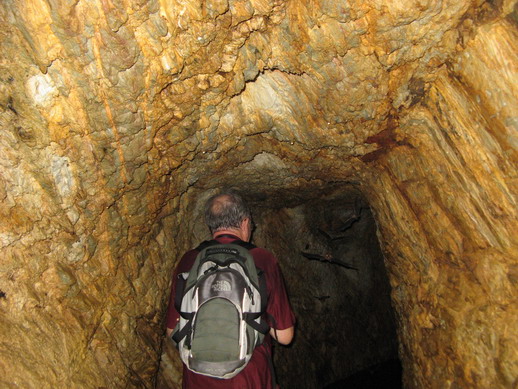


The Malaysian Bomba (Fire Dept) had been here recently and had taped off a route through the tunnels. Unfortunately they had also left boxes of rubbish outside the cave and up on the hill. It was mostly water bottles and polystyrene containers. If they had bothered to collect their rubbish in boxes, why on earth couldn't they also remove the boxes, rather than leave them for the animals to scatter.

The passages were full of bats, which were flying all around us, and several of them gently collided with us. However as most of the passages led on, most of the bats were able to fly ahead of us. Incidentally the bats are harmless and there is no need to worry about them or to disturb them.


 |
| cockroaches |


The tunnel came back to the entrance chamber, so we decided to go in for another round, this time exploring some passages taped off by the Bomba. Here the water had no smell so I guess the bad smell in the other passages was due to the mud being churned up by previous visitors.


 |
| yet more bats |


Having explored the tunnels, we washed out feet in the stream outside, then we climbed up the hill where we saw many shafts which had been dug. Some were just trial shafts, but others connected to the mine below.


It was an interesting visit, and now I am curious to know the history of the place and to know if there are similiar tunnels in the area.
You can see Jan's photos
© Liz Price
No reproduction without permission
10 May 2008
Tarutao Park, Thailand - BT
This was originally published in the The Brunei Times
© Liz Price
No reproduction without permission

© Liz Price
© Liz Price
No reproduction without permission
Thai archipelago's unspoilt Tarutao National Park
Stunning: Despite its past as a penal colony, Thailand's Ko Tarutao is a beautiful tropical island with golden sands, green seas and wonderful sunsets. Picture: Liz Price
Sunday, April 27, 2008
WE SPENT part of our holiday in a place which used to be a haven for pirates and more recently a penal colony and place of detention for political prisoners. The name of this place means "old, mysterious and primitive". Despite its dubious history and intriguing name it turned out to be a stunning place, a beautiful tropical island with golden sands, green seas and wonderful sunsets. We were on Ko Tarutao.
Ko Tarutao is a small island in the Andaman Sea off the west coast of Satun, the southernmost province of Thailand. It is part of Ko Tarutao National Marine Park, which is a large archipelago of 51 islands approximately 30 km from Pak Bara in La-Ngu district, 60km northwest of Satun town. The islands are north of Langkawi in Malaysia and form part of the same geological group. In fact the main island of Tarutao is only five kilometres from Langkawi. These islands are formed of granite and allied rocks, and there is also much limestone. This limestone is the oldest limestone in the area, some 450 million years old.
In Satun we negotiated a taxi to take us to Pak Bara. It was an ancient but huge car and we paid about eight dollars for the 60km trip. From Pak Bara it was an interesting one and a half hour boat ride as we went past lots of scenic limestone islands and saw several dolphins.
Arriving in Ko Tarutao we paid our entrance fee to the Marine Park and bought a guide book, then organised a room. There is a choice of accommodation from dorms, to twins /doubles, and two-room lodges. You can also camp on some beaches. Park HQ is at Ao Phante Malaka.
Tham Chorakhe or Crocodile Cave is a tourist attraction not to be missed. A small boat took us up river, past lots of mangroves with occasional limestone cliffs jutting out of the forests. From the jetty a boardwalk leads over mangrove swamps, then steps go down to the cave entrance. The river enters the cave so a pontoon walkway has been constructed on very noisy polystyrene blocks, which squeaked annoyingly as we walked along. The causeway swayed and wobbled, so I had to make sure I was steady before taking pictures of the stalactite formations. We came to a large dry chamber and we able to explore this with the help of electric lights. It was a nice cave with a lot of stalactites and stalagmites.
The other tourists turned round and went back out, but we were cavers and we could see the far end of the cave ahead, beckoning us. We were separated from it by mud and water but as we were wearing our old caving shoes we thought it wouldn't be a problem. However we weren't expecting the mangrove mud to be so thick and sticky and glutinous. It took a tenacious hold of our shoes and it was a real struggle to move as with each step we sank in mud above ankle level. We were getting nowhere, so decided to give up. Even getting back to the dry chamber was a real struggle, the mud certainly didn't want to give up its grip on our shoes.
Fortunately none of the islands in the Marine Park have been developed by private operators. Only five of the islands have a regular boat service and only three of those are generally visited by tourists, Tarutao, Adang and Lipe. Tarutao is the biggest and has waterfalls, inland rivers, caves, beaches and protected wildlife. Wildlife on the island includes dusky langur, mousedeer, wild pig, fishing cat and crab-eating macaque. In Crocodile Cave we saw crabs and mice. Marine life includes dolphins, dugongs, lobster and turtles. Four types of turtle lay their eggs on the beaches between September and April.
The island was a place of exile for political prisoners from 1939 to 1947 and remains of the prison can be seen on the southern tip of the island, and the middle of the east coast. There is also a graveyard, charcoal furnaces and fermentation tanks for making naam plaa or fish sauce. Many prisoners were revolutionary groups who had held unsuccessful coup attempts. Escape from the island was a disheartening prospect due to the sharks, crocodiles and fierce guards. The political prisoners enjoyed an open prison atmosphere separate from the common prisoners. One third of the convicts died on the island, many from malaria. During WWII, order broke down. Supplies no longer came from the mainland and both guards and prisoners soon became the most feared pirates in the area, preying on merchant ships as they sailed through the Straits of Malacca.
After the War, British naval troops were sent to Tarutao to clean out the pirate groups. The prisons were closed, and villagers from the mainland began to settle on the island and became fishermen and farmers. In 1974 Tarutao became Thailand's second Marine National Park. The villagers were unhappy about this and most moved away, leaving just 17 families.
A road runs down the length of the island. 11km of its length was built by the prisoners in the 1940's, and the more recent 12km constructed by the park division. Today the road is mostly overgrown but park personnel have kept a path open to make it easier to get from north to south without having to climb over rocky headlands along the shore.
The visitors centre has natural history exhibits and information about the prison era, as well as a scale model of the park. There is also an information centre and a library which is a gold mine of science textbooks and 19th century English literature.
Behind the Park HQ is Toe Boo cliff and this is a great place to climb up to see the views and also the sunsets. We were lucky and had glorious sunsets a couple of evenings.
Ko Rang Nok or Birds Nest Island is a small island off the south coast. Locals collect the swiftlets' nests for the Chinese market. There are some coral reefs off the island. Sea gypsies and pirates once plied these waters, today fishermen try to make a living.
Ko Tarutao is definitely worth a visit as it doesn't suffer from mass tourism and remains unspoilt. And it is so close to Malaysia, it is easily reached by road and boat.The Brunei Times
Ko Tarutao is a small island in the Andaman Sea off the west coast of Satun, the southernmost province of Thailand. It is part of Ko Tarutao National Marine Park, which is a large archipelago of 51 islands approximately 30 km from Pak Bara in La-Ngu district, 60km northwest of Satun town. The islands are north of Langkawi in Malaysia and form part of the same geological group. In fact the main island of Tarutao is only five kilometres from Langkawi. These islands are formed of granite and allied rocks, and there is also much limestone. This limestone is the oldest limestone in the area, some 450 million years old.
In Satun we negotiated a taxi to take us to Pak Bara. It was an ancient but huge car and we paid about eight dollars for the 60km trip. From Pak Bara it was an interesting one and a half hour boat ride as we went past lots of scenic limestone islands and saw several dolphins.
Arriving in Ko Tarutao we paid our entrance fee to the Marine Park and bought a guide book, then organised a room. There is a choice of accommodation from dorms, to twins /doubles, and two-room lodges. You can also camp on some beaches. Park HQ is at Ao Phante Malaka.
Tham Chorakhe or Crocodile Cave is a tourist attraction not to be missed. A small boat took us up river, past lots of mangroves with occasional limestone cliffs jutting out of the forests. From the jetty a boardwalk leads over mangrove swamps, then steps go down to the cave entrance. The river enters the cave so a pontoon walkway has been constructed on very noisy polystyrene blocks, which squeaked annoyingly as we walked along. The causeway swayed and wobbled, so I had to make sure I was steady before taking pictures of the stalactite formations. We came to a large dry chamber and we able to explore this with the help of electric lights. It was a nice cave with a lot of stalactites and stalagmites.
The other tourists turned round and went back out, but we were cavers and we could see the far end of the cave ahead, beckoning us. We were separated from it by mud and water but as we were wearing our old caving shoes we thought it wouldn't be a problem. However we weren't expecting the mangrove mud to be so thick and sticky and glutinous. It took a tenacious hold of our shoes and it was a real struggle to move as with each step we sank in mud above ankle level. We were getting nowhere, so decided to give up. Even getting back to the dry chamber was a real struggle, the mud certainly didn't want to give up its grip on our shoes.
Fortunately none of the islands in the Marine Park have been developed by private operators. Only five of the islands have a regular boat service and only three of those are generally visited by tourists, Tarutao, Adang and Lipe. Tarutao is the biggest and has waterfalls, inland rivers, caves, beaches and protected wildlife. Wildlife on the island includes dusky langur, mousedeer, wild pig, fishing cat and crab-eating macaque. In Crocodile Cave we saw crabs and mice. Marine life includes dolphins, dugongs, lobster and turtles. Four types of turtle lay their eggs on the beaches between September and April.
The island was a place of exile for political prisoners from 1939 to 1947 and remains of the prison can be seen on the southern tip of the island, and the middle of the east coast. There is also a graveyard, charcoal furnaces and fermentation tanks for making naam plaa or fish sauce. Many prisoners were revolutionary groups who had held unsuccessful coup attempts. Escape from the island was a disheartening prospect due to the sharks, crocodiles and fierce guards. The political prisoners enjoyed an open prison atmosphere separate from the common prisoners. One third of the convicts died on the island, many from malaria. During WWII, order broke down. Supplies no longer came from the mainland and both guards and prisoners soon became the most feared pirates in the area, preying on merchant ships as they sailed through the Straits of Malacca.
After the War, British naval troops were sent to Tarutao to clean out the pirate groups. The prisons were closed, and villagers from the mainland began to settle on the island and became fishermen and farmers. In 1974 Tarutao became Thailand's second Marine National Park. The villagers were unhappy about this and most moved away, leaving just 17 families.
A road runs down the length of the island. 11km of its length was built by the prisoners in the 1940's, and the more recent 12km constructed by the park division. Today the road is mostly overgrown but park personnel have kept a path open to make it easier to get from north to south without having to climb over rocky headlands along the shore.
The visitors centre has natural history exhibits and information about the prison era, as well as a scale model of the park. There is also an information centre and a library which is a gold mine of science textbooks and 19th century English literature.
Behind the Park HQ is Toe Boo cliff and this is a great place to climb up to see the views and also the sunsets. We were lucky and had glorious sunsets a couple of evenings.
Ko Rang Nok or Birds Nest Island is a small island off the south coast. Locals collect the swiftlets' nests for the Chinese market. There are some coral reefs off the island. Sea gypsies and pirates once plied these waters, today fishermen try to make a living.
Ko Tarutao is definitely worth a visit as it doesn't suffer from mass tourism and remains unspoilt. And it is so close to Malaysia, it is easily reached by road and boat.The Brunei Times
© Liz Price
Subscribe to:
Posts (Atom)