sign in a cave in Laos

27 July 2012

Lime kilns in Perak, Malaysia

Last week I had an interesting visit to some old fashioned lime kilns in Perak, Malaysia. The kilns are used to make quick lime.

Quick lime is produced by heating limestone. Today most companies use state-of-the-art high tech modern lime kilns to make the quick lime. However in Perak there are still some old fashioned, cottage industry type lime kilns.

Limestone is CaCO3. Quick lime or burnt lime is calcium oxide (CaO). It is white, alkaline and crystalline. It is made by the thermal decomposition of limestone in a lime kiln. It needs to be heated above 825°C .

CaCO3 + heat = CaO + CO2

In the Bercham area, north of Ipoh in Perak, Malaysia, there are still working lime kilns. There are 2 rows of kilns.
The open area in front of the kilns housed the logs for burning, quick lime stones and bags of the finished product, the quick lime.

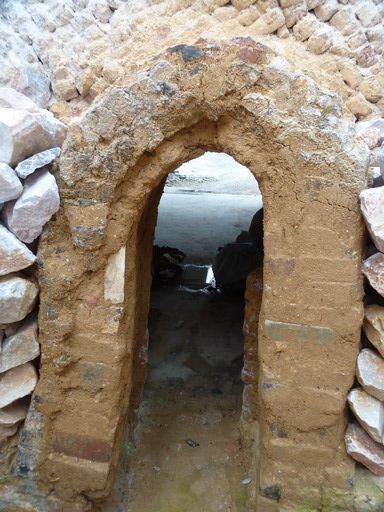
There are 3 kilns in a row. A short tunnel leads via a low access arch to a circular brick lined kiln. The brick work was amazing. Such orderly patterns. The fire bricks looked smaller than normal house bricks.

The shafts seem almost circular. The arch in the second kiln was made of red bricks.

Men carefully stack the limestone at the bottom of the kiln, building up the domed layers, which gradually slope in, with a timber centre. Once the layers meet in the middle they can then throw down more limestone from the top.
Air has to pass freely to provide combustion and the layers need to maintain their shape throughout the burning process to avoid collapse. Wood is used to produce the heat. Excessive temperatures product unreactive "dead burned" lime. Extra wood could be fed in through the access tunnel. Lumps of CaO fall to the bottom.
The arch in the third kiln -


The process is quite slow -
5-6 days to stack the kiln
1 week to burn
3 days to cool
remove the lime on the next day.

We went up to the top to see the loading area.
This photo is looking straight down -
Piles of limestone waiting to be used
and reject quicklime that has not burnt properly

UPDATES
These kilns stopped working sometime in 2013.

See blog on more lime kilns in Perak, at Gunung Panjang. These kilns have been abandoned for some time.

© Liz Price No reproduction without permission

------------------------------------------------------------------------------------------------------------------------

6 comments:

  1. You look like a Greek Kore...:-)
    ReplyDelete


  2. Very interesting!
    Do they load the kilns from the top or through the entrance tunnel?
    ReplyDelete


  3. They start loading from the bottom, building up the layers which gradually slope in, till they meet in the middle, then when they've reached a certain height, they add the rest of the stones from the top.
    ReplyDelete


  4. My relative lives in Bercham Garden. I didn't know anything about this. What is it for anyway ?
    ReplyDelete


  5. To make lime, which is used in a lot of industries , for building and engineering materials , waste water treatment, etc.
    ReplyDelete

16 July 2012

Gunung Kanthan quarry

Gunung Kanthan is the northernmost limestone hill in the Kinta Valley. It is also one of the largest hills. The Kinta Valley is approx 40 km long running north to south, with the city of Ipoh roughly in the middle. Ipoh is the capital of Perak, in West Malaysia.

The biggest known cave in Gunung Kanthan is Gua Kanthan. This cave is home to an endemic trapdoor spider, Liphistius kanthan.

Gunung Kanthan is being quarried by Lafarge.
Their plant is on the west side of the hill across the Ipoh to Kuala Kangsar trunk road. The railway line runs past the works.
Gua Kanthan is at the southern end of the hill which is currently untouched by the quarrying, but for how long????
On a visit in Nov 2011 I drove along the whole eastern side of Gunung Kanthan (green line). These first few photos are the untouched southeast side of the hill, where there are fish ponds and gardens.
This cave was visible from the track but when we tried to get nearer, we found the land occupied by an (illegal?) monastery
and the monks would not let us in as they said it was a meditation place. It looked like they were occupying quite a large cave. Ponds and gardens surrounding the monastery
This guy was slowly crossing the road
Another cave, or at least a large opening
We then came to the centre of the hill, where the quarry has bisected the hill.
Note the red excavator on the hillslope (below)
This is now the northeast side of the hill. The JCB was sending down a lot of stones
It looked as if there could be caves hidden behind the rubble at the base of the hill
Field of corn
Half the hill is quarried, half is still pristine
Driving along the northeast side, another large opening
Towards the north end the track got smaller and was blocked by a fence, so we were unable to get to the very end of the hill.

On the return, another view of the centre of the hill
and the Lafarge plant is visible


On a caving trip to Gua Kanthan in 1993, we exited via the back door and tried to walk around the hill to look for caves. However we had trouble negotiating the vegetation and the swamps and saw no caves and later found ourselves in the quarry workings


Guunung Kanthan register number Prk 47/01.

© Liz Price
No reproduction without permission

11 July 2012

Goa Lalay, Pelabuhan Ratu, Java

Goa Lalay or Bat Cave, is a small cave, about 4.5 km south of Pelabuhan Ratu, on the south coast of West Java, Indonesia.
It is a small cave with a large colony of bats, famous for the evening bat flight. The main bat cave is fenced off, this is from where the bats emerge each night. Entrance fee to watch was Rp1000 in 2002.

I went in a small neighbouring cave which seemed to be just one chamber with some tunnels leading off, but I had no torch. There was lava like sand on the floor.

There are 4 caves here, one is used as a meditation cave. Seems to be an old sea cave complex.

Lalay is bat in Sundanese language.

© Liz Price
No reproduction without permission

Gua Boni Ayu, Sukabumi, Java

I've only been to one cave in the Sukabumi area of West Java, Indonesia. That is Gua Boni Ayu (Buniayu). Ayu means beautiful in Sundanese. My visit was in 2002.

From Sukabumi we drove south towards Sagaranten and up and over a mountain range before reaching Gua Boni Ayu. This karst area is riddled with dolines and covered by pine and damar trees.

The Forest Dept. looks after the cave and runs it as a show cave. They even had about 7 sets of Petzl carbides.

Lots of steps down to the cave entrance, then steps down in the cave. We came to the streamway and followed it. It was very muddy. There were lots of straws and some nice gours and a few stal.
The streamway is quite small and you have to stoop in places. We stopped at a place and I was told that in 2000 an earthquake had caused a collapse. It's now a squeeze.

Cave has lots of insect bats, a few large crickets, small whip spiders.

We went back out and at the entrance followed a high level passage where there were bats and swiflets. We did a muddy route out to another entrance at high level. We were in the cave for about 75 mins.

After the trip we had a quick look at a shaft nearby.

© Liz Price
No reproduction without permission

8 July 2012

Gua Kelawar, Batu Kurau, Perak

Batu Kurau is an isolated limestone outcrop, near Anak Kurau in Perak.

My first visit to Batu Kurau was in August 1998. On that trip we surveyed Gua Kelawar, which is the biggest cave. It is 157 m long. To reach the cave you have to walk through the river
This entrance is quite small and hidden by vegetation in 1998
We used this entrance in 2007
The main feature of the cave is the bats. Lots of them.
The eye shine of the fruit bats can be seen on the bats

The main chamber was amazing. It was packed full of bats. The floor had a semi-solid lake of liquid guano. It was brown when stirred.
There was an incredible heat given off - I've never experienced this before. The noise of the bats was also new to me, as noisy as a steam train whistling. The bats were packed solidly on the roof. Their eyes were quite bright. They are probably all fruit bats. Even the Bat Cave at Gunung Tempurung doesn't seem to have the heat of this chamber. Needless to say we couldn't survey very accurately here due to the stench and the fact we weren't going to cross the guano lake! There were cockroaches on the walls.
There is a nice shaped 'window' leading to the main chamber
Looking out from the main chamber
Bats in the smaller passage
Evans wrote about the Batu Kurau caves in 1920 but doesn't seem to mention this particular cave.

Gua Kelawar register number Prk 59/11.

See more on Batu Kurau barber shop.

© Liz Price No reproduction without permission