I have posted a few times in the past about the tin dredge in Selangor, close to KLIA.
I was interested to see this article, "Anyone interested in buying Selangor’s tin dredge?" in Free Malaysia Today, published on 23 March 2019. My blog is mentioned in the article.
And the FMT article first appeared in The Thrifty Traveller's blog, "Selangor Tin Dredge", posted in 2017.
It seems that over the years, nothing has been done towards selling or preserving the dredge.

sign in a cave in Laos
Showing posts with label tin dredge. Show all posts
Showing posts with label tin dredge. Show all posts
6 April 2019

21 March 2016
Tin dredge in Selangor
Every time I go to Kuala Lumpur airport, I look out to see if the dredge is still there. And as of March 2016, it is!
See my blog on the Selangor dredge from 2010.
Many press reports write that the dredge at Tanjung Tualang in Perak is the only one in Malaysia. That is wrong. There are still two dredges in Malaysia!
See my blog on the Selangor dredge from 2010.
Many press reports write that the dredge at Tanjung Tualang in Perak is the only one in Malaysia. That is wrong. There are still two dredges in Malaysia!
28 October 2015
Tin dredge Tj Tualang, Perak
The tin dredge at Tanjung Tualang in Perak, Malaysia was open to the public for a few years, from 2008. I visited shortly after it opened for tours. It then closed in 2012 and there were fears that the dredge was sinking. Last time I saw it, in Aug 2015, the whole area was fenced off.

Over the years a lot of money had been poured into projects to try and save the dredge and restore it for tourism. In Oct 2015 a piece was published in NST saying a company had been entrusted to again restore it. See article in Ipoh World blog.

Over the years a lot of money had been poured into projects to try and save the dredge and restore it for tourism. In Oct 2015 a piece was published in NST saying a company had been entrusted to again restore it. See article in Ipoh World blog.
16 August 2011
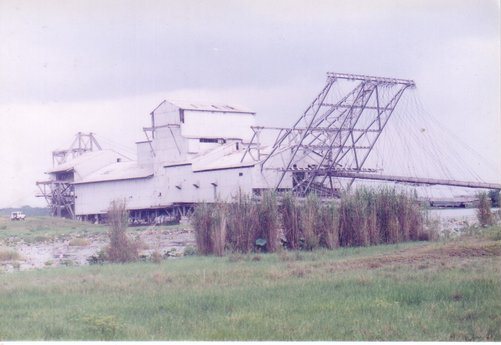
Perak dredge 1997
I have revisited the dredge.




20 December 2010
Tin dredge at Dengkil, Selangor

As far as I know there is only one remaining tin dredge in Selangor. I used to know of two, and have photos of them, taken from flights in/out of KLIA and LCCT.
Dredge from plane July 2007 -

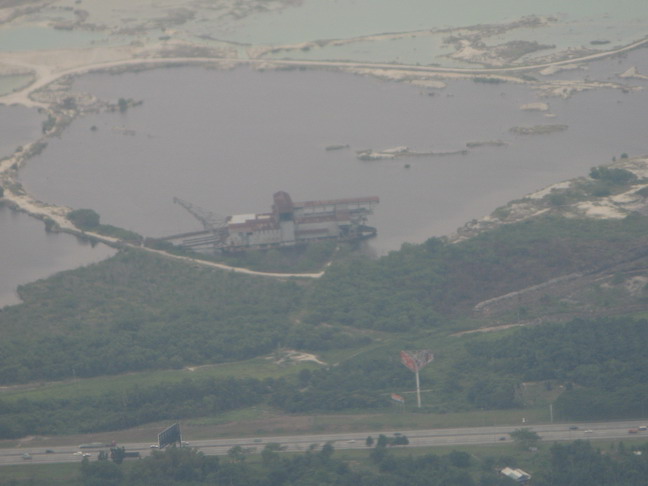
When looking at Google Earth, one is still shown.

This is the Petaling Lake dredge -


The 'missing' dredge at Paya Indah is Petaling Dredge No. 9, which as I suspected is a new one, built in 1982. This is a 5600 tonnes bucketline dredge equipped with 24 cu ft (680 litres) buckets and digs to a depth of 130 ft (40 m).
Several years ago there was talk in the press about converting this dredge into a museum. The Sun reported on this.
UPDATE January 2014 - According to Mohd Ezuddin Samian's comments below, this Petaling Dredge No. 9 had been sold and shipped overseas.
Dredges are still being constructed in Malaysia, at Port Klang (and also in Singapore). New ones have been sent to Ghana, Ecuador and Brazil.
Older Malaysian dredges have been sent overseas. One (PT7) has gone to Sierra Leone, 2 to Bangka Island in Indonesia. Another to Zaire.
Anyway on my birthday in Dec, Jan and I did a trip to see the last remaining dredge. It is located in Dengkil, and can be seen from the ELITE highway just before the last turn to the KLIA highway.


As we approached, a guard stationed on the dredge came to see who we were and immediately started talking into a walkie talkie. We talked to him across the water and asked if we could go onto the dredge, but he said no. He told us the dredge is up for sale, and might be bought by Australians, so that is why it is guarded. The Malay guard even had a dog, though the dog took no interest in us.
[The dredge was still there in Nov 2012, April 2015]


The buckets -


There are some nice pictures of the dredge on a blog, the photos were presumably taken before the dredge had any guard or fence around it.
The dredge seems to be in very good condition, especially compared to dredge T.T. No. 5 at Tanjung Tualang in Perak. I noticed it has moved slightly since the last GE image from Jan 2010.
UPDATE January 2014 - According to Mohd Ezuddin Samian's comments below, this dredge is the "Sri Banting Dredge". See details on OCIE page.
We saw a strange green building near the highway and went to have a look. Checking on GE shows it was built between 2007 and 2009. We went in and were totally amazed at the amount of stuff dumped there. Loads of childrens' toys, clothes, furniture. The place looked as if it had been almost fully constructed then was abandoned for whatever reason.


On the way out using a different track, we drove over a rubbish dump!


See more on Selangor Dreding history.
© Liz Price
No reproduction without permission
18 January 2009
Dredging up the past - Malaysian Naturalist
Dredging up the past
from Malaysian Naturalist 2001 55(2)


from Malaysian Naturalist 2001 55(2)


5 January 2009


21 September 2008
Tin dredge, Perak - Brunei Times
Historical tin dredge gets facelift to attract visitors

Dredging up the past: (Top to Bottom) The 4,500-tonne tin dredge at Tanjong Tualang, Perak. It was opened in February 2008 to the public for tours. During the heyday of the tin mining industry, Malaysia was one of the world's leading producers of tin. Picture: BT/Liz Price
Liz Price
PERAK, MALAYSIA
Sunday, September 21, 2008
AS we approached the dredge, it looked like a colossal metal monster sitting in a pond, like a relative of a dinosaur. It looked too big to possibly move, but these massive dredges devoured swamp and jungle as they searched for tin deposits.
Tin mining is one of Malaysia's oldest and most successful industries. In the 1600s, this industry was beginning to thrive in Kedah, Perak and Selangor.
Over the centuries tin was extracted in huge quantities, from both open cast and deeper mines. Dredges were commonly used.
Today there are only about three old dredges left in Malaysia, and this one at Chenderoh, near Tanjong Tualang, Perak, has been preserved. In February 2008 it was opened to the public for tours.
Walking onto the tin dredge was like stepping back in time. The cavernous interior was strangely silent, but I am sure that when this dredge was in full operation the noise and vibration would have been almost unbearable. This huge metal monster is a relic of the past, a reminder of the once bustling tin mining industry which thrived in Malaysia.
The dredge, TT No 5, was given a US$30,000 ($42,819) face lift by the company Osborne and Chappel, and Steven Ng is the man responsible to renovating this giant.
Osborne & Chappel was started by British engineers in Malaya in the 1890s and developed the alluvial mining industry in Malaysia. TT5 was built in 1938 by WF Payne and Sons (UK), and modified 1960.
We walked onto the dredge and I realised just how big it is. The pontoon is 75m long and 20m wide and three storeys high.
It is essentially a floating factory where buckets on a chain scoop earth deep from the pond, these buckets are then transported up to an area high in the body of the dredge.
Our guide opened a hatch in the wall and revealed the buckets on the ladder which takes them to the top of the dredge. It looked like something from a bizarre fairground ride.
Each bucket is huge, made of manganese steel and the edges are reinforced to endure the damage done when scooping up the earth containing the tin.
There are 115 buckets on the ladder and each one can hold more than 600 litres. The maximum digging depth of this dredge was 31 metres. At the front end we could see the buckets where they come out of the water before beginning the long ascent to the top of the dredge. We were able to go up to the upper levels to get an overall picture of how the dredge worked. The dredge weighs 4,500 tonnes and was moved by means of a 1.5-kilometre long cable, worked from the control area.
At the top of the dredge, we had a literal birds' eye view over the surrounding ponds. I was surprised to see a few birds nesting in the dredge. There are three ponds in the vicinity and the one TT5 sits on has been surrounded by paths and earth embankments.
Fish have been stocked in the neighbouring ponds which will hopefully encourage more birds in the area.
From the front end of the dredge we walked along the narrow walkway on the roof and entered the next area where we had a close up view of the buckets as they ascended to the very top.
Further on we could look down on the jigs. Leaving the buckets the excavated material is broken up by jets of high pressure water as it falls on to the revolving or oscillating screens.
The large stones and rubble are retained by these screens and the tin bearing material passes to the jigs.
These are vibrating trays, and water is forced up from below, pulsing up in a wave, so the heavy tin sinks down and the lighter hematite floats off.
From this primary separating plant, the tin goes down to the palong below and into a big container ready for transportation.
The waste goes out via a disposal shute at the tail end of the dredge and is dumped on the banks. These tailings are bulky as excavating one cubic metre of new ground produces 20 cubic metres of waste material, as the new ground is compact, but the waste is separated and full of water.
The dredge operated 24 hours a day, there were 3 shifts of about 17 men. An area near the jigs was designated as the eating area where the men had their food. A selection of tools is now exhibited here.
Back at deck level, we could see the many hoses above our heads which carried the tin from the jigs to the collecting areas and could get a better understanding of how the process worked.
We continued our tour around the back end of the dredge and had a look at the control area. On the wall here is a list of the major components of the dredge and the date they were installed and last serviced.
There are squat toilets on the dredge at the back end, which open directly to the pond.
After our tour on the dredge, we walked around the outside and then went to the small exhibition room. During the heyday of the tin mining industry, 40 dredges were operating in Perak, with a record of 105 working in 1929. This particular dredge stopped work around 1983 after more than 40 years of service.
Future plans will see the setting up of a living museum, with people dressed in traditional clothes, with women dressed as "dulang" washers. A video will also be shown on how this giant worked.
A visit to this dredge is an ideal way to get some understanding of one of Malaysia's most important industries.
The Brunei Times
----------------------------------------------------------------------
Source URL:
http://www.bt.com.bn/en/en/travel/2008/09/21/historical_tin_dredge_gets_facelift_to_attract_visitors

Dredging up the past: (Top to Bottom) The 4,500-tonne tin dredge at Tanjong Tualang, Perak. It was opened in February 2008 to the public for tours. During the heyday of the tin mining industry, Malaysia was one of the world's leading producers of tin. Picture: BT/Liz Price
Liz Price
PERAK, MALAYSIA
Sunday, September 21, 2008
AS we approached the dredge, it looked like a colossal metal monster sitting in a pond, like a relative of a dinosaur. It looked too big to possibly move, but these massive dredges devoured swamp and jungle as they searched for tin deposits.
Tin mining is one of Malaysia's oldest and most successful industries. In the 1600s, this industry was beginning to thrive in Kedah, Perak and Selangor.
Over the centuries tin was extracted in huge quantities, from both open cast and deeper mines. Dredges were commonly used.
Today there are only about three old dredges left in Malaysia, and this one at Chenderoh, near Tanjong Tualang, Perak, has been preserved. In February 2008 it was opened to the public for tours.
Walking onto the tin dredge was like stepping back in time. The cavernous interior was strangely silent, but I am sure that when this dredge was in full operation the noise and vibration would have been almost unbearable. This huge metal monster is a relic of the past, a reminder of the once bustling tin mining industry which thrived in Malaysia.
The dredge, TT No 5, was given a US$30,000 ($42,819) face lift by the company Osborne and Chappel, and Steven Ng is the man responsible to renovating this giant.
Osborne & Chappel was started by British engineers in Malaya in the 1890s and developed the alluvial mining industry in Malaysia. TT5 was built in 1938 by WF Payne and Sons (UK), and modified 1960.
We walked onto the dredge and I realised just how big it is. The pontoon is 75m long and 20m wide and three storeys high.
It is essentially a floating factory where buckets on a chain scoop earth deep from the pond, these buckets are then transported up to an area high in the body of the dredge.
Our guide opened a hatch in the wall and revealed the buckets on the ladder which takes them to the top of the dredge. It looked like something from a bizarre fairground ride.
Each bucket is huge, made of manganese steel and the edges are reinforced to endure the damage done when scooping up the earth containing the tin.
There are 115 buckets on the ladder and each one can hold more than 600 litres. The maximum digging depth of this dredge was 31 metres. At the front end we could see the buckets where they come out of the water before beginning the long ascent to the top of the dredge. We were able to go up to the upper levels to get an overall picture of how the dredge worked. The dredge weighs 4,500 tonnes and was moved by means of a 1.5-kilometre long cable, worked from the control area.
At the top of the dredge, we had a literal birds' eye view over the surrounding ponds. I was surprised to see a few birds nesting in the dredge. There are three ponds in the vicinity and the one TT5 sits on has been surrounded by paths and earth embankments.
Fish have been stocked in the neighbouring ponds which will hopefully encourage more birds in the area.
From the front end of the dredge we walked along the narrow walkway on the roof and entered the next area where we had a close up view of the buckets as they ascended to the very top.
Further on we could look down on the jigs. Leaving the buckets the excavated material is broken up by jets of high pressure water as it falls on to the revolving or oscillating screens.
The large stones and rubble are retained by these screens and the tin bearing material passes to the jigs.
These are vibrating trays, and water is forced up from below, pulsing up in a wave, so the heavy tin sinks down and the lighter hematite floats off.
From this primary separating plant, the tin goes down to the palong below and into a big container ready for transportation.
The waste goes out via a disposal shute at the tail end of the dredge and is dumped on the banks. These tailings are bulky as excavating one cubic metre of new ground produces 20 cubic metres of waste material, as the new ground is compact, but the waste is separated and full of water.
The dredge operated 24 hours a day, there were 3 shifts of about 17 men. An area near the jigs was designated as the eating area where the men had their food. A selection of tools is now exhibited here.
Back at deck level, we could see the many hoses above our heads which carried the tin from the jigs to the collecting areas and could get a better understanding of how the process worked.
We continued our tour around the back end of the dredge and had a look at the control area. On the wall here is a list of the major components of the dredge and the date they were installed and last serviced.
There are squat toilets on the dredge at the back end, which open directly to the pond.
After our tour on the dredge, we walked around the outside and then went to the small exhibition room. During the heyday of the tin mining industry, 40 dredges were operating in Perak, with a record of 105 working in 1929. This particular dredge stopped work around 1983 after more than 40 years of service.
Future plans will see the setting up of a living museum, with people dressed in traditional clothes, with women dressed as "dulang" washers. A video will also be shown on how this giant worked.
A visit to this dredge is an ideal way to get some understanding of one of Malaysia's most important industries.
The Brunei Times
----------------------------------------------------------------------
Source URL:
http://www.bt.com.bn/en/en/travel/2008/09/21/historical_tin_dredge_gets_facelift_to_attract_visitors
22 March 2008
Dredging up the past - a tin dredge in Perak - Star
THE STAR
DREDGING UP THE PAST
For a trip down memory lane to Malaysia’s tin-mining past, nothing beats a visit to TT No.5, one of only three dredges left in the country.
Walking onto the tin dredge was like stepping back in time. The cavernous interior was strangely silent, but I am sure that when this dredge was in full operation, the noise and vibration would have been almost unbearable. This huge metal monster is a relic of the past, a reminder of the once bustling tin mining industry that thrived in Malaysia.
Tin mining is one of Malaysia’s oldest and most successful industries. In the 1600s, this industry started to thrive in Kedah, Perak and Selangor. Over the centuries, tin was extracted in huge quantities from both open cast and deeper mines. Dredges were commonly used.
Today, there are only about three old dredges left in the country, and this one at Chenderoh, near Tanjong Tualang, Perak, has been preserved. In Feb 2008, it was opened to the public for tours.
The dredge looks like a colossal metal monster sitting in a pond, maybe a relative of the dinosaur. It looks too big to possibly move, but these massive dredges once devoured swamp and jungle as they searched hungrily for tin deposits.
Steven Ng, 56, the man responsible for renovating this giant, is a director of Osborne & Chappel, the company that gave the dredge, TT No. 5, a RM100,000 face lift. Osborne & Chappel was started by British engineers in Malaya in the 1890s and was at the forefront of the alluvial mining industry in Malaysia.
TT5 was built in 1938 by W.F. Payne and Sons (UK), and modified in 1960.
As we walked onto the dredge, we realised just how big it was. The pontoon is 75m long, 20m wide, and three storeys high. It is essentially a floating factory where buckets on a chain scoop earth deep from the pond. These buckets were then transported up to an area high in the body of the dredge.
Nordin our guide opened a hatch in the wall and revealed the buckets on the ladder, which once took them to the top of the dredge. It looked like something from a bizarre fairground ride.
Each bucket was huge, made of manganese steel and the edges were reinforced to endure the damage done when scooping up the earth containing tin.
There are 115 buckets on the ladder, and each one can hold more than 600 litres. The maximum digging depth of this dredge was 31m.
At the front end we could see the buckets where they came out of the water before beginning the long ascent to the top of the dredge. We also clambered up to the upper levels to get an overall picture of how the dredge worked.
The dredge was built using steel girders, many of which came from Britain and have the manufacturers’ names stamped on them, such as Shelton, Skinningrove, and Appleby-Frobingham.
The dredge weighs 4,500 tonnes. It was moved by means of a 1.5km long cable, worked from the control area.
If the cable was released on the right side, the dredge moved left.
At the top of the dredge, we got a bird’s eye view over the surrounding ponds. I was surprised to see a few birds nesting in the dredge. There are three ponds in the vicinity, and the one TT5 sits on is surrounded by paths and embankments. Fish have been stocked in the neighbouring ponds, which hopefully will encourage more birds in the area.
From the front end of the dredge, we walked along the narrow walkway on the roof and entered the next area where we had a close up view of the buckets all the way to the very top. Further on, we got to look down on the jigs. Leaving the buckets, the excavated material was broken up by jets of high-pressure water as it fell on to the revolving or oscillating screens.
Large stones and rubble were retained by these screens, while the tin bearing material passed to the jigs. These were vibrating trays, where water was forced up from below, pulsing up in a wave, so the heavy tin sank and the lighter hematite floated off. From this primary separating plant, the tin went down to the palong below and into a big container ready for transportation.
The waste went out via a disposal chute at the tail end of the dredge and was subsequently dumped on the banks. These tailings were bulky as excavating just one cubic metre of new ground produced 20 cubic metres of waste material, as the new ground was compact, but the waste was separated and full of water.
Nordin informed us that the dredge operated 24 hours a day, with three shifts of about 17 men. An area near the jigs was designated as the eating area, where the men had their food. A selection of tools is now exhibited here.
Back at deck level, we could see the many hoses above our heads, which carried the tin from the jigs to the collecting areas. We continued our tour around the back end of the dredge and had a look at the control area. On the wall here is a list of the major components of the dredge and the date they were installed and last serviced.
We could see that the bucket band was fitted in 1974. Nordin showed us how the buckets were fixed to the band, and we could see the giant hammer used for removing the pins, which held the buckets in place. There are squat toilets on the dredge at the back end, which open directly to the pond. After our tour of the dredge, we walked around the outside and then went to the small exhibition room.
During the heyday of the tin mining industry, 40 dredges were operated in Perak, with a record of 105 working in 1929 in the whole of the peninsula. This particular dredge stopped work around 1983 after more than 40 years of service.
Ng’s goal is to preserve the dredge. More money is needed to repair the two pumps. He also wants to set up a palong and to turn the area into a living museum, with people dressed in traditional clothes, including women dressed as dualang washers. A video will also be shown on how this giant worked. A visit to this dredge is an ideal way to get some understanding of what was once one of Malaysia’s most important industries.
TT5 is open from 8:30am to 7pm daily, including weekends and public holidays. A RM10 entrance fee is charged for a walkabout on deck level while the grand tour is priced at RM15 and includes a guided one-hour tour on the upper levels and a video presentation.
TT No. 5 5th Mile
Jalan Tanjong Tualang,
31000 Batu Gajah
PerakFor more information, call: 05 3702 2216 or 012 517 1260
© Liz Price
LIFESTYLE Travel & Adventure
Saturday March 22, 2008DREDGING UP THE PAST
For a trip down memory lane to Malaysia’s tin-mining past, nothing beats a visit to TT No.5, one of only three dredges left in the country.
Walking onto the tin dredge was like stepping back in time. The cavernous interior was strangely silent, but I am sure that when this dredge was in full operation, the noise and vibration would have been almost unbearable. This huge metal monster is a relic of the past, a reminder of the once bustling tin mining industry that thrived in Malaysia.
Tin mining is one of Malaysia’s oldest and most successful industries. In the 1600s, this industry started to thrive in Kedah, Perak and Selangor. Over the centuries, tin was extracted in huge quantities from both open cast and deeper mines. Dredges were commonly used.
Today, there are only about three old dredges left in the country, and this one at Chenderoh, near Tanjong Tualang, Perak, has been preserved. In Feb 2008, it was opened to the public for tours.
The dredge looks like a colossal metal monster sitting in a pond, maybe a relative of the dinosaur. It looks too big to possibly move, but these massive dredges once devoured swamp and jungle as they searched hungrily for tin deposits.
Steven Ng, 56, the man responsible for renovating this giant, is a director of Osborne & Chappel, the company that gave the dredge, TT No. 5, a RM100,000 face lift. Osborne & Chappel was started by British engineers in Malaya in the 1890s and was at the forefront of the alluvial mining industry in Malaysia.
TT5 was built in 1938 by W.F. Payne and Sons (UK), and modified in 1960.
 |
Monstrous: A motionless tin dredge is now part of history.
|
Nordin our guide opened a hatch in the wall and revealed the buckets on the ladder, which once took them to the top of the dredge. It looked like something from a bizarre fairground ride.
Each bucket was huge, made of manganese steel and the edges were reinforced to endure the damage done when scooping up the earth containing tin.
There are 115 buckets on the ladder, and each one can hold more than 600 litres. The maximum digging depth of this dredge was 31m.
At the front end we could see the buckets where they came out of the water before beginning the long ascent to the top of the dredge. We also clambered up to the upper levels to get an overall picture of how the dredge worked.
The dredge was built using steel girders, many of which came from Britain and have the manufacturers’ names stamped on them, such as Shelton, Skinningrove, and Appleby-Frobingham.
The dredge weighs 4,500 tonnes. It was moved by means of a 1.5km long cable, worked from the control area.
If the cable was released on the right side, the dredge moved left.
At the top of the dredge, we got a bird’s eye view over the surrounding ponds. I was surprised to see a few birds nesting in the dredge. There are three ponds in the vicinity, and the one TT5 sits on is surrounded by paths and embankments. Fish have been stocked in the neighbouring ponds, which hopefully will encourage more birds in the area.
From the front end of the dredge, we walked along the narrow walkway on the roof and entered the next area where we had a close up view of the buckets all the way to the very top. Further on, we got to look down on the jigs. Leaving the buckets, the excavated material was broken up by jets of high-pressure water as it fell on to the revolving or oscillating screens.
Large stones and rubble were retained by these screens, while the tin bearing material passed to the jigs. These were vibrating trays, where water was forced up from below, pulsing up in a wave, so the heavy tin sank and the lighter hematite floated off. From this primary separating plant, the tin went down to the palong below and into a big container ready for transportation.
The waste went out via a disposal chute at the tail end of the dredge and was subsequently dumped on the banks. These tailings were bulky as excavating just one cubic metre of new ground produced 20 cubic metres of waste material, as the new ground was compact, but the waste was separated and full of water.
Nordin informed us that the dredge operated 24 hours a day, with three shifts of about 17 men. An area near the jigs was designated as the eating area, where the men had their food. A selection of tools is now exhibited here.
Back at deck level, we could see the many hoses above our heads, which carried the tin from the jigs to the collecting areas. We continued our tour around the back end of the dredge and had a look at the control area. On the wall here is a list of the major components of the dredge and the date they were installed and last serviced.
We could see that the bucket band was fitted in 1974. Nordin showed us how the buckets were fixed to the band, and we could see the giant hammer used for removing the pins, which held the buckets in place. There are squat toilets on the dredge at the back end, which open directly to the pond. After our tour of the dredge, we walked around the outside and then went to the small exhibition room.
During the heyday of the tin mining industry, 40 dredges were operated in Perak, with a record of 105 working in 1929 in the whole of the peninsula. This particular dredge stopped work around 1983 after more than 40 years of service.
Ng’s goal is to preserve the dredge. More money is needed to repair the two pumps. He also wants to set up a palong and to turn the area into a living museum, with people dressed in traditional clothes, including women dressed as dualang washers. A video will also be shown on how this giant worked. A visit to this dredge is an ideal way to get some understanding of what was once one of Malaysia’s most important industries.
TT5 is open from 8:30am to 7pm daily, including weekends and public holidays. A RM10 entrance fee is charged for a walkabout on deck level while the grand tour is priced at RM15 and includes a guided one-hour tour on the upper levels and a video presentation.
TT No. 5 5th Mile
Jalan Tanjong Tualang,
31000 Batu Gajah
Perak
© Liz Price
26 February 2008
photos of the Perak tin dredge

As far as I know there are only 3 dredges remaining in Malaysia *. Malaysia used to be one of the world's largest producers of tin. This dredge is at Chenderong, near Tanjong Tualang, in Perak. I've seen the dredge from the outside several times over the years, the first time the lake was as the miners left it, and the next time the embankments had been made around the dredge. In Feb 2008 the dredge opened to the public for tours, so I was able to get on the dredge.


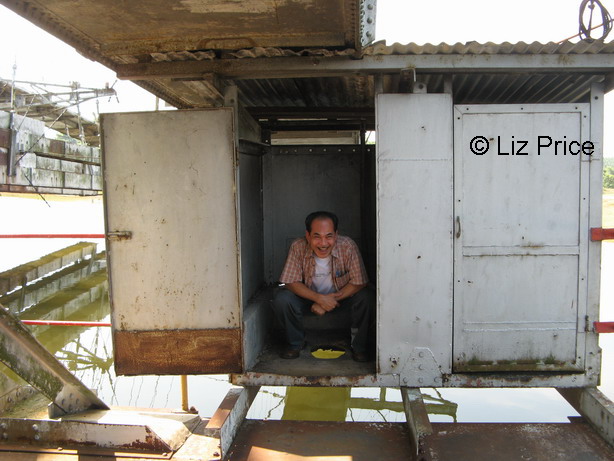


I first visited this dredge in 1997.
For other photos of tin, see tin mining relics and also the tin dredge at Dengkil Selangor.
* It appears that one of the dredges in Selangor has gone (2010) so now there is 1 in Selangor (soon to be sold and exported) and the one in Perak.
----------------
© Liz Price
No reproduction without permission
Subscribe to:
Posts (Atom)