sign in a cave in Laos

18 June 2012

Muzium Negara - stone tools

This blog features some of the stone tools on display at the National Museum, or Muzium Negara, in Kuala Lumpur, Malaysia. The Palaeolithic period or Old Stone Age includes the Lenggong Valley in Perak, caves around Lahad Datu in Sabah, and Niah in Sarawak. Different types of stone tools are shown.

Kota Tampan was an important stone tool workshop. It was located in the Lenggong Valley in Perak.

These flaked tools are from Bukit Bunuh, north of Kota Tampan

Hammer stones
Chopper tools (above) and a general collection of tools (below)


The Palaeolithic period or Old Stone Age includes the Lenggong Valley in Perak, caves around Lahad Datu in Sabah, and Niah in Sarawak.


Neolithic sites include Niah and Gua Cha
Some stone axes
Pottery shards were also found. From Gua Kechil in Pahang -
Baturong, Sabah


And some jewellery. A necklace made of shells from Gua Harimau in Lenggong
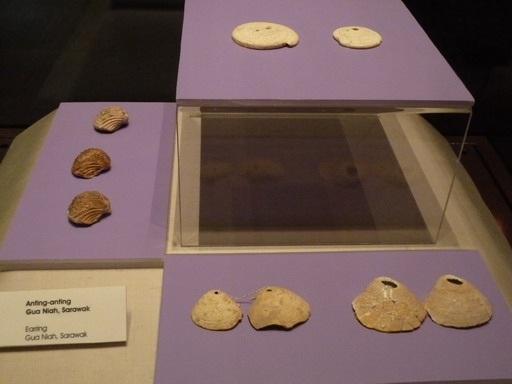
and ear rings from Gua Niah


See more on the museum displays of Perak Man, and cave burials and cave paiantings.

© Liz Price No reproduction without permission

Muzium Negara - Perak Man

The previous blog was the first one on the National Museum, Muzium Negara, Early History gallery, and generally showed cave burials. This blog is on Perak Man.


Perak Man is the most complete human skeleton found in Malaysia. It was found in Gua Gunung Runtuh in Perak, and is about 11,000 years old.


I assume this is the real skeleton and not a replica, as it is in a show case with temperature and humidity control, making it hard to take photos. 2 weeks after I posted this blog, I read that this skeleton IS that of Perak Man.


See other blog on Perak Man and his previous visit to Muzium Negara.

© Liz Price No reproduction without permission

Muzium Negara Early History - burials

The National Museum of Malaysia, Muzium Negara, in Kuala Lumpur, has renovated since my last visit. There are 4 galleries and the first one is of interest to me as it is the Early History one.

This gallery covers 3 eras - the Permian, the Prehistoric and the Proto Historic.


The Permian era explains scientific theories on the development of the earth and environment that contribute to the development of human culture.

The Prehistoric era explains the development of human culture from the Paleolithic, Hoabinhian/Epi-Palaeolithic, and Neolithic era up to the Metal Age.

The Proto Historic era include Hindu/Buddhist beliefs.

---

There is quite a feature on cave burials.

There are various skulls shown, the first one is from Gua Cha, and the second one is Homo sapiens from Gua Niah


There are several large display cases containing adult skeletons. The temperature and humidity is controlled. But it was difficult to take photos.


This picture shows a skeleton buried with knees drawn up near the chest.

Gua Cha skeleton


There is a nice replica of a cave showing people and cave drawings. At the front of the cave is the skeleton of an infant which was found in Gua Cha in Kalantan.

Some communities especially in Sabah and Sarawak practiced jar burials. Bones and ash were placed in jars which were then put on the floor of caves.


See next albums on museum displays of Perak Man, and stone tools and cave paintings.

© Liz Price No reproduction without permission

8 June 2012

Fairy Cave, Bau, Sarawak


Fairy Cave is a show cave located at Bau, near Kuching, in Sarawak, Malaysia. Wind Cave is also in the area.
On my last visit in 2007 I was surprised to see a well built solid enclosed staircase leading up to the entrance. On previous visits there was just a set of stone steps going up the hill :


The new staircase


The actual cave is very large, however the entrance passage is quite small

but soon pops out into the main chamber


The statue of the Fairy, from which the cave gets its name

There are offerings


At the top of the main chamber steps lead up to a back entrance.

View looking towards the main entrance -


There are monophyllaea and ferns growing


Looking back into the cave


On this trip I was with some bat researchers from Unimas. This is Raymond holding a bat detector


Going back down, this photo shows the sturdy structure of the staircase. It looks built to last!!!


See Wind Cave

© Liz Price
No reproduction without permission