sign in a cave in Laos

19 August 2011

Battambang Caves 2 - Sdao area

In 2008 I joined an international caving expedition to Battambang, Cambodia.

This area is beyond Phnom Sampeu, on the main road No 10 to the Thai border. The main village is Sdao, in Rattanak Mondol district. We went here the first 2 days of the expedition.
The limestone hills are rather small here. Phnom Chak Treang

There were 3 of us, plus 2 guys from official departments, and then we picked up 2 men from a local office as well as an armed policeman, and each day we acquired a local guide - so that meant 6 locals for 3 of us (not including our driver).


The first cave we visited was basically one chamber, with Buddha statues and beds.
Graffiti in Khmer and Thai

We walked around the field to the 2nd cave. At the entrance a farmer had dug in the floor to deepen it for monks and had found pottery with bones and stone tools, so our official guys were able to collect some pieces.

A ladder led up and another led down to a continuation of the cave.
and there were some big roots in the cave

From here we went to an archaeological site, Laang Spean. It is is bit further around the hill.

It is a large rock shelter.
French archaeologists dug here in the 1960’s. There are 3 trenches, and they found stone tools from 6-7000 BC and pottery from 4290 BC.


Spean means bridge and there is an impressive rock bridge at the top end of the cave.


© Liz Price
No reproduction without permission


16 August 2011

Huat Tian Keong cave temple at Bercham, Perak


At the end of June I visted some cave temples in the Bercham area, north of Ipoh, in Perak. Accompanied by Hong, we visited temples at Gunung Bercham and also Gunung Tambun (the latter is not to be confused with the hill where the Tambun cave paintings are).

During the afternoon we went to Gunung Tambun and found ourselves at the Huat Tian Keong cave temple. This is located right next to the Bourgainvillea Club. Although the media generally writes this temple is at Bercham, it is actually located in Gunung Tambun. I had visited this cave in Dec 2004.

The cave is short, basically a single chamber with 2 entrance pasages. However the main feature of the cave is the fact there is a bar/restaurant inside the cave! It is the first time I have seen a bar in a temple cave. Of course we had a beer or two and then decided to have a late lunch as well. It was very pleasant sitting in a natural cave passage and at the time of our visit there was a nice wind blowing.

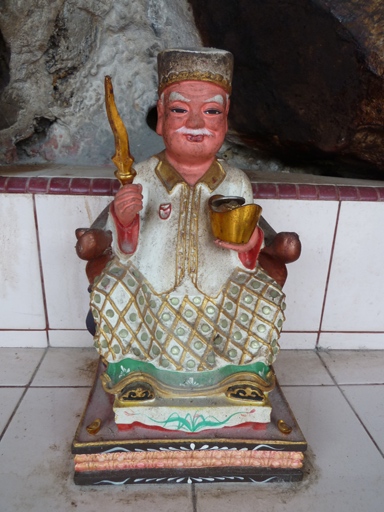
The temple has a mix of Taoist, Buddhist and Hindu deities. The main deity is Huat Tian Keong (Datuk Hitam). Outside the cave there is a small turtle pond. Also an altar with several figures of the Earth God, wearing songkok, jacket and sarong etc.

There was an interesting feature about this temple in The Star 18 Aug 2011 as it celebrates the 100th year anniversay.
aerial view (above) and Ganesh (below)
unwanted tree is being killed
dragon
lots of figures
Main chamber
Huat Tian Keong (Datuk Hitam)
incense sticks
natural stalagmite
nice way to travel
Second entrance passage -
just right for a few tables
Red lanterns
turtle pond; 6 Earth God statues - <
with walking stick(above) and keris (below)
The Bourgainvillea Club is nearby


© Liz Price
No reproduction without permission

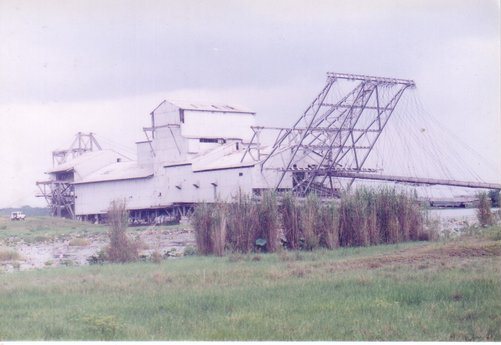
Perak dredge 1997

The first time I saw the Tanjung Tualang dredge in Perak was in Oct 1997. Sin Chuang Eng took me there and we also visited some tin mines which was fascinating.

I have revisited the dredge.


Tin buckets at Clearwater

13 August 2011

Nong Khiaw scenery, Laos

Nong Khiaw in northern Laos is a peaceful village bisected by the Nam Ou River, in a gorgeous setting surrounded by limestone mountains and caves. The main street is basically a row of houses, guesthouses and small shops ending at a school.

Located in Luang Prabang province Nong Khiaw is a small district and a popular stopover for tourists. It’s a 2 ½ hour drive north by car from the World Heritage town of Luang Prabang, or a six-hour boat ride.

There’s not much to do except sit and stare at the scenery, or go for a walk, boat ride or watch the fishermen.

Discovering the area on foot is great as you experience life in rural Laos. You greet everyone with “sabaidy” which is hello, and they usually respond with a smile. There are kids playing and animals wandering around.

The children spend time on the sandy areas by the river and love to give flowers to passing tourists. But there is a catch as they then ask for a pen, candy, bag or kip which is the local currency. Another drawback of tourism is that the restaurants really cater to Western tourists who want baguettes and pancakes, Nescafe and French wine, rather than the local sticky rice and Lao coffee.

If you walk along the road leading out of town, you come across some stunning scenery as the road passes between two limestone hills. On the right, a sign says “Welcome to Historical Pathok Cave”.
The cave entrance in the cliff is visible from the road and you have to walk through the rice paddies to reach it and then climb a bamboo ladder.

There is still a huge problem of landmines and bombs left over from the Vietnam War, and many parts of Laos have not yet been cleared, so make sure you stick to well used paths.

There are other trails in the village and you can get information from the restaurants.

The river taxis are mostly moored on the downriver side of the village. On the upper side are small dwellings and guesthouses alongside the river. The speedboats are becoming an intrusion into the peace of the village. They cater for tourists going to Luang Prabang and Muang Khua.

From Nong Khiaw, you can go by bus to Vieng Thong and then on to Nam Noen, and from here you can get to Phonsavan to see the magnificent Plain of Jars. It’s certainly a stunning part of Laos and well worth a visit.