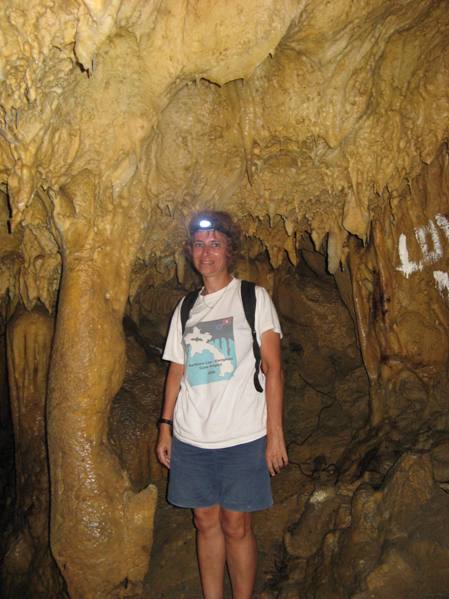
sign in a cave in Laos

31 July 2011

Perak Man, Gua Gunung Runtuh, Lenggong

Gua Gunung Runtuh is a well known cave in Lenggong, Perak, as it is the home of Perak Man. Perak Man, found in 1991, is the only complete human skeleton which has been found in Malaysia.

The skeleton has been dated at between 10-11,000 years old, which makes him a Stone Age man, from the Palaeolithic period.

It is quite a steep climb up to the cave, assisted by ropes

The cave is very short, basically a passage through the hill. There is little to see except for the excavation pits dug by USM.
It is believed he was an important member of his tribe judging by the way he was buried, in a foetal position, accompanied by stone tools. He was about 157cm tall and probably aged between 30-55 when he died.

Unfortunately rubbish has been dumped in a side passage, presumably by the diggers

Replica of Perak Man's burial (in the Muzium Negara exhibition 2006)


You can see more on Perak Man by visiting the Lenggong Museum, which is located south of Lenggong.

Gua Gunung Runtuh register number Prk 64/02.

See more on Perak Man.

© Liz Price
No reproduction without permission

Gua Badak, Lenggong, Perak

The Negrito aboriginal cave art at Lenggong is modern graffiti! There are a series of charcoal drawings on the rock cliff at Gua Badak, north of Lenggong.

The Lanoh Negritos made the illustrative recordings of their lives in charcoal. The drawings were first discovered and documented in the 1920's by Ivor Norman Evans (his first study was in 1918), then by P.D.R.Williams-Hunt in 1950, who records five sites at Gua Badak. The drawings were then thought to have been lost by quarrying. However they were re-discovered in March 1992.


Gua Badak hill

1991 photo (above)
2007 photo

The sketches depict tribal art such as animals, people, trees, mats and even bicycles and motorcars. Apart from the charcoal drawings, they made white pictures by scrapping away the limestone rock.

The drawings are simple, using matchstick men.

There is a man carrying a pole laden with coconuts and a berok monkey to pluck the coconuts. A bow and arrow symbolize their hunting tools which were replaced by the blowpipe.

The Negritos had seen cars so drew those. There are men on horses, a man with an elephant, a hunting party. Animals shown such as leaf monkeys, monitor lizard, porcupine are all good eating.

Sadly there is no protection for the paintings, and they are exposed to the elements as well as algae etc.

Gua Badak register number Prk 60/01.
See more on Malaysian cave paintings and an updated post on Gua Badak Aug 2012.

© Liz Price
No reproduction without permission

28 July 2011

Caves on Seram, Maluku, Indonesia

Pulau Seram, or Seram Island, is the largest island of Maluku. Maluku or The Moluccas in Indonesia are also known as The Spice Islands. Most of the limestone has been unexplored by cavers. Caves are known on the northern parts, around the coastal villages of Sawai and Saleman.

Kampung Saleman is a small Moslem fishing village and tourists are taken to see the evening bat flight from Goa Lusiala. The large entrance is clearly visible high in the cliff of Gunung Polesi behind the village. Each evening flocks of bats leave the cave in an impressive “bat flight”.

A good view of the 300m high limestone hills can be seen when travelling by boat between Sawai and Saleman.
Looking into a sea cave

Goa Hatu Putih (aka Goa Lasai) is about a 40 minute walk from Sawai, and is in Manusela National Park.
The entrance is in a rock on the hillside, and is a resurgence with 2 small streams coming out.

Fruit bats in entrance chamber, note the eye shine
There are also some non-edible birds nests.

There is quite a lot of stal inside - stalagmites and stalactites

There are some bats inside as well as invertebrates such as spiders, whip spiders and ants.

We visited a short sea cave

Goa Akohi is a famous show cave in south Seram, in Tamilouw which is east of Masohi.
The ticket office - info centre is called Lovely House. The cave is managed by Dinas Pariwisata (Tourism Office).

Looking down on the cave entrance
Very unassuming entrance, a concrete blockhouse
Electric lighting was installed and used for the first time in March 2007, powered by a generator located next to the entrance.

The cave is full of spectacular stalactites and stalagmites. Large concrete square stepping stones form a path down through the cave. The cave is really beautiful. The cave guide finds nothing wrong with touching the stal and using them as handholds.

Unfortunately the concrete entrance blockhouse which was built 2006, covers the natural entrance. This seems to have severely restricted the air flow in the cave, as most of the cave is completely dry and very hot and stuffy. After a while everyone was hot and uncomfortable.

The lighting has been installed very badly, as many of the lights dazzle the visitor, and cables are laid without care.
Some delicate formations
The staircase back to fresh air

© Liz Price
No reproduction without permission