The Lenggong Valley in Perak, Malaysia, was listed as a World Heritage site on 30 June 2012.
My last visit to the museum was in 2003, shortly after it opened.
I returned on 20 July 2012, just 3 weeks after Lenggong was listed as a WH site. I expected great things from the musuem, and was disappointed. There was no real mention of the WH status and the museum exhibits had not been updated since at least 2009.
In comparison the Perak Darul Musuem in Ipoh is far better. Earlier in 2012 it was set up to feature archaeology in anticipation of Lenggong getting the UNESCO listing. The result is good. I can't say the same about the Lenggong museum.
Using the highway from Ipoh, you take the Kuala Kangsar exit, but there are no signs about Lenggong. It is only after the toll that the first sign is seen. This says the museum is 33 km, but in fact it is at least 38 km, which would be confusing for those using gps.
Having turned off the main road you go past Kota Tampan village. There is a building site, which looks like it might be connected with the museum and the first signs of World Heritage.
At the junction to the museum is a large fake stone with a dark brown sign saying welcome to the museum.
Outside the museum I noticed the large sign on the wall was completely missing the name of the museum, only the address was shown. Compare with 2nd photo taken in 2003
The phone was also missing from the booth!
And disappointly there was no real mention of World Heritage, only this same sign which appeared in a few places
Department of National Heritage , Archaeology gallery, Lenggong Valley, our heritage, world heritage.
We parked by the fake boulder and the stench of air freshener from the toilet hit us. Since my last visit, the museum was moved into the adjacent building. The entrance is made to look like a cave entrance.
Again there was no real mention of the World Heritage status, only the notice in Bahasa Malaysia.
Entry to the museum is free. As we signed the book, the caretaker went in to switch on some audio visual displays.
It was interesting to see that the visitor numbers were very high on some days since the world heritage listing less than 3 weeks before.
The first audio visual is a welcome talk by Dr. Adi Hj Taha, who sadly passed away in Feb 2012. The screen is housed in a huge replica of an earthenware jar (3000 years old) found in Gua Harimau.
There are many wall displays like giant posters, containing historical photos of various digs.
We were immediately hit by noise pollution with 2 audio visuals on the go plus a recording of some gamelan type music which was totally unnecessary.
The visitor space was quite cramped and the wall displays a bit overpowering. There were 2 cabinets of tools used by archaeologists.
A further series of posters and then a time chart. I realised that the information has not been updated since 2009. Bukit Bunuh is listed as being 40,000 years old, Kota Tampan at 74,000, and Bukit Jawa at 100-200,000 years old. Considering that Bukit Bunuh was dated in 2009 to be about 1.83 myo, there is plenty of time to have updated the museum info.
Bukit Jawa Kpg Temeleng Lawin at the bottom as they are the oldest sites
Archaeological sites
The Gua Badak drawings are shown and because old historical photos were used, the results are not too good.
There is a display of stone tools but they are not individually labelled. Metal artefacts are shown on a poster.
Another chart showing the migration of Homo sapiens from Africa to Perak shows them leaving Africa 150,000 years ago, going via Yemen and being in Malaysia 70-74,000 years ago. The text describes Kota Tampan as being a wooded valley near Penang! No update to list Bkt Bunuh at 1.83 myo.
There is a large “diorama” in a display cabinet showing prehistoric families going about daily activities and then the corner of this room is devoted to Perak Man.
Unfortunately the display cases have sliding doors resulting in an overlapping of glass in the front, which made photo taking more difficult. The visitor then walks through a “polystyrene” cave.
Unfortunately one of the fake boulders is already breaking.
In the corner of the cave is a replica of the 11,000-year old Perak Man skeleton (the original is in the National Museum in KL). There is a lot of information about Perak Man around the cave walls.
The next room is Gua Teluk Kelawar. There are more models of people going about daily life in Gua Teluk Kelawar.
Uptil now all displays had been in Bahasa Malaysia and English. But now the charts on the diet of early man were only in Malay.
The Centre for Archaeological Research Malaysia is often mentioned, but this changed its name to the Centre for Global Archaeological Research, PPAG, in February 2009.
Next to be featured is Gua Harimau. A display shows a complete skeleton but only partial skeletons were found in this cave. Some of the Bronze Age findings and jewellery from Gua Harimau are shown.
In the next section are posters on rock paintings at Lenggong and Gua Tambun and maps of cave sites. And a replica of the 8000 year old Gua Cha skeleton.
Another old time chart again shows Bukit Jawa etc as being the oldest sites
A staircase leads to the upper floor but this is closed.
As soon as we left, the doors were closed for the long Fri prayer/lunch time.
The building next door is the old musuem, which I visited in 2003 (2nd photo is 2003).
I liked the toilet signs
We then walked outside to the geology park.
In summary - I hope some attempt will be made to update the information and features in the museum. Also the information boards often showed poor English - this really needs to be improved, especially if foreign visitors start coming in larger numbers to view the museum.
Although the museum is located at Kota Tampan there is no information of where the original dig site was.
© Liz Price
No reproduction without permission
Pictorial blogs on some of the interesting caves I have visited around Southeast Asia. On some blogs I have included photos taken over the years.
Although this blog was only born in 2011, I have now included older posts from my Multiply blog which closed in March 2013. This includes articles I have written. I am now also adding news relating to caves I have a particular interest in.
See my website on Caves of Malaysia.
sign in a cave in Laos
29 July 2012
28 July 2012
Archaeology in Perak Darul Ridzuan Museum
The Perak Darul Ridzuan Museum is located in the city of Ipoh, in Perak, Malaysia.
The museum building was originally the house of a rich tin miner. Ipoh developed due to tin. The museum used to have a collection of historical artifacts on tin mining.
In early 2012 the museum was closed for a while for upgrading and to turn it into the Perak Archaeological Museum. This was in the expectation of Lenggong Valley getting Unesco World Heritage status. This listing was declared on 30 June 2012.
The museum is now open again and a large area is devoted to the archaeology display. The newly renovated interior is bright and with good displays and lighting.
Universiti Sains Malaysia agreed to hand over archaeological items found in the Lenggong Valley to be exhibited at the museum.
Stone tools in chronological order, but no information on what they are.
The displays are in Bahasa Malaysia and English.
There are good video presentations
The museum information is up to date and features all the recent finds, unlike the Lenggong Museum, which does not mention Bukit Bunuh.
A display of stone tools -
There is a replica of the Perak Man skeleton. Talking to the caretaker, he told us that this is the real skeleton. However the real one is on display in the National Museum in Kuala Lumpur. Although there are calls to take 'him' home to Lenggong.
The caretaker also told me that Perak Man had been tortured and then tied up. It is a pity that the staff are not trained about the exhibits.
The central hall features rock paintings and some of the Tambun drawings are displayed on easels
There are many video displays. Fortunately the sound was controlled so they were not a nusiance
The upper floor features more modern times. Sadly there is not much on display about tin mining, no lumps of tin ore etc. However outside is a display of tin mining equipment.
Lumps of tin ore (photo taken in 2006).
In the entrance hall is a large time chart, from the beginnings through to current times.
Unfortunately, the 2nd and 3rd entries have been switched and are therefore showing against the wrong dates!!!
© Liz Price
No reproduction without permission
Gunung Panjang climb to new cave
Gunung Panjang is a large limestone hill in the Kinta Valley, near Ipoh in Perak, Malaysia. Panjang is best known for the rock paintings at Gua Tambun - although the drawings are actually on a cliff face, not in a cave.
In the past Gunung Panjang has been mined for iron ore. There was an iron mine on the northwest side, around the area where the paintings are. And in several places the red colour can be seen on the rock face.
At the end of 2011 I was told that a man living in the housing estate at the base of the northeast side of the hill had found a cave. In Dec 2011 I went with Hong to see if we could find it. However we didn't know the location and it was a bit daunting looking at the steep hill
We bashed our way through the vegetation upto the base of the cliff but found nothing, so gave up. In July 2012 we returned, this time led by Brett, the guy who found the cave. This is the view of the area from his house
The trail starts in the park
Almost immediately we had to start climbing. The route was very steep. Thankfully Brett had brought along some secateurs which he used to remove rattan and other thorns and creepers. This really helped.
We entered the gap in the hill and went on up to a tunnel. This tunnel was used by the miners, presumably to extract the iron ore from the wang inside. There are still signs of cables on the hill, it seems the miners hauled their machinery up the hill and blasted the tunnel to access the wang.
These shot holes show the tunnel has been blasted.
View into the wang from the tunnel We went down into the wang heading towards the cave in the left wall. It was more or less across on the other side
The cave entrance is rather small. It leads to a passage which slopes down to a drop which I couldn't descend without a rope. There were some nice crystals
View looking up to the entrance. We made our way back, checking one wall for caves but found nothing. There were some monophyllaea on the wall
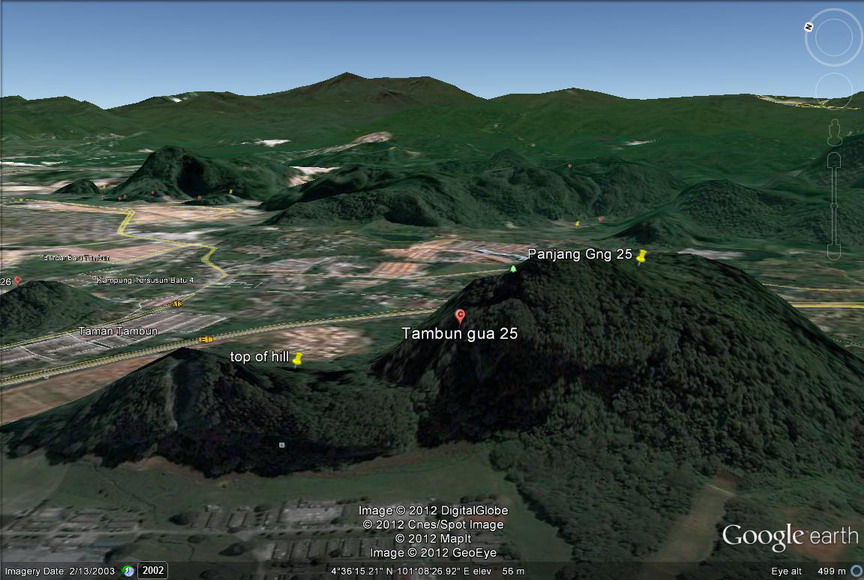
These google earth images show roughly where we went, almost across the hill from the rock paintings
I named the cave Panjang Wang Cave.
© Liz Price
No reproduction without permission
Subscribe to:
Posts (Atom)