STAR Saturday May 7, 2011
Sai Baba cave temple
Story by LIZ PRICE
Sathya Sai Baba, the world-famous spiritual guru who died last month, is immortalised in the Sai Baba Tambun Cave Temple near Ipoh, Perak.
I FIRST met Sai Baba in a cave near Ipoh. However, it wasn’t the real Sai Baba, I hasten to add; it was just his statue.
It was the first time I had seen a cave temple dedicated to this spiritual leader — and I’ve seen a lot of cave temples over the years. This particular site stayed prominently in my memory because, unlike other cave temples, it housed many faiths and had statues from other religions.
Sathya Sai Baba, the Indian spiritual guru, died aged 84 on Easter Sunday, April 24, 2011. He was revered by millions of followers as a living god. Apart from being a spiritual figure, he was also an educator. Sai Baba was born in India in 1926. What stood out about him was that he didn’t adhere to a particular religion, and his followers were free to keep their original religions.
At the centre of the Tambun Cave Temple’s back wall are large photos of Sathya Sai Baba.
And this is what makes the cave temple something special.
The temple is located outside of Ipoh in Perak, near Tambun Lost World, just before the new Banjaran spa resort. It is called Bhagawan Sri Sathya Sai Baba Prashanti Nil Ayam, or more simply Tambun Cave Temple. It is the first such temple in Malaysia and was established more than 35 years ago.
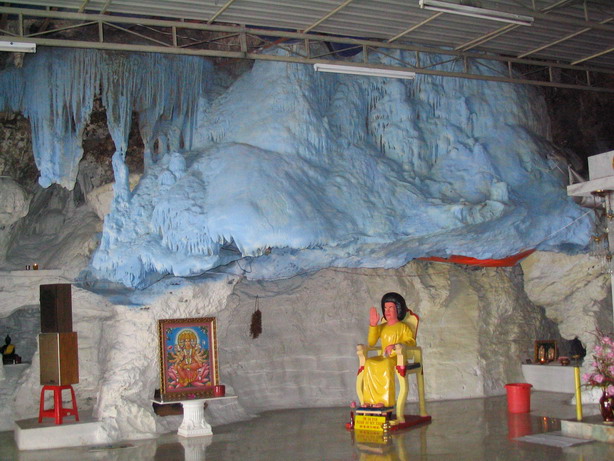
As you enter the temple, your eyes are immediately drawn to the brightly coloured statue of a seated Sathya Sai Baba, who had distinctive frizzy hair and was always clad in his trademark saffron robes. This statue occupies a prime spot in the room. A highly polished shiny reflective floor and whitewashed walls add to the brightness.
Sathya Sai Baba has his right hand raised in a gesture as if greeting you, and the sign on the base of his chair says: “Om Sai Ram”. Sai Ram is a greeting, and it is said as a repeated mantra.
In the centre of the back wall, there are large photos of the guru. These are surrounded by statues from other religions, which I found fascinating. Adjacent to Sathya Sai Baba is a colourful statue of the Hindu god Ganesh, a white Buddha, and a smaller statue that I think may represent the “first” Sai Baba.
The recently deceased Sathya Sai Baba proclaimed himself in 1940 to be the reincarnation of Sai Baba, a holy man who had died eight years before Sathya was born. At the age of 13 or 14, he made the proclamation and from then on, began to attract devotees. As a child, Sathya Sai Baba was said to be highly intelligent and charitable. During his adult years, he set up temples and ashrams.
Sathya Sai Baba was only 36 when he suffered a stroke and four severe heart attacks. However, he announced he would die at the age of 96, and stated he would be born again eight years after his death. Despite this, his health started failing in 2005, and he died in 2011, 12 years before his predicted death.
The temple is housed in a cave chamber. There are natural alcoves around this chamber, and these are used to hold other statues and pictures from the Buddhist, Daoist, Hindu and Catholic faiths. These include the Hindu Krishna, the Chinese Monkey God, the Goddess of Mercy and the different Buddhas. There is even a Christian shrine with statues, photos and a crucifix.
The Sathya Sai Baba movement believes in the unity of all religions. The number of international devotees are said to be in the millions. Sathya Sai Baba supported charitable work in over 165 countries. However, he only made one overseas trip in 1968, and that was to Uganda.
In 1976, he claimed to be a full divine Avatar. The word avatar seems to be getting more use in recent years, maybe as a result of the 2009 science fiction film by James Cameron. In Hinduism, an avatar is a descent of a deity from heaven to earth, or a descent of the Supreme Being, commonly referred to in English as “incarnation”, but more accurately as “appearance” or “manifestation”.
Around the world, devotees sing devotional songs in front of his picture. Although they follow different religions, they all have a goal to confirm their own faith and become better followers of that faith. The meetings might be daily or weekly on Sundays. The Tambun Cave Temple holds Baba Bhajan, or devotional songs, on a Sunday. Their motto is “Love all, serve all. All are welcome”.
I certainly felt welcome on the few occasions I have visited the temple. Although not a follower of the Sathya Sai Baba movement, I am always pleased to see a place that encourages people of different religions to come and visit. Indeed the temple is a fitting tribute to the multicultural and multireligious aspects of Malaysia.
o The Shirdi Sai Baba Society of Malaysia ( 03-3323 5259 / 012-273 9486 / 012-239 2911 / email: kannan_malik@yahoo.co.in) is located at Lot 2574, Jalan Seruling 59, Taman Klang Jaya, 41200 Klang, Selangor, Malaysia.
The Sathya Sai Nivas association holds events such as prayers and peace gatherings in Malaysia, see more at http://sathyasainivas.net/.
Fact File
The Sai Baba Cave Temple is located near Tambun, northeast of Ipoh, off Jalan Tambun. It is near the Sunway Complex, and the Lost World of Tambun, and is immediately before the entrance to the Banjaran Hotsprings Retreat.
The temple is open Sundays from 10 am to noon. The Tambun Cave Temple has a Face Book page.
Pictorial blogs on some of the interesting caves I have visited around Southeast Asia. On some blogs I have included photos taken over the years.
Although this blog was only born in 2011, I have now included older posts from my Multiply blog which closed in March 2013. This includes articles I have written. I am now also adding news relating to caves I have a particular interest in.
See my website on Caves of Malaysia.
sign in a cave in Laos
7 May 2011
26 April 2011
Modern-Day Cavewoman Explores Spectacular Caves
http://www.ouramazingplanet.com/caves-asia-liz-price-1425/
Modern-Day Cavewoman Explores Spectacular Caves
OurAmazingPlanet
Sleepytime. Hundreds of bats hang from the ceiling of a cave. These furry, flying mammals are fairly high up on the food chain inside the caves.
The snakes are constrictors and swallow their prey whole.
Modern-Day Cavewoman Explores Spectacular Caves
OurAmazingPlanet
Liz Price, a woman unfazed by roaches or darkness, pictured in a cave in Laos. Credit: Liz Price.
Sometimes what starts off as a hobby can become an all-consuming passion – one that changes a person's life forever. Such is the case for Liz Price, an English-born former pharmacy researcher.
As a university student in her native England, Price fell in love with caving. She says it was the vast, tropical caves of Southeast Asia that truly won the top spot in her heart. Now, Price calls Malaysia home, where she explores the many caves of the region, volunteering as a guide and writing about her adventures and research for books and articles.
The caves in Southeast Asia are cathedral-sized showcases of spectacular geological architecture, but Price isn't just interested in rocks. The caverns are home to a host of creatures that might send the more faint-hearted screaming in the other direction.
For Price, the giant cockroaches, huge snakes and massive centipedes that lurk in the pitch-black are part of the allure of the caves. They are creatures deserving of respect instead of revulsion, she says. [See the cave creatures Price has met.]
We asked Price to explain what it takes to be a modern-day cavewoman, and what it is that draws her, again and again, into the darkness of the caves.
OAP: So how did you get into caving in the first place?
Liz Price: When I went to university, I was persuaded by some people from the caving club to join them for a caving weekend. I didn't enjoy the first two caves. I found them small and muddy and I came out covered in bruises. However I was persuaded to do another weekend trip, and that was when I became hooked.
It was quite a difficult trip in a river cave, but I really enjoyed the challenge, and to this day, that cave is one of my favorite English caves. River caves are always more special than dry caves, probably because they seem more alive. The sound of the water is exhilarating -- you can never be sure what is around the next corner. Even a mere cascade of water can sound like a large waterfall from a distance.
From then on, I got the caving bug. I can't define anything in particular that caused this, it is something that probably only cavers will understand! Every cave is different, and even if you go into the same cave many times, it never gets boring.
Inside a cave in Laos, the hardened rock takes on the look of gently flowing marshmallow. Credit: Liz Price.
OAP: I understand you've explored caves all over the world. Over the years, have you had any experiences that were particularly frightening?
Price: My worst experience was in England. I was doing an extreme trip which involved a very long, wet small section of a cave, where we had to crawl flat out for a long distance, with body touching both floor and ceiling. I was sent into this confined section first, as I was the smallest in the group and the others wanted to know if it was the correct way.
It was, and I got through, but whilst waiting for the larger members of the party to negotiate the tiny passage, I got extremely cold. By the time the last member had forced his way through, I was starting to get hypothermia. I got colder and colder, and by the time we had established the correct route, I just wanted to sit there forever, which is a symptom of hypothermia.
OAP: What is the strangest creature you've encountered in a cave?
Price: Because of my love of caves and also cave fauna, I don't really consider any beasties as strange! I must have considered some of the cave invertebrates to be strange when I first encountered them. But now I like them all. Even the cockroaches!
One of my most memorable encounters was meeting a porcupine head on in a passage. I was going one way and he was coming towards me, but there was a large boulder separating us and it was only as we rounded the boulder from opposite sides that we met face to face, and both retreated backwards due to the surprise!
Centipedes and cockroaches hang overhead inside a cave. Credit: Liz Price.
OAP: What is it about these creatures that intrigues you? Why do you think you're drawn to them?
Price: I've no idea why I am drawn to them. Maybe it's the fact that they live in caves, and I like caves so much! However, I admire cave fauna for its ability to survive in a pitch black environment. Bats are absolutely fascinating creatures, especially the fact that they navigate through dark caves. They are extremely useful to humans -- the fruit-eating bats help pollinate our crops, and the insect eaters feed on many insect pests. All the 'creepy crawlies' in a cave play a role in the food chain and help support the cave environment.
OAP: Has anything ever crawled on you?!
Price: Many times I've had cockroaches falling on me, running down my hair and neck, or climbing up my legs. But I just brush them off and carry on. I don't mind cave cockroaches as I consider them to be quite clean, unlike the urban ones in houses and restaurants, which crawl through dirty places. I've frequently had bat pee and poo landing on me, which isn't too pleasant.
OAP: What keeps you going back to caves?
Price: It's like asking a golfer why he keeps going back for more, or why rock climbers keep climbing cliffs. I guess it's just in my blood.
There are also many cave areas of the world which have not yet been explored. So it's quite easy to find a new cave -- a place where you are the very first person ever to tread. It is always nice know that you are the first people to enter. It's one of the few places left on the planet where you can enter virgin, unexplored territory.
Reach Andrea Mustain at amustain@techmedianetwork.com . Follow her on Twitter @AndreaMustain.
Slide show :
The entrance to Saddan Cave, a temple cave in Myanmar.
The caves of Southeast Asia are among the largest and most spectacular in the world. From Laos to Myanmar to Vietnam, the caves entice explorers with their promise of adventure -- and plenty of surprises in the darkness.
Liz Price, an adventurer, researcher and writer based in Southeast Asia has made caving her life's work, and has spent countless hours exploring every last corner of the region's subterranean labyrinths. See some of the incredible creatures she has encountered in her explorations, from the expected (bats) to the unsettling (amazingly large insects).
These hardy creatures pass their lives in near-darkness. Survival means finding food wherever you can, and in these wild caves, the predator can become the preyed upon in the blink of a well-adapted eye.
Credit: Liz Price.
Cockroaches crawling the walls of Gomantong Cave in Malaysia.
Living up to their reputation for surviving just about anywhere, cockroaches crowd the caves in Southeast Asia. The roaches thrive with plenty of bat guano around to feed on. In turn, the roaches are preyed upon by many of their fellow cave-dwellers.
Price says she's not bothered by the many-legged critters, even when they crawl on her. "I just brush them off and carry on," she said.

A very large centipede hangs out on a cave wall. These impressive insects can feed on the swarms of cockroaches that fill the caves. But even a creature this fierce-looking isn't safe from predators.

Dinner. A huge cave spider feasts on a centipede. It's an insect-eat-insect world in the caves, where the hunter can become the hunted.


Flying in the dark. For bats, not a problem. The tiny mammals use a kind of sonar to help them navigate, sending out high-frequency sounds that bounce off their surroundings, and help the bats avoid any impediments to their flight path.
Although bats are high up the food chain in caves, they, too, fall victim to hungry neighbors. They provide a tasty treat to creatures -- big and small -- that manage to get hold of them.

A cave racer, a kind of snake, secures a meal. Price said the racer, found in many tropical caves, is one of her favorite cave dwellers.
"It's non-venomous, and a very placid snake. Only on two occasions have I seen an angry cave racer, and I am sure there was a reason for that -- maybe it was guarding eggs or young, or it was simply hungry!"The snakes are constrictors and swallow their prey whole.

The circle of life. Cockroaches can make a meal out of almost anything, including any unlucky bats that fall to the cave floor. These roaches are feeding on a dead bat in Gomantong Cave in Malaysia.
Modern-day cavewoman has spelunk
http://www.msnbc.msn.com/id/42752602/ns/technology_and_science-science/
Modern-day cavewoman has spelunk
She has dealt with everything from cockroaches to bat poo
By Andrea Mustain
OurAmazingPlanet OurAmazingPlanet
updated 4/25/2011 3:18:06 PM ET 2011
Sometimes what starts off as a hobby can become an all-consuming passion — one that changes a person's life forever. Such is the case for Liz Price, an English-born former pharmacy researcher.
As a university student in her native England, Price fell in love with caving. She says it was the vast, tropical caves of Southeast Asia that truly won the top spot in her heart. Now, Price calls Malaysia home, where she explores the many caves of the region, volunteering as a guide and writing about her adventures and research for books and articles.
The caves in Southeast Asia are cathedral-sized showcases of spectacular geological architecture, but Price isn't just interested in rocks. The caverns are home to a host of creatures that might send the more faint-hearted screaming in the other direction.
Liz Price, a woman unfazed by roaches or darkness, pictured in a cave in Laos.
For Price, the giant cockroaches, huge snakes and massive centipedes that lurk in the pitch-black are part of the allure of the caves. They are creatures deserving of respect instead of revulsion, she says. [See the cave creatures Price has met.]
We asked Price to explain what it takes to be a modern-day cavewoman, and what it is that draws her, again and again, into the darkness of the caves.
OAP: So how did you get into caving in the first place?
Liz Price: When I went to university, I was persuaded by some people from the caving club to join them for a caving weekend. I didn't enjoy the first two caves. I found them small and muddy and I came out covered in bruises. However I was persuaded to do another weekend trip, and that was when I became hooked.
It was quite a difficult trip in a river cave, but I really enjoyed the challenge, and to this day, that cave is one of my favorite English caves. River caves are always more special than dry caves, probably because they seem more alive. The sound of the water is exhilarating — you can never be sure what is around the next corner. Even a mere cascade of water can sound like a large waterfall from a distance.
From then on, I got the caving bug. I can't define anything in particular that caused this, it is something that probably only cavers will understand! Every cave is different, and even if you go into the same cave many times, it never gets boring.
OAP: I understand you've explored caves all over the world. Over the years, have you had any experiences that were particularly frightening?
Price: My worst experience was in England. I was doing an extreme trip which involved a very long, wet small section of a cave, where we had to crawl flat out for a long distance, with body touching both floor and ceiling. I was sent into this confined section first, as I was the smallest in the group and the others wanted to know if it was the correct way.
It was, and I got through, but whilst waiting for the larger members of the party to negotiate the tiny passage, I got extremely cold. By the time the last member had forced his way through, I was starting to get hypothermia. I got colder and colder, and by the time we had established the correct route, I just wanted to sit there forever, which is a symptom of hypothermia.
OAP: What is the strangest creature you've encountered in a cave?
Price: Because of my love of caves and also cave fauna, I don't really consider any beasties as strange! I must have considered some of the cave invertebrates to be strange when I first encountered them. But now I like them all. Even the cockroaches!
One of my most memorable encounters was meeting a porcupine head on in a passage. I was going one way and he was coming towards me, but there was a large boulder separating us and it was only as we rounded the boulder from opposite sides that we met face to face, and both retreated backwards due to the surprise!
Inside a cave in Laos, the hardened rock takes on the look of gently flowing marshmallow.
OAP: What is it about these creatures that intrigues you? Why do you think you're drawn to them?
Price: I've no idea why I am drawn to them. Maybe it's the fact that they live in caves, and I like caves so much! However, I admire cave fauna for its ability to survive in a pitch black environment. Bats are absolutely fascinating creatures, especially the fact that they navigate through dark caves. They are extremely useful to humans — the fruit-eating bats help pollinate our crops, and the insect eaters feed on many insect pests. All the 'creepy crawlies' in a cave play a role in the food chain and help support the cave environment.
OAP: Has anything ever crawled on you?!
Price: Many times I've had cockroaches falling on me, running down my hair and neck, or climbing up my legs. But I just brush them off and carry on. I don't mind cave cockroaches as I consider them to be quite clean, unlike the urban ones in houses and restaurants, which crawl through dirty places. I've frequently had bat pee and poo landing on me, which isn't too pleasant.
OAP: What keeps you going back to caves?
Price: It's like asking a golfer why he keeps going back for more, or why rock climbers keep climbing cliffs. I guess it's just in my blood.
There are also many cave areas of the world which have not yet been explored. So it's quite easy to find a new cave — a place where you are the very first person ever to tread. It is always nice know that you are the first people to enter. It's one of the few places left on the planet where you can enter virgin, unexplored territory.
- The 7 Longest Caves in the World
- Image Gallery: Amazing Caves Around the World
- Explore the Underworld: Coolest Spelunking Trips
Reach Andrea Mustain at amustain@techmedianetwork.com. Follow her on Twitter @AndreaMustain.
© 2011 OurAmazingPlanet. All rights reserved. More from OurAmazingPlanet.
24 April 2011
Sai Baba cave temple 2011
![]() |
| 2001 (white dome to right of gate) |
![]() |
| 2004 (yellow dome) |
| 2008 (pink dome) |
| 2004 |
The temple is located near Tambun Lost World, and just before the new Banjaran spa resort. Sai Baba had distinctive frizzy hair and was always clad in his trademark saffron robes, and his statue occupies a prime spot in the cave temple.
![]() |
| 2004 |
| 2008 |
One really interesting thing about this cave temple is that there are many statues from other religions. Sai Baba didn't adhere to a particular religion, and his followers were free to keep their original religions. I found it fascinating to see statues of Hindu gods such as Ganesh and Krishna, Christian shrines, Chinese Monkey God, Goddess of Mercy, and Buddha.
![]() |
| Ganesh |
![]() |
| Krishna |
![]() |
| photo |
![]() |
| more photos |
![]() |
| elephant? |
![]() |
| Christian shrine |
![]() |
| Christian figures |
![]() |
| Monkey god |
![]() |
| Goddess of Mercy |
![]() |
| Sai Baba |
![]() |
| Buddha |
Sai Baba Cave register number Prk 38/02.
© Liz Price
No reproduction without permission
Indian temple, Gunung Lang, Ipoh
This temple is at the end of Gunung Lang, opposite Gunung Cheroh. It is separated by a small headland of hill from the Lang Meditation Monastery,a forest retreat for monks.
There are a lot of dogs at this temple - both living and statues. Also a pond with fish and some huge catfish.
The temple is not really cave related although it is sited at the foot of a limestone hill. Dogs and lions -
Watch dogs
Want a new car?
© Liz Price
No reproduction without permission
Subscribe to:
Posts (Atom)